“Denuclearization” is for every country
Guest opinion
By Vic Hummert

Gen. Russell Honoré, who led the response to Hurricane Katrina, said he could “live without” nuclear weapons.
The United Nations session of July 7, 2017 was a monumental gathering during which 123 out of 195 countries voted to abolish nuclear weapons.
Hurricane Katrina devastated New Orleans in 2005. Nearly 2,000 people died in that tragic natural mishap. General Russell Honoré, a Louisiana native, was sent to organize relief efforts for the devastated city. When I asked General Honore’ what he thought of nuclear weapons, he promptly replied, “I could live without them!” Encouraged by his reply, I asked why the USA and its UN Ambassador, Nikki Haley, were so opposed to abolition. General Honoré said, “because of the money involved.” The building of nuclear weapons is a multi-trillion dollar enterprise employing tens of thousands at more than twenty locations around the United States. Read more…
Kashmir conflict risks nuclear war

© Apollo, Pakistan Today
IPPNW calls on India’s Prime Minister Narendra Modi and Pakistan’s Prime Minister Imran Khan to take immediate steps to deescalate the tensions in the disputed Kashmir region and to reduce the grave danger of nuclear war.
Recent acts of terror and military incursions in the long-disputed territory have exacerbated a conflict that threatens to plunge these two countries into a fifth and, conceivably, final major war since partition. Both countries have traded threats of nuclear retaliation. This is how nuclear war begins. Read more…
Don’t expect rulers of nuclear-armed nations to accept nuclear disarmament―unless they’re pushed to do so

Massive antinuclear protests in Europe and the United States pushed the Cold War superpowers to negotiate the INF Treaty.
At the beginning of February 2019, the two leading nuclear powers took an official step toward resumption of the nuclear arms race. On February 1, the US government, charging Russian violations of the Intermediate-Range Nuclear Forces (INF) Treaty, announced that it would pull out of the agreement and develop new intermediate-range missiles banned by it. The following day, Russian President Vladimir Putin suspended his government’s observance of the treaty, claiming that this was done as a “symmetrical” response to the US action and that Russia would develop nuclear weapons outlawed by the agreement.
In this fashion, the 1987 Soviet-American INF Treaty―which had eliminated thousands of destabilizing nuclear weapons, set the course for future nuclear disarmament agreements between the two nuclear superpowers, and paved the way for an end to the Cold War―was formally dispensed with. Read more…
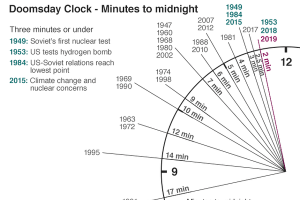
Why is the Doomsday Clock set at 2 minutes to midnight?
Bulletin of the Atomic Scientists
Ever since the US atomic bombings of Japanese cities in August 1945, a specter has haunted the world―the specter of nuclear annihilation.
The latest report from the Bulletin of the Atomic Scientists, issued on January 24, reminds us that the prospect of nuclear catastrophe remains all too real. Citing the extraordinary danger of nuclear disaster, the editors and the distinguished panel of experts upon whom they relied reset their famous “Doomsday Clock” at two minutes to midnight. Read more…
Why Green New Deal advocates must address militarism
Where is the call for the New Peace Deal that would free up hundreds of billions from the overblown military budget to invest in green infrastructure?
by Medea Benjamin and Alice Slater
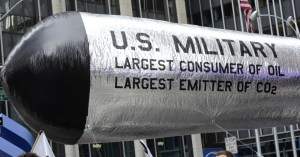
Demonstrators highlighted the enormous and negative impact of the U.S. military during the 2014 People’s Climate March in New York City. (Photo: Stephen Melkisethian/flickr/cc)
In the spirit of a new year and a new Congress, 2019 may well be our best and last opportunity to steer our ship of state away from the twin planetary perils of environmental chaos and militarism, charting a course towards an earth-affirming 21st century.
The environmental crisis was laid bare by the sobering December report of the UN Climate panel: If the world fails to mobilize within the next 12 years on the level of a moon shot, and gear up to change our energy usage from toxic fossil, nuclear and industrial biomass fuels to the already known solutions for employing solar, wind, hydro, geothermal energy and efficiency, we will destroy all life on earth as we know it. The existential question is whether our elected officials, with the reins of power, are going to sit by helplessly as our planet experiences more devastating fires, floods, droughts, and rising seas or will they seize this moment and take monumental action as we did when the United States abolished slavery, gave women the vote, ended the great depression, and eliminated legal segregation. Read more…
Reviving the nuclear disarmament movement: a practical proposal

The Nuclear Freeze movement in the 1980s brought millions of protesters into US streets to demand an end to nuclear danger.
In late November 2018, Noam Chomsky, the world-renowned public intellectual, remarked that “humanity faces two imminent existential threats: environmental catastrophe and nuclear war.”
Curiously, although a widespread environmental movement has developed to save the planet from accelerating climate change, no counterpart has emerged to take on the rising danger of nuclear disaster. Indeed, this danger―exemplified by the collapse of arms control and disarmament agreements, vast nuclear “modernization” programs by the United States and other nuclear powers, and reckless threats of nuclear war―has stirred remarkably little public protest within the United States and even less public debate during the recent US midterm elections. Read more…
Press release, dated 26 November 2018, from the students of the International Physicians for the Prevention of Nuclear War and the International Federation of Medical Students’ Associations (IFMSA).
The prevalence of peace is a major determinant of a society’s health and together they represent a vital determinant of a sustainable future and society. The deterioration of peace in many regions of this world has been associated with negative outcomes on health. Recent war strategies have breached international humanitarian law and used attacks on not only healthcare facilities but also healthcare workers and civilians as a tactic causing death tolls to rise. Read more…
In July 2017, by a vote of 122 to 1, with one abstention, nations from around the world attending a United Nations-sponsored conference in New York City voted to approve a treaty to ban nuclear weapons. Although this Treaty on the Prohibition of Nuclear Weapons received little coverage in the mass media, its passage was a momentous event, capping decades of international nuclear arms control and disarmament agreements that, together, have reduced the world’s nuclear weapons arsenals by approximately 80 percent and have limited the danger of a catastrophic nuclear war. The treaty prohibited all ratifying countries from developing, testing, producing, acquiring, possessing, stockpiling, using, or threatening to use nuclear weapons. Read more…
Time out for nukes!
Guest commentary
by Alice Slater
With 122 nations having voted last summer to adopt a treaty for the complete prohibition of nuclear weapons, just as the world has banned chemical and biological weapons, its seems that the world is locked in a new Cold War time-warp, totally inappropriate to the times. We were warned last week from the Intergovernmental Panel on Climate Change, that prior calculations about the risk of catastrophic climate change were off, and that without a full scale immediate mobilization humanity will face disastrous rising sea levels, temperature changes, and resource shortages.
Now is an opportunity to take a time-out on nuclear gamesmanship, new threats, trillions of wasted dollars and IQ point on weapons systems that Presidents Reagan and Gorbachev acknowledged, back in 1987 at the end of the Cold War, could never be used, warning that “A nuclear war cannot be won and must never be fought.” Read more…

Gorbachev and Reagan sign the INF Treaty on December 8, 1987
[Donald Trump announced on Saturday that the United States will withdraw from the 1987 Treaty on Intermediate-Range Nuclear Forces (INF), a decision confirmed by national security adviser John Bolton earlier this week. The following is a statement issued today by IPPNW’s executive committee.]
In a world already nervous about the intentions of the nuclear-armed states and their continued modernization of nuclear weapons, the Trump Administration’s announcement that it will withdraw from the historic INF Treaty is grave and unwelcome news. Read more…

 Bimal Khadka
 Bjorn Hilt
 Charles K. Johnson
 Gunnar Westberg
 IPPNW
IPPNW John Loretz
 Lawrence Wittner
 Maria Valenti
 mollymcgint
 Sue Wareham
 Tilman Ruff
 Tim Wright
 Xanthe Hall


 IPPNW peace and health blog