New scientific study describes severe consequences of a limited, regional nuclear war
New research on the consequences of a limited, regional nuclear war, published this week in the peer-reviewed journal Science Advances, concludes that casualty levels and long-term impacts on the global environment will be far more severe than previously believed. (Toon, Owen B., Charles G. Bardeen, Alan Robock, Lili Xia, Hans Kristensen, Matthew McKinzie, R. J. Peterson, Cheryl Harrison, Nicole S. Lovenduski, and Richard P. Turco, 2019: Rapid expansion of nuclear arsenals by Pakistan and India portends regional and global catastrophe. Science Advances, 5, eaay5478, doi:10.1126/sciadv.aay5478.)
The authors of the paper, entitled “Rapid expansion of nuclear arsenals by Pakistan and India portends regional and global catastrophe,” look first at regional blast, thermal, and radiation effects, and conclude that “for the first time in human history, the fatalities in a regional war could double the yearly natural global death rate.
“Moreover, the environmental stresses related to climate changes caused by smoke produced from burning cities could lead to widespread starvation and ecosystem disruption far outside of the war zone itself.“ Read more…
For me it all began with a bet
by Lars Pohlmeier, MD
Thirty years ago the Berlin Wall fell. That was the source of my political optimism to abolish nuclear weapons.
In September 1989, I was standing right in the center of Berlin in front of “Checkpoint Charlie,” which was one of the checkpoints between the so-called Soviet Sector and the American Sector in the divided city of Berlin. Several dozens of kilometers of wall divided East and West Berlin and also surrounded the Western part of Berlin.
My friend Hennig and I, both 19 years old at the time, were looking at the heavily armed soldiers ready to kill anyone without notice who would try to cross the border from the East to the West. We were thinking about whether this wall would ever be gone in our lifetime. Read more…
How nuclear power powers the bomb
by Alex Rosen, Co-President, IPPNW-Germany
Reuters recently reported that nuclear energy is both too slow and too expensive to present a meaningful response to the climate catastrophe facing our planet So why are countries like the UK, France, Russia, or China still investing in it?
The answer lies in the demands of the military, who require a robust backbone of civil nuclear infrastructure for their nuclear weapons programs. Read more…
Doctor sees another side of himself in exhibition portrait
[Editor’s note: The following article, written by Canberra Times reporter Steve Jones, was published in The Times on 20 September.]
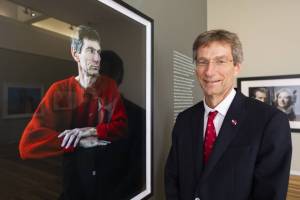
IPPNW co-president Tilman Ruff at Australia’s National Portrait Gallery in Canberra.
by Steve Jones, The Canberra Times
Not many of us get to see a portrait of ourselves in a big-time art gallery.
But it happened to Dr Tilman Ruff at lunchtime on Thursday.
His portrait, by photographer Nikki Toole, is in a special exhibition at the newly re-opened National Portrait Gallery in Canberra.

IPPNW co-president Ira Helfand (second from right, front row) represented the federation at the World Summit of Nobel Peace Laureates in Merida, Mexico, along with Drs. Jans Fromow Guerra and Ruby Chirino of the Mexican affiliate.
Nobel Laureates’ statement on the urgent need to prevent nuclear war
[Editor’s note: The 17th World Summit of Nobel Peace Laureates, meeting in Merida Mexico on 21 September, has adopted the following statement drafted by IPPNW.]
Since August 1945, when the US detonated the first atomic bombs over Hiroshima and Nagasaki, the Nobel Peace Prize has been awarded eight times to individuals and organizations for their work to prevent nuclear war and to rid the world of the scourge of nuclear weapons. Read more…
Devastating effects of nuclear weapons are the highest form of violence
[Editor’s note: On 18 September, IPPNW co-president Arun Mitra gave the following talk—”Humanitarian consequences of nuclear war: possibilities and perspectives for prevention”—at the International Scientific-Practical Conference dedicated to the 30th anniversary of the “Nevada-Semipalatinsk” International Antinuclear Movement.]
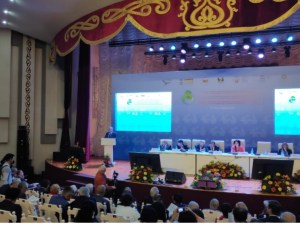
Dr. Mitra addressing the “Nevada-Semey” conference on 18 September.
This is my second visit to the country which banned nuclear weapon testing long ago. During my first visit in 2014 to participate in the 21st World Congress of International Physicians for the Prevention of Nuclear War (IPPNW), we had the privilege to visit Semipalatinsk. The visit not only enriched our knowledge of the health and environmental impact of nuclear weapon testing, it also reaffirmed the commitment to continue to struggle for a nuclear-weapons-free world. Read more…
IDPD National Conference demands that all nuclear weapons possessing countries join TPNW; expresses concern over health issues in Kashmir
by Arun Mitra
The 11th National Conference of Indian Doctors for Peace and Development was held at Thiruvananthapuram, Kerala on 31 August and 1 September 2019. Among several issues discussed in the conference, it put main thrust on the demand to all the nuclear weapons possessing countries to join Treaty Prohibiting Nuclear Weapons (TPNW) as an opportunity to save the world from nuclear disaster. The conference also expressed concern over health issues in Kashmir. Read more…
Japanese government must take urgent action to protect Japanese people from unacceptable radiation exposure
 Now more than eight years after the Fukushima nuclear disaster, IPPNW strongly supports the call by civil society organisations in Japan for the ionising radiation maximum permissible dose limit for members of the public to be promptly reduced from 20 to 1 mSv per year. Read more…
International Physicians for the Prevention of Nuclear War (IPPNW) is calling on the Indian government to restore immediately all communications and freedom of movement in Kashmir and Jammu, and urging all states in the disputed border regions to initiate new diplomatic talks aimed at reducing tensions and negotiating a peaceful settlement to the long-standing conflict. Read more…
Dear moderators of the US Presidential debates: How about raising the issue of how to avert nuclear war?
 You mass media folks lead busy lives, I’m sure. But you must have heard something about nuclear weapons―those supremely destructive devices that, along with climate change, threaten the continued existence of the human race.
 Yes, thanks to popular protest and carefully-crafted arms control and disarmament agreements, there has been some progress in limiting the number of these weapons and averting a nuclear holocaust. Even so, that progress has been rapidly unraveling in recent months, leading to a new nuclear arms race and revived talk of nuclear war.
Do I exaggerate? Consider the following. Read more…

 Bimal Khadka
 Bjorn Hilt
 Charles K. Johnson
 Gunnar Westberg
 IPPNW
IPPNW John Loretz
 Lawrence Wittner
 Maria Valenti
 mollymcgint
 Sue Wareham
 Tilman Ruff
 Tim Wright
 Xanthe Hall


 IPPNW peace and health blog