Although the rulers of the world’s major military and economic powers have repeatedly claimed that they are making their nations great again, their policies have not resulted in widespread happiness among their citizens.
That conclusion emerges from the recent World Happiness Report-2022, published by the UN Sustainable Development Solutions Network. Based on Gallup World Polls conducted from 2019 through 2021, this extensive study provides a revealing look at how roughly 150,000 respondents in 146 countries rated their own happiness. The study’s findings underscore the limited levels of happiness in the world’s major military-economic powers.
Read more…by Matt Bivens
In Stanley Kubrick’s comedic masterpiece “Dr. Strangelove or: How I Learned to Stop Worrying and Love the Bomb,” a series of unfortunate events has the world hurtling toward all-out nuclear war. Desperate to prevent this, the US president has the Russian ambassador brought to the White House’s top secret “War Room” for emergency consultations.
Read more…Who speaks for the world?
Russia’s brutal war upon the nation of Ukraine should remind us that, for thousands of years, great powers have used their military might to launch military assaults upon smaller, weaker societies.
Since World War II alone, these acts of aggression have included France’s colonial wars in Indochina and Algeria, Britain’s military intervention in the Middle East and Africa, the Soviet Union’s military conquest of Hungary, Czechoslovakia, and Afghanistan, China’s invasions of Tibet and Vietnam, and America’s wars in Indochina, Iraq, and Afghanistan.
Today, great power crimes against humanity, often driven by imperial arrogance and ambition, remain a plague upon the world.
Read more…The back story of the ban treaty
[This book review, which originally appeared in Medicine, Conflict and Survival in December 2021, has been updated and slightly revised. MCS is IPPNW’s designated journal.]
Banning the bomb, smashing the patriarchy, by Ray Acheson
The treaty prohibiting nuclear weapons: how it was achieved and why it matters, by Alexander Kmentt

The Treaty on the Prohibition of Nuclear Weapons (TPNW), which was adopted by the UN General Assembly in 2017 and entered into force in January 2021, was the end product of a highly effective partnership of non-nuclear weapons states, civil society, and international organizations who engaged in a “humanitarian initiative” to advance the goal of nuclear disarmament. The process, which was simultaneously visionary and practical, well planned and improvised, organized and—occasionally—chaotic, played out over a relatively short seven-year period. As of this writing, the TPNW has 86 signatories, 60 of which have ratified it. The First Meeting of States Parties (1MSP) is now scheduled for June 2022, with the Russian invasion of Ukraine and heightened threat of nuclear war as the backdrop.
The story of how the ban treaty process began and evolved, how and why it worked, who participated (and who did not), how it successfully challenged the status quo, what the TPNW does, and the impact it could have on the goal of eliminating nuclear weapons, is told in two recent books by central participants, one a high-level diplomat, the other a civil society analyst and activist. Read in tandem, these important books help explain why so little progress had been made up until now to eliminate the world’s worst weapons of mass destruction, how a transformative treaty could change that, and why the nuclear-armed states consider the TPNW and its supporters so disruptive to their sense of geopolitical status and entitlement.
Read more…By Rebecca Johnson
In late February, as his invasion of Ukraine became bogged down, Vladimir Putin announced that Russia’s nuclear forces had been put on ‘special alert’. This posturing is familiar in wargame scenarios. It frequently ends with nuclear weapons being launched.
So, how did we get back to believing that nuclear war is possible? Why didn’t ‘nuclear deterrence’ stop this from happening? And what comes next?
Read more…The path to survival is clear
[On 16 March, Dr. James Muller, one of IPPNW’s co-founders, addressed the Russian Academy of Science about the dangers of nuclear war. His 15-minute speech, delivered in Russian in a video stream from Boston, was also broadcast on a Russian scientific channel. Dr. Muller’s entire address, in English, follows.]
I thank my Russian medical and scientific colleagues for the opportunity to address this General Meeting of Professors of the Russian Academy of Sciences. I will try to give this talk in Russian. I learned the language 55 years ago during my 6 months as an exchange student in the First Moscow Medical School. In 1972 I lived with my family in Moscow near the Metro Sokol. Please excuse my mistakes.
While the sun will soon rise here in Boston, it will bring no joy as we begin another day defiled by continued massive violence in Ukraine, disruption of collaboration with our Russian medical and scientific colleagues, and the threat of a nuclear war that will destroy human civilization.
Read more…Citizens of the world are against war and nuclear weapons
[The following statement about the war in Ukraine has been co-signed by 12 Nobel Peace Laureates, including IPPNW.]
As Nobel Peace Prize Laureates we reject war and nuclear weapons. We call on all our fellow citizens of the world to join us in protecting our planet, home for all of us, from those who threaten to destroy it.
The invasion of Ukraine has created a humanitarian disaster for its people. The entire world is facing the greatest threat in history: a large-scale nuclear war, capable of destroying our civilization and causing vast ecological damage across the Earth.
We call for an immediate ceasefire and the withdrawal of all Russian military forces from Ukraine, and for all possible efforts at dialogue to prevent this ultimate disaster.
We call on Russia and NATO to explicitly renounce any use of nuclear weapons in this conflict, and we call on all countries to support the Treaty on the Prohibition of Nuclear Weapons to ensure that we never again face a similar moment of nuclear danger.
The time to ban and eliminate nuclear weapons is now. It is the only way to guarantee that the inhabitants of the planet will be safe from this existential threat. It is either the end of nuclear weapons, or the end of us. We reject governance through imposition and threats, and we advocate for dialogue, coexistence and justice. A world without nuclear weapons is necessary and possible, and together we will build it. It is urgent that we give peace a chance.
American Friends Service Committee (1947)
His Holiness The Dalai Lama (1989)
Leymah Gbowee (2011)
International Campaign to Abolish Nuclear Weapons (2017)
International Peace Bureau (1910)
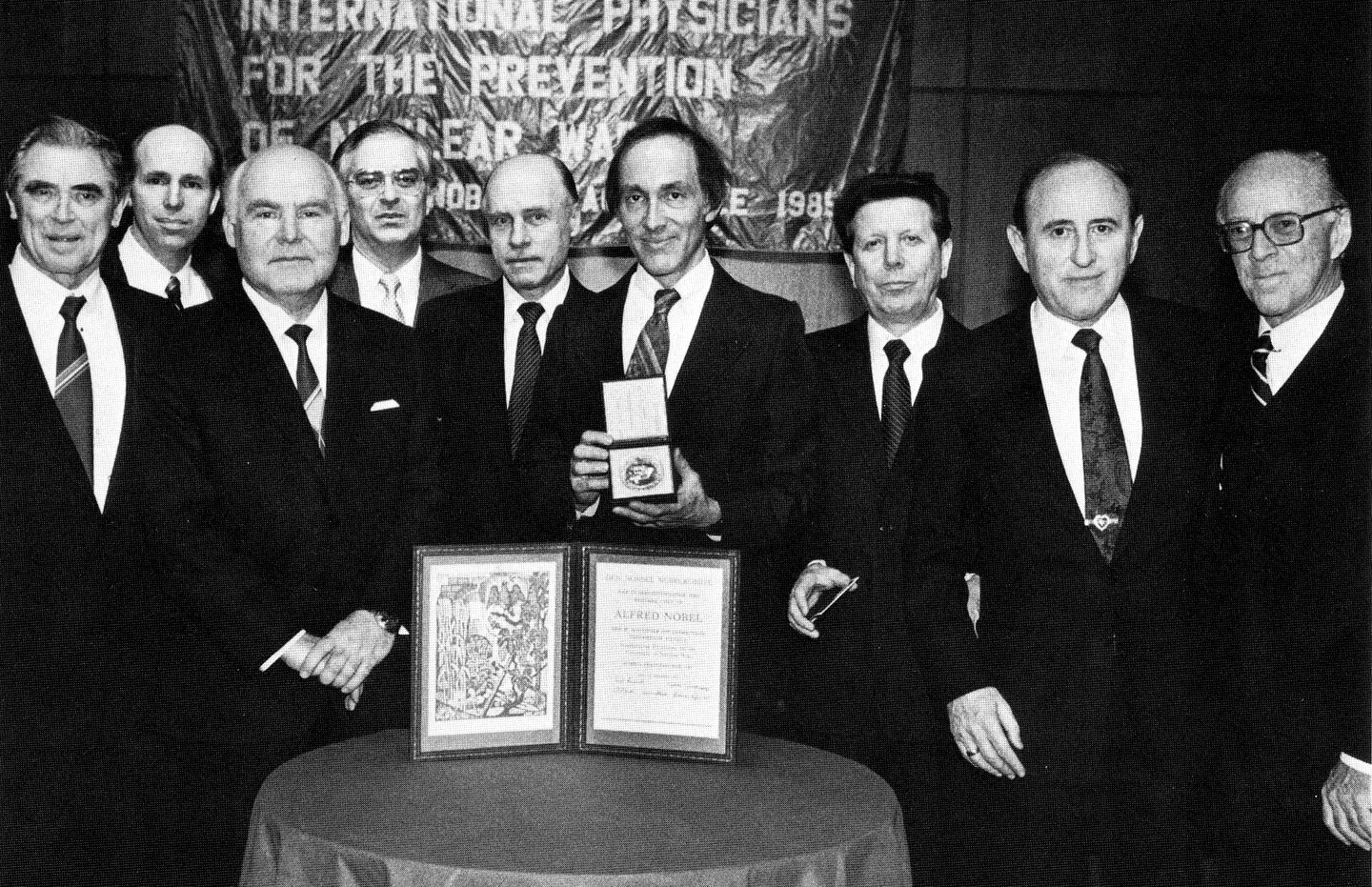
International Physicians for the Prevention of Nuclear War (1985)
Tawakkul Karman (2011)
Pugwash Conference on Science and World Affairs (1995)
Kailash Satyarthi (2014)
Lech Walesa (1983)
Jody Williams (1997)
Muhammad Yunus (2006)
A joint statement of IPPNW physicians in Russia and Ukraine
The conflict between Russia and Ukraine continues, leading to human casualties. And in the case of escalation of the conflict it may cause more severe consequences, involvement of other countries, nuclear facilities and even nuclear confrontation.
It is a great tragedy in the center of Europe caused by the inability of authorities to speak to and understand each other, and who desire to have unilateral benefits for one country while not taking into consideration the rights and security of other countries.
Read more…Global medical and public health organizations call for immediate end to war in Ukraine and critical need to prevent nuclear escalation

Representing doctors, public health professionals and medical students worldwide, we call for an immediate cease fire and the withdrawal of all invading and occupying military forces and an urgent negotiated end to the current war in Ukraine. The alarmingly acute and growing danger of nuclear escalation must be reversed and nuclear war prevented by the urgent elimination of nuclear weapons.
Read more…The Ukraine crisis could trigger a nuclear catastrophe
There are two potential nuclear dimensions to a war in Ukraine, which could create a massive humanitarian disaster and have profound global implications.
In the first week of February, US officials estimated that if war using conventional weapons broke out, 25,000 to 50,000 civilians could die in Ukraine, along with 5,000 to 25,000 Ukrainian and 3,000 to 10,000 Russian soldiers, and that between 1 and 5 million people would flee their homes and become refugees.
The toll could be much greater, especially if the conflict spread to neighbouring countries and NATO forces became embroiled.
Read more…



 IPPNW peace and health blog