New IPPNW Resource: Humanitarian Impacts of Nuclear Weapons
The following is the introduction to a new IPPNW report, a Campaign Kit on the Humanitarian Impacts of Nuclear Weapons, released in advance of the first Review Conference to the Treaty on the Prohibition of Nuclear Weapons. Read the report in full and section highlights here.
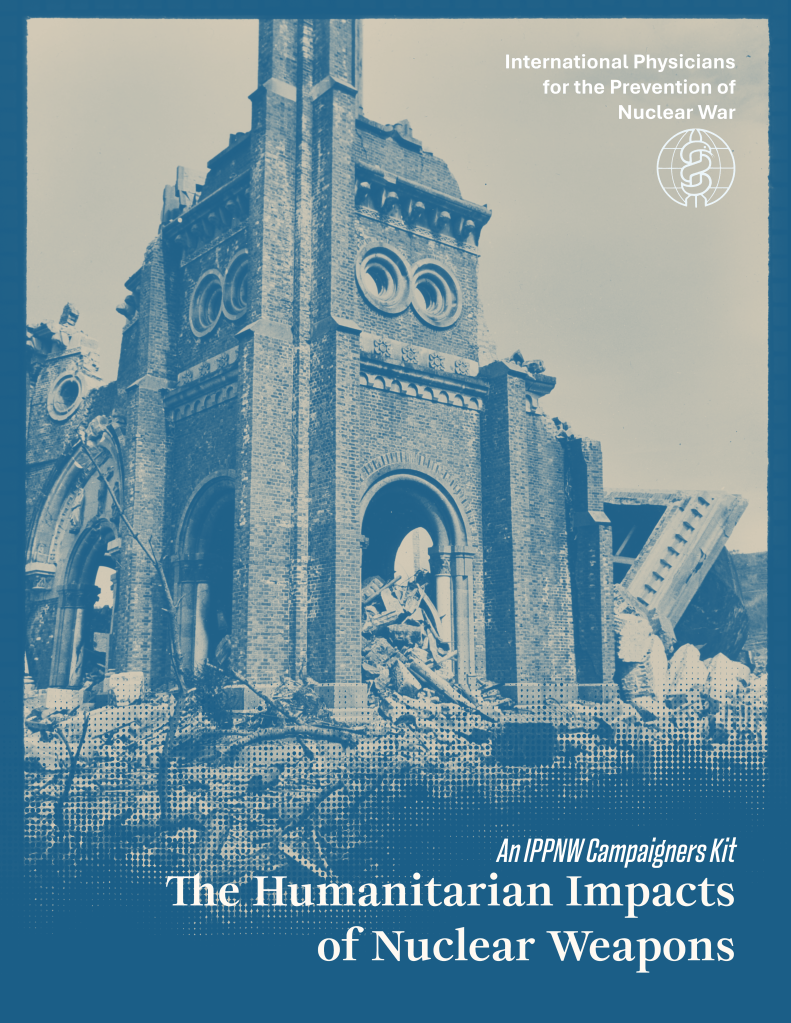
Understanding a problem is the first step toward changing it. That is the idea behind disarmament education: people who know what nuclear weapons do to people, cities, and ecosystems, and who understand how past generations limited and banned other indiscriminate weapons, are far better equipped to effect change. Nuclear weapons persist in part because their consequences are kept abstract, hidden behind terms like “deterrence” and “strategic stability.” This report makes them concrete.
The foundation of this report, and much of its content, comes from IPPNW’s 2014 Campaign Kit on the The Humanitarian Impact of Nuclear Weapons. Much of the information in the Kit is, regrettably, more relevant than ever. While the physical effects of a nuclear detonation have not changed, the world around them has. Since 2014, a majority of the nine nuclear-armed states have been directly engaged in war or violent conflict, raising the ever-present risk of nuclear war. In May 2025, India and Pakistan fought a four-day exchange of missiles and drones that appears to have been among the most serious between nuclear-armed nations in history. As this report is written, Israel, Russia, and the United States are all at war with non-nuclear-weapon-states.
Meanwhile, all nine nuclear-armed states are violating their obligations under international law, expanding or upgrading their arsenals with virtually no binding limits or transparency. At the start of 2026, they collectively possessed over 12,000 nuclear weapons – more than enough to end the world as we know it many times over. New START, the last bi-lateral nuclear armed control treaty between the US and Russia, expired in February 2026 with no replacement in sight. Experts estimate that China’s arsenal has doubled in the past decade. In 2021, the United Kingdom raised the ceiling on its nuclear warhead stockpile by more than 40 percent, and announced it would decrease transparency on its number of operational warheads. France announced an increase of its own arsenal, a backtracking on transparency, and plans to expand nuclear “sharing” in the region in March 2026. North Korea has conducted three underground nuclear tests since our 2014 Kit was published, the only nuclear weapon state to test in the 21st Century. In response to the destabilizing actions of the N-9, risks of proliferation are growing in every region around the world.
This all comes at an enormous cost. In 2025 alone, the nine states spent just under $119 billion on their nuclear arsenals, a 19% increase on the year before. That is over a hundred billion dollars spent on weapons designed to annihilate cities, children, infrastructure, and culture at a time when the climate crisis and artificial intelligence add new pressure to an already fragile system.
In the midst of this uniquely dangerous period, there is reason for hope. Rooted in the scientific evidence and lived experience of survivors gathered at the series of conferences on the humanitarian impacts of nuclear weapons in Oslo (2013), Nayarit (2014), and Vienna (2014), the Treaty on the Prohibition of Nuclear Weapons (TPNW) was adopted by 122 states in July 2017 and entered into force in January 2021. It is the first and only comprehensive, legally binding prohibition on nuclear weapons, placing them alongside chemical and biological weapons, landmines, and cluster munitions. It bans the development, testing, production, acquisition, possession, stockpiling, transfer, or use or threat of use of nuclear weapons. More than 100 states have now signed or joined, a majority of the world’s countries.
“The facts demand a ban” was the central premise of the 2014 Kit. With the ban in force and three successful Meetings of States Parties held, we reaffirm that the facts now demand abolition. Just as they demanded a ban in 2014, they demand that the nuclear-armed states and their allies join it now.
We encourage you to use this tool to spark change in your community and reach the decision-makers who shape it. Copy and paste sections. Rework others to share the information in your own voice. Use it to engage your coworkers, parliamentarians, city councilors, college deans, and foreign ministry officials. All that we ask is that you use it.
I want to share my deep appreciation to Dr. Ira Helfand, John Loretz, and Dr. Tilman Ruff for their work on the 2014 Kit. I extend special gratitude to Tomohiko Aishima, Chie Sunada, Yuko Oshima, Miki Kawamura, Mohamed Ambrosini, Anna Ikeda, Hayato Sadavrati, and all of our partners at Soka Gakkai International for their continued partnership and generous financial support, which made this publication possible.
And thank you, to all of you, for everything you do, big and small, to protect this unique, special planet of ours.
Toward abolition,
Molly McGinty, IPPNW Program Director

 Bimal Khadka
 Bjorn Hilt
 Charles K. Johnson
 Dr. Ghassan Shahrour
 Gunnar Westberg
 IPPNW
 John Loretz
 Lawrence Wittner
 Maria Valenti
 mollymcgint
 Sue Wareham
 Tilman Ruff
 Tim Wright
 Xanthe Hall