From Antalya to Addis Ababa: IPPNW’s priorities for climate justice, health and peace
The 2026 United Nations Climate Change Conference (COP31) in Antalya, Turkey, ended without an overarching political agreement after the European Union and other countries rejected a proposed text that failed to explicitly mention fossil fuels. For those of us advocating for health, peace, and climate justice, this was a deeply disappointing outcome.
Irish Climate Minister Darragh O’Brien captured the frustration: “We will not accept negotiating backward in time.” The failure did not overturn existing climate commitments, but it exposed the difficulty of securing collective political action commensurate with the crisis.
Yet the negotiating breakdown was not the whole story of Antalya. For IPPNW, the conference was also an opportunity to strengthen cooperation between health professionals, peace campaigners, feminist organizers and climate justice movements.
Our message was consistent: protecting health requires preventing war, confronting the dangers of nuclear technologies and directing resources towards a just and peaceful climate transition.
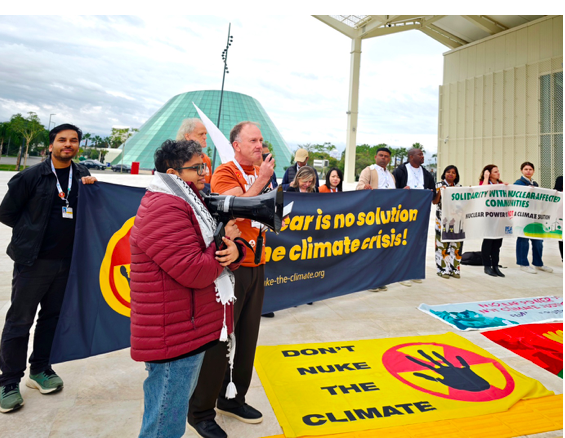
Nuclear power is not a climate solution
A central focus of our engagement was challenging the promotion of nuclear power as a response to the climate crisis.
Working alongside allies including Earthlife Africa, Friends of the Earth Japan, and Peace Boat, IPPNW delegates brought that challenge into both the official conference and civil society spaces. Our message—“No Nuclear Spin. Let Renewables Win!”—called for investment in equitable renewable energy and energy efficiency rather than an expansion of nuclear dependence.
Through discussions on Fukushima, Chernobyl, and proposed nuclear expansion, we raised questions about radioactive waste, construction timelines, financial risk, proliferation and accountability. We emphasized the need to listen to affected communities and scrutinise industry claims rather than accept technological promises at face value.
Our position was not simply opposition to one technology. It was a demand for an energy transition organised around health, justice and democratic participation. We advocated for public investment that delivers affordable energy, strengthens essential services and gives communities meaningful influence over decisions.
For IPPNW, this work belongs alongside—not in place of—our commitment to preventing nuclear war. Our contribution is to bring a health-centred perspective to debates in which the long-term consequences for people and communities can otherwise become secondary.
Connecting the climate crisis with militarization
At the Peoples’ Climate Summit and COP side event, our delegation brought the relationship between war, climate and health into the conversation.
I contributed to the “Climate Crisis and War Regime” panel, arguing that climate policy must confront the priorities that sustain militarization while leaving health services, social protection and climate action inadequately supported.
Dr Angelika Claussen helped strengthen connections around war, climate and health. Dr Maria Sotiropoulou contributed to discussions on nuclear power and led a commemoration of Margarita Papandreou, bringing feminist and peace perspectives into our engagement.
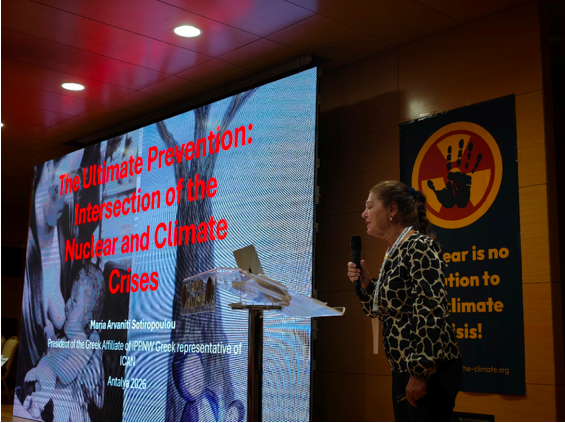
Together, these contributions expressed a shared purpose: to make prevention central to climate politics. Our advocacy called for preventing nuclear catastrophe, reducing the risks of war and investing in the conditions that allow people to live healthy, secure lives.
The practical question we put to governments was straightforward: why are resources available for military expansion while essential investments in care and climate protection remain contested?
Moving the money towards care and climate justice
Our exchanges with Peace Boat, the Women’s International League for Peace and Freedom (WILPF), and other partners helped turn that question into a shared political demand.
The feminist call to “Move the Money” connected our peace advocacy with demands for investment in healthcare, social protection, adaptation and a just energy transition.
For IPPNW, this is an important area for sustained work. Rather than relying only on global spending comparisons, we should scrutinise specific budget decisions: what governments allocate to military programs, what they commit to climate and health, and whether those commitments are delivered.
Our demand is not merely for different expenditure totals. It is for a different understanding of security—one centered on people’s ability to access healthcare, food, water, shelter and a liveable environment.
Engagement with feminist networks also reinforced the importance of asking who makes decisions, whose knowledge counts and who carries the risks. We brought these questions into discussions about energy choices and the meaning of a just transition.
Building solidarity beyond the negotiating rooms
The Peoples’ Climate Summit and the Global Day of Action provided opportunities to connect with people whose work extended far beyond the official negotiations.
Marching in the rain along with 10,000 activists, participating in discussions and remembering environmental defenders were expressions of solidarity. They also created space to exchange experience and build relationships across movements.
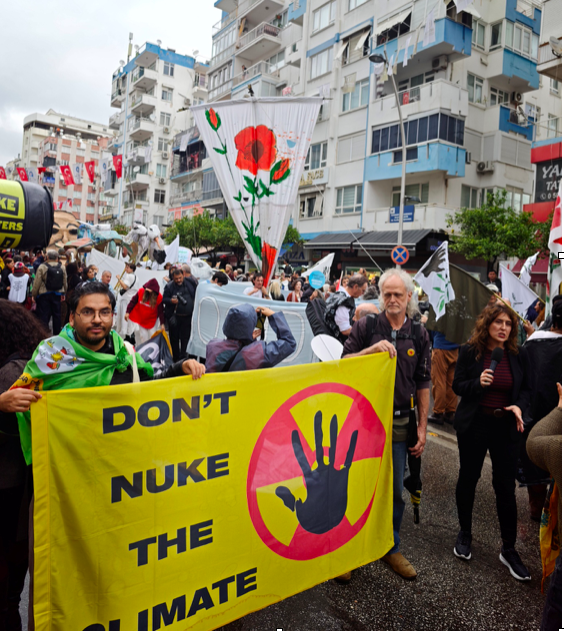
For our delegation, these encounters were among the most valuable parts of Antalya. But their value will ultimately depend on what follows. Shared platforms need to become sustained cooperation, specific demands and coordinated advocacy.
IPPNW’s contribution should remain clear: bring clinical and public health perspectives, uphold our commitment to preventing war and nuclear catastrophe, and work alongside communities rather than speak on their behalf.
Our proposed priorities for COP32
With COP32 due to take place in Addis Ababa, Ethiopia, in 2027, we should build on these relationships through a focused programme of work:
- Put health at the center of climate finance;
- Advocate for accessible, grant-based adaptation and loss-and-damage finance that does not deepen debt;
- Make those demands concrete by linking them to resilient healthcare facilities, safe water, food security, heat protection and continuity of essential services; identify who should provide the funding and how delivery will be assessed;
- Strengthen the connection between peace and climate advocacy;
- Work with peace and feminist organisations to scrutinise military spending and develop joint demands for investment in health, care and climate protection;
- Our contribution should connect broad calls for demilitarisation with identifiable policy choices and opportunities for action;
- Continue evidence-led scrutiny of nuclear expansion;
- Challenge the presentation of nuclear power as an unquestioned climate solution. Examine proposals transparently across costs, delivery times, safety, waste, proliferation concerns and community participation;
- Advocate for equitable renewable energy and efficiency through locally grounded alternatives, while maintaining rigorous standards for the evidence we use;
- Build partnerships led by African priorities;
- Prepare for Addis Ababa through sustained dialogue with African health professionals, civil society organisations, interfaith networks and frontline communities.
These partnerships should shape our agenda from the outset—not simply support positions developed elsewhere. Shared work should include meaningful participation in decisions, resources and representation.
Carrying Antalya’s work forward
COP31 failed to deliver an overarching agreement. Our response must be more than disappointment.
For IPPNW, the task is to turn our health expertise, peace commitments and international relationships into sustained political influence. That means remaining engaged with negotiations while organising beyond them, challenging nuclear risks while advancing equitable alternatives, and connecting climate demands with concrete choices about public resources.
To everyone who contributed to our discussions, actions and partnerships in Antalya: thank you.
We go towards Addis Ababa with a clear purpose: to advance climate action that protects health, prevents war and puts people’s wellbeing at the centre of security.
Dr. Khadka is a member of IPPNW’s Board of Directors

 Bimal Khadka
 Bjorn Hilt
 Charles K. Johnson
 Dr. Ghassan Shahrour
 Gunnar Westberg
 IPPNW
 John Loretz
 Lawrence Wittner
 Maria Valenti
 mollymcgint
 Sue Wareham
 Tilman Ruff
 Tim Wright
 Xanthe Hall