A bold campaign to confront global crises
Although the world is experiencing severe global crises, there are new efforts underway to create a more effective means of coping with them.
The crises are clear enough. They include vast slaughter in horrific wars, worldwide climate catastrophe, massive population displacement, and deepening poverty.
Read more…Nuclear testing, safety, and security

by Kati Juva
The world got alarmed at the end of October when US president Trump ordered the US to resume nuclear tests, ostensibly because China and Russia have been testing. In fact, neither China nor Russia has conducted a nuclear test explosion in decades—Russia declared a unilateral moratorium in 1991 and China has not tested since at least 1996. A global seismic and satellite surveillance system makes it virtually impossible to explode a nuclear warhead undetected.
Read more…“Nothing is more precious than peace”, Reflections from Nagasaki
by Sofia Vitale, Student Member of Physicians for Social Responsibility (USA) and IPPNW
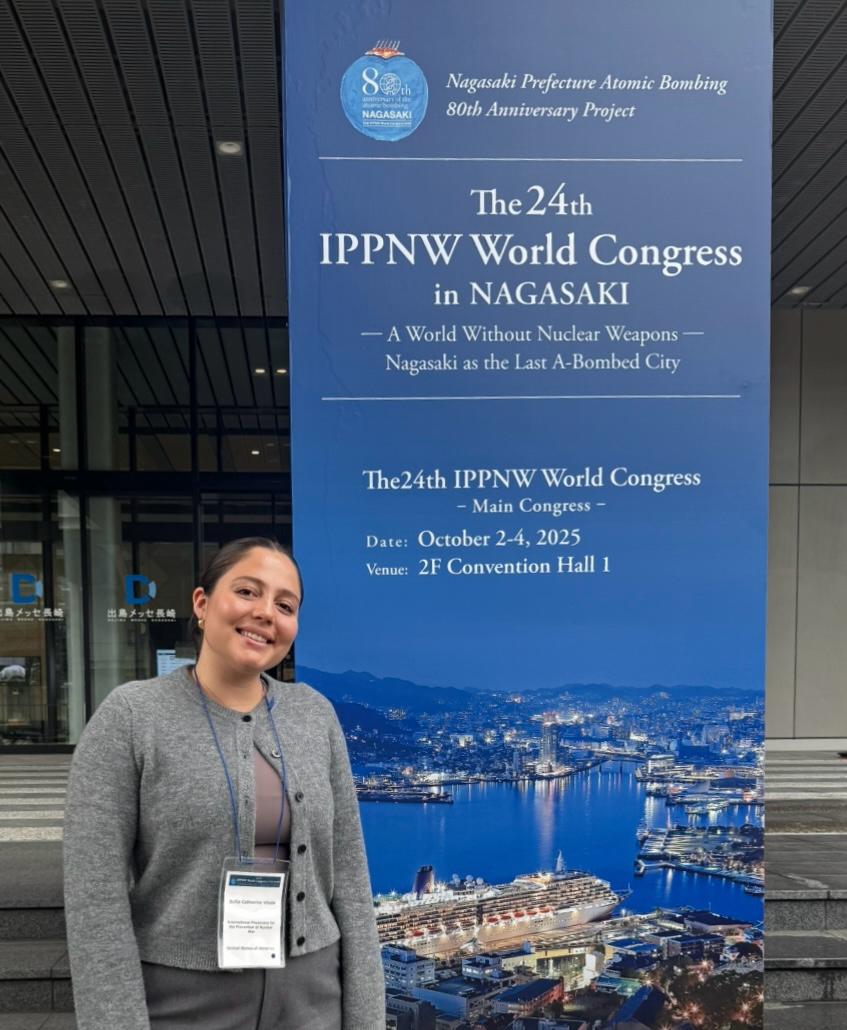
“Nothing is more precious than peace. Nothing brings more happiness. Peace is the most basic starting point for the advancement of humankind” (The New Human Revolution, Vol. 1, “Sunrise” Chapter).
Every effort towards peace is ultimately an effort to protect human life and to create a future in which all people can live with dignity and happiness. As Daisaku Ikeda’s words remind us, peace is the foundation of all human progress. These words came alive for me during the 24th IPPNW World Congress in Nagasaki, Japan – a conference that profoundly changed my life.
Read more…Read the full statement here and below. 30 October, 2025.
On October 29, before a meeting in South Korea with Chinese President Xi, President Donald Trump announced on social media that he “instructed the Department of War to start testing [US] Nuclear Weapons on an equal basis” with Russia and China. The post contains various inaccuracies and it is unclear whether he wants to resume nuclear explosive testing — an act the United States, Russia, and China have not undertaken in over 30 years — or continue nuclear-capable missile testing.
As physicians and health professionals, we condemn any and all nuclear weapons testing and de-stabilizing posturing. Regardless of intent, President Trump’s statement is a dangerous escalation that threatens global security and undermines decades of disarmament efforts, including the 1970 Nuclear Non-Proliferation Treaty.
Read more…Turning back from the brink of nuclear war
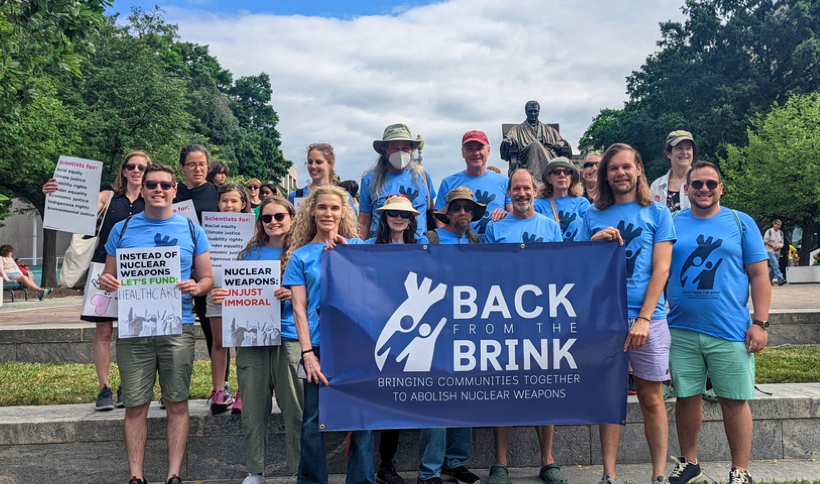
Early this year, legislators in the U.S. House of Representatives and in the U.S. Senate introduced resolutions that call upon the U.S. government to lead a global effort to halt and reverse the nuclear arms race. Co-sponsored by 36 members of the House and 5 members of the Senate, H. Res. 317 and S. Res. 323 urge the U.S. government to pursue nuclear disarmament, renounce the first use of nuclear weapons, end sole presidential authority to launch them, cancel plans for new, enhanced nuclear weapons and delivery systems, maintain the current moratorium on nuclear testing explosions, and provide a just economic transition for impacted communities.
Read more…Albert Einstein and the problem of war

Although Albert Einstein is best-known as a theoretical physicist, he also spent much of his life grappling with the problem of war.
In 1914, shortly after he moved to Berlin to serve as director of the Kaiser Wilhelm Institute of Physics, Einstein was horrified by the onset of World War I. “Europe, in her insanity, has started something unbelievable,” he told a friend. “In such times one realizes to what a sad species of animal one belongs.” Writing to the French author Romain Rolland, he wondered whether “centuries of painstaking cultural effort” have “carried us no further than . . . the insanity of nationalism.”
Read more…[The following statement was issued by IPPNW’s International Council on 5 October, at the conclusion of the 24th World Congress in Nagasaki.]
IPPNW expresses its grave concern at the extreme suffering caused by the large-scale destruction of healthcare and other essential civilian services that is currently occurring in both Gaza and Sudan.
Read more…“All that’s required is political will and leadership”

by Matt Bivens, MD, an emergency medicine attending physician at Beth Israel Deaconess Medical Center in Boston and St. Luke’s Hospital in New Bedford MA
Terumi Tanaka was 13 years old, at home, reading a book, when the last atomic bomb ever dropped on a city exploded less than 2 miles away.
The flash of bright light startled him, and he threw himself on the ground and covered his ears, just before a shock wave struck. He woke unharmed under debris, self-extricated, and entered the waking nightmare of a wrecked Nagasaki.
Read more…IPPNW World Congress issues Nagasaki Declaration

We have gathered in Nagasaki, as doctors, medical students, and activists, to commemorate the Hibakusha, the victims and survivors of the US atomic bombings here and in Hiroshima 80 years after those terrible events, and the survivors of the more than 2,000 nuclear tests conducted around the world. We recognize and thank the Hibakusha and Nihon Hidankyo, recipients of the 2024 Nobel Peace Prize, for their life-long dedication to the abolition of nuclear weapons. We are honored by their presence at this Congress. With their example before us, we recommit ourselves to achieving a world free from nuclear weapons.
Read more…A Reflection: Day 1 of IPPNW’s 24th World Congress
by Saurav Singh, Student Member of the Russian Physicians for the Prevention of Nuclear War
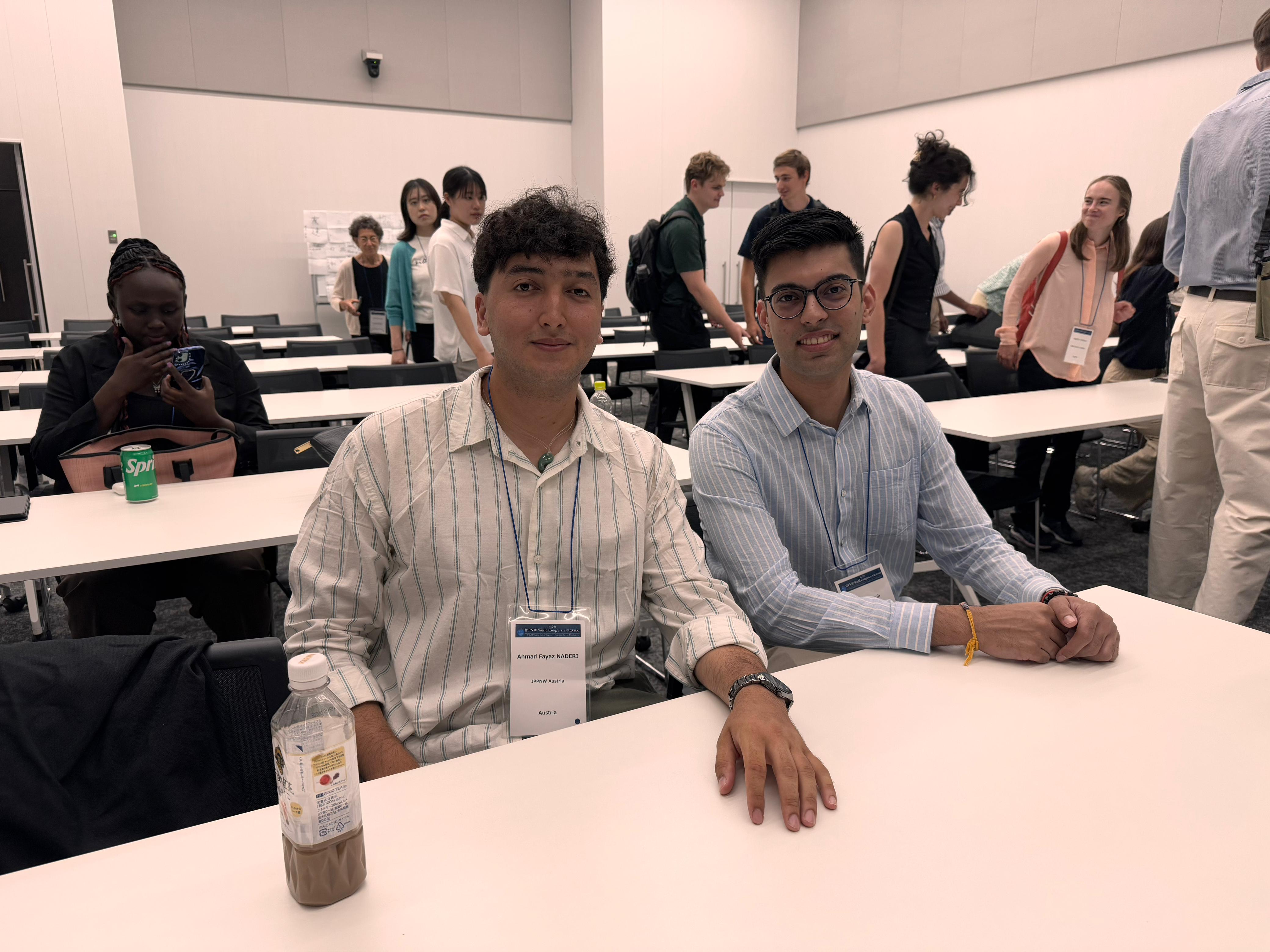
The first day of the 24th IPPNW World Congress commenced on October 2, 2025. The proceedings began with an opening ceremony featuring introductory speeches from key figures who have significantly contributed to the organization. This was followed by a keynote video address by High Representative Izumi Nakamitsu Under Secretary General at the UN Office for Disarmament Affairs. The central themes from these opening remarks emphasized that the role of medical science extends to public health advocacy beyond clinical settings and that collective action amplifies impact. A sense of urgency was conveyed to inherit the mission of peace and strive towards a future with “no more Hiroshima, no more Nagasaki.”
Read more…
 Bimal Khadka
 Bjorn Hilt
 Charles K. Johnson
 Gunnar Westberg
 IPPNW
IPPNW John Loretz
 Lawrence Wittner
 Maria Valenti
 mollymcgint
 Sue Wareham
 Tilman Ruff
 Tim Wright
 Xanthe Hall


 IPPNW peace and health blog