The urgent need to begin negotiating a Nuclear Weapons Convention
IPPNW and the International Campaign to Abolish Nuclear Weapons (ICAN) have called on the United Nations General Assembly to “take up the Nuclear Weapons Convention as its highest disarmament and non-proliferation priority” during its 63rd session, which opened on September 16. Despite dozens of resolutions adopted by the General Assembly each year, progress toward a nuclear-weapons-free world has been stalled for decades. In a statement sent to the General Assembly President and to the chairs of the UN First Committee and the Conference on Disarmament, IPPNW warned that “This ongoing unprecedented threat [of nuclear war] to all people and the survival and sustainability of our planet is not only continuing but escalating.” IPPNW affiliates are sending copies of the statement to their UN missions and Conference on Disarmament delegations throughout the months of September and October.
IPPNW’s Submission to the 63rd Session of the United Nations General Assembly
For more than 45 years, physicians have documented and described the horrifying medical and humanitarian consequences of nuclear weapons explosions. We have informed political and military leaders that doctors, hospitals, and other medical infrastructure would be so completely overwhelmed in the event of a nuclear war that we would be unable to respond in any meaningful way to relieve the suffering of survivors or to restore health to a devastated world. We have warned that the unique nature of nuclear weapons — their unprecedented destructive power and the radiation they release, causing cancers, birth defects, and genetic disorders across generations — removes any moral justification for their use as weapons of war and requires their abolition.
This ongoing unprecedented threat to all people and the survival and sustainability of our planet is not only continuing but escalating. The Weapons of Mass Destruction Commission chaired by Dr Hans Blix noted:
“Over the past decade, there has been a serious and dangerous, loss of momentum and direction in disarmament and non-proliferation efforts.”[1]
Numerous authoritative assessments conclude that the risk use of nuclear weapons is growing. One of the most authoritative is the Board of The Bulletin of the Atomic Scientists, including 18 Nobel Laureates. In moving the hands of the Doomsday Clock from 7 to 5 minutes to midnight in January 2007 they stated:
“Not since the first atomic bombs were dropped on Hiroshima and Nagasaki has the world faced such perilous choices. North Korea’s recent test of a nuclear weapon, Iran’s nuclear ambitions, a renewed US emphasis on the military utility of nuclear weapons, the failure to adequately secure nuclear materials, and the continued presence of some 26,000 nuclear weapons in the United States and Russia are symptomatic of a larger failure to solve the problems posed by the most destructive technology on Earth.”[2]
International lawyers, physicians, scientists, and other civil society experts have offered a roadmap toward a nuclear-weapons-free world in the Model Nuclear Weapons Convention. The model NWC—a comprehensive framework for global nuclear disarmament in all its aspects—has been a working document of the General Assembly since 1997. Support for a convention has been voiced repeatedly by majorities of UN Member States. A First Committee resolution (A/C.1/62/L.36) adopted last year and supported by 127 Member States called for the commencement of “multilateral negotiations leading to an early conclusion of a nuclear weapons convention prohibiting the development, production, testing, deployment, stockpiling, transfer, threat or use of nuclear weapons and providing for their elimination.”[3]
We urge the General Assembly to put this resolution into action by engaging in substantive discussion of the Nuclear Weapons Convention during the 63rd session, and by instructing the Conference on Disarmament and the participants in the 2010 Non-Proliferation Treaty Review Conference to place the Convention at the center of their deliberations from this point on. Such direction from the General Assembly would recall its first resolution, adopted in 1946 and calling for “the elimination from national armaments of atomic weapons and of all other major weapons adaptable to mass destruction.” This urgent task not only remains unfulfilled more than 60 years later, but, with regard to nuclear weapons, it has barely begun. Nuclear arms control and disarmament proposals continue to be offered in a piecemeal, disconnected fashion while existing arsenals are “modernized” and new arsenals come into existence. Procedural disputes are used as stalling tactics. For every step forward we seem to take two steps back. The Conference on Disarmament, the world’s sole multilateral disarmament negotiating body, has not undertaken any substantive negotiations for well over a decade. The First Committee sends dozens of strongly worded resolutions on different aspects of nuclear disarmament to the General Assembly each year, and each year the General Assembly adopts them and moves to the next item on its agenda. NPT Review Conferences and Preparatory Committee sessions are dominated by debates about whether disarmament or non-proliferation should come first, when the Treaty obligates Member States to pursue both simultaneously. Former Secretary-General Kofi Annan made this point eloquently at the conclusion of his term:
“[T]hese two objectives –- disarmament and non-proliferation -– are inextricably linked, and…to achieve progress on either front we must also advance on the other.…It would be much easier to confront proliferators, if the very existence of nuclear weapons were universally acknowledged as dangerous and ultimately illegitimate.”[4]
In making that assertion, Secretary-General Annan reiterated the view of the International Court of Justice, which, 10 years earlier, had advised the General Assembly that all states had an obligation, under international law, “to pursue in good faith and bring to a conclusion negotiations leading to nuclear disarmament in all its aspects under strict and effective international control.”[5] Secretary-General Ban Ki-moon told the Conference on Disarmament this January that “To get back on the path to success, the Conference must rekindle the ambition and sense of common purpose that produced its past accomplishments.”[6] The Nuclear Weapons Convention, while its precise terms remain to be negotiated, embodies that common purpose.
|
|
Reinforcing and building on the NPT
The NWC cuts through the widely held perception that nuclear disarmament is an improbable dream. It offers a vision of what a nuclear-weapons-free world might look like, showing the steps that could practically lead to nuclear weapons being safely and securely eliminated. The model NWC contains detailed provisions for national implementation and guidelines for verification; establishes an international agency responsible for enforcement and dispute settlement; and indicates procedures for reporting and addressing violations. It is comparable, in these respects, to other treaties banning entire categories of weapons, such as the Chemical Weapons Convention, the Biological Weapons Convention and the Mine Ban Treaty. The model NWC simply applies the lessons of successes in nuclear disarmament with the comprehensive, universal treaty-based approach which has been the logical approach for all the successes towards abolishing other major classes of weapons to date. To assert that a similar approach to nuclear weapons is impractical or counterproductive is inconsistent and disingenuous. A nuclear weapons convention will enable nuclear weapons states to fulfil their legal obligations under the NPT, will bridge the divide between non-proliferation and disarmament, and will address the issue of universality, which has plagued the NPT from the beginning.
The NPT is already under serious strain. The exception recently granted nuclear trade with India essentially rewards India despite its development of nuclear weapons as a non-party to the NPT, and provides for nuclear cooperation previously restricted to NPT signatories. This adds to the failure of the nuclear weapon states to disarm, and instead to enhance their nuclear arsenals, to erode the incentives for the vast majority of non-nuclear weapons to continue to fulfill their obligations under the Treaty. Other nuclear weapons states outside the NPT can be expected to seek similar exemptions. The only prospect which stands a serious chance of breaking this negative spiral towards nuclear anarchy is serious, widespread commitment to eradication of nuclear weapons, made credible by tangible progress towards this goal.
At the 1995 NPT Review and Extension Conference, the Parties agreed “to pursue systematic and progressive efforts to reduce nuclear weapons globally, with the ultimate goal of eliminating those weapons.” They went further in 2000, committing themselves to an “unequivocal undertaking” to eliminate nuclear weapons, and endorsing specific benchmarks spelled out in a 13-step action plan. Each of these benchmarks—including entry into force of the Comprehensive Test Ban Treaty, a ban on the production of fissile materials for nuclear weapons, reduced operational status, a diminished role for nuclear weapons in security policies, and the continued development of verification capabilities, among others—is an integral part of the Convention, which organizes the many aspects of nuclear disarmament into a coherent whole.
States parties to the Convention would be required to declare all nuclear weapons, nuclear material, nuclear facilities and nuclear weapons delivery vehicles they possess or control, and their locations. The model Convention outlines a series of five phases for elimination: taking nuclear weapons off alert; removing weapons from deployment; removing nuclear warheads from their delivery vehicles; disabling the warheads, removing and disfiguring the “pits” where the weapons are stored; and placing the fissile material under international control. Compliance and verification would be assured through declarations and reports from States, routine and unannounced inspections, and a full range of technical monitoring systems.
The NWC does not undermine existing nuclear non-proliferation and disarmament regimes—a concern sometimes raised by governments and diplomats. It would complement, enhance and build on all of these. In short, there is no reason not to make this historic transition from a fragmented approach to a comprehensive approach, and there is every reason to do so. In fact the recent history of nuclear proliferation demonstrates unequivocally that any approach which perpetuates a double standard—that nuclear weapons are essential instruments of security in the hands of some nations, and intolerable threats to security in the hands of others, a threat so great as to warrant pre-emptive war—is doomed to failure. Widespread access to nuclear technology and materials ensures that. The only sustainable, practical approach which could gain the support of all nations is one consistent goal—zero nuclear weapons—for all.
New science and the stark consequences of failure
|
T |
he stakes could not be higher. Increasing knowledge of how to construct nuclear weapons, increasing availability of the materials with which to make a bomb, increasing numbers of people desperate enough to use the bomb, and, most important, a lack of international resolve to ban the bomb and banish it from the arsenals of the world, make the use of nuclear weapons inevitable if we do not act decisively.
As physicians, we are obliged to remind you what that would mean.
The 12.5-kiloton bomb detonated in the air over Hiroshima decimated the city and created ground temperatures that reached about 7,000 degrees Celsius. Of the 76,000 buildings in the city, 92% were destroyed or damaged. There were more than 100,000 deaths and approximately 75,000 injuries among a population of nearly 250,000. Of the 298 physicians in the city, 270 were dead or injured and 1,564 of 1,780 nurses died or were injured.
The 21-kiloton bomb detonated in the air over Nagasaki three days later leveled 6.7 square kilometers (2.6 square miles). There were 75,000 immediate deaths and 75,000 injuries, with destruction of medical facilities and personnel and health consequences for the population of the city that were similar to those of Hiroshima.
A 2002 study published in the British Medical Journal estimated the casualties from a 12.5 kiloton nuclear explosion at ground level near the port area of New York City. The model projected 262,000 people would be killed, including 52,000 immediately and the remainder succumbing to radiation injuries. Caring for survivors would also be difficult, if not impossible, with the loss of 1,000 hospital beds in the blast and another 8,700 available beds in areas of high radiation exposure.[7]
A regional nuclear war in South Asia involving only 100 Hiroshima-sized (15-kt) weapons targeted on megacities would kill 20 million people outright, a number equal to half of all those killed worldwide during the six years of World War II. A nuclear war between the US and Russia, whose leaders persist in maintaining the world’s largest nuclear arsenals and have thousands of weapons ready to be launched in a matter of minutes, would kill hundreds of millions and could trigger a nuclear winter. As physicians, we are not comforted by assertions that these weapons are in responsible hands and that such possibilities are not to be feared. It is not the character of their owners but the nature of the weapons which is at issue.
In December 2006, climate scientists who had worked with the late Carl Sagan in the 1980s to document the threat of nuclear winter produced disturbing new research about the climate effects of low-yield, regional nuclear war.[8] Using South Asia as an example, these experts found that even a limited regional nuclear war on the order of 100 Hiroshima-sized nuclear weapons would result in tens of millions of immediate deaths and unprecedented global climate disruption. Smoke from urban firestorms caused by multiple nuclear explosions would rise into the upper troposphere and, due to atmospheric heating, would subsequently be boosted deep into the stratosphere. The resulting soot cloud would block the sun, leading to significant cooling and reductions in precipitation lasting for more than a decade. Within 10 days following the explosions, there would be a drop in average surface temperature of 1.25° C. Over the following year, a 10% decline in average global rainfall and a large reduction in the Asian summer monsoon would have a significant impact on agricultural production. These effects would persist over many years. The growing season would be shortened by 10 to 20 days in many of the most important grain producing areas in the world, which might completely eliminate crops that have insufficient time to reach maturity.
To make matters even worse, such amounts of smoke injected into the stratosphere would cause a huge reduction in the Earth’s protective ozone. A study published in April by the National Academy of Sciences, using a similar nuclear war scenario involving 100 Hiroshima-size bombs, shows ozone losses in excess of 20% globally, 25–45% at midlatitudes, and 50–70% at northern high latitudes persisting for five years, with substantial losses continuing for five additional years.[9] The resulting increases in UV radiation would have serious consequences for human health.
There are currently more than 800 million people in the world who are chronically malnourished. Several hundred million more live in countries that depend on imported grain. Even a modest, sudden decline in agricultural production could trigger significant increases in the prices for basic foods, as well as hoarding on a global scale, making food inaccessible to poor people in much of the world. While it is not possible to estimate the precise extent of the global famine that would follow a regional nuclear war, it seems reasonable to anticipate a total global death toll in the range of one billion from starvation alone. Famine on this scale would also lead to major epidemics of infectious diseases, and would create immense potential for mass population movement, civil conflict, and war.
These findings have significant implications for nuclear weapons policy. They are powerful evidence in the case against the proliferation of nuclear weapons and against the modernization of arsenals in the existing nuclear weapon states. Even more important, they argue for a fundamental reassessment of the role of nuclear weapons in the world. If even a relatively small nuclear war, by Cold War standards—within the capacity of 8 nuclear-armed states—could trigger a global catastrophe, the only viable response is the complete abolition of nuclear weapons.
Conclusion: an urgent need for action beyond rhetoric
|
T |
he Member States of the United Nations set out to achieve a nuclear-weapons-free world in the 20th century, and failed to reach that goal. This failure can be traced back, in part, to the fact that the General Assembly did not insist upon the commencement of negotiations on a timebound schedule. Mayors for Peace, under the leadership of Hiroshima Mayor Tadatoshi Akiba, has called for the elimination of all nuclear weapons by 2020—the 75th anniversary of the US atomic bombings of Hiroshima and Nagasaki. This goal is achievable if negotiations on a Nuclear Weapons Convention commence no later than the conclusion of the 2010 NPT Review. The General Assembly has an opportunity and a responsibility to provide its disarmament bodies with the Convention roadmap, and to set a timeline for results. Every day of inaction further risks the chance that our collective luck will run out.
We respectfully request the President of the 63rd session and the General Assembly as a whole to take up the Nuclear Weapons Convention as its highest disarmament and non-proliferation priority.
[1] Weapons of Mass Destruction Commission. The WMDC report: weapons of terror — freeing the world of nuclear, biological and chemical arms. Stockholm. 2006.
[2] Bulletin of the Atomic Scientists. “Doomsday clock” moves two minutes closer to midnight. Press release. 17 January 2007. [www.thebulletin.org].
[3] UNGA. Follow-up to the advisory opinion of the International Court of Justice on the legality of the threat or use of nuclear weapons. Document A/C.1/62/L.36. 17 October 2007.
[4] Annan, K. Lecture. Princeton University. 28 November 2006. [http://www.un.org/News/Press/docs/2006/sgsm10767.doc.htm%5D
[5] International Court of Justice. Legality of the threat or use of nuclear weapons. Advisory opinion of 8 July 1996. [http://www.icj-cij.org/docket/index.php?p1=3&p2=4&k=e1&p3=4&case=95%5D
[6] Secretary-General’s statement to the Conference on Disarmament. Geneva, Switzerland. 23 January 2008. [www.un.org/apps/sg/sgstats.asp?nid=2962]
[7] Helfand I, Forrow L, Tiwari J. Nuclear terrorism. BMJ 2002;324:356-359.
[8] Robock A, et.al. Climatic consequences of regional nuclear conflicts, Atmospheric Chemistry and Physics Discussion 2006;6:11817-11843.
[9] Mills MJ et al. Massive global ozone loss predicted following regional nuclear conflict. PNAS, 2008;105(14):5307-5312.
Dr. John describes choice between dominance and cooperation at peace summit
IPPNW Co-President Ime John was a featured speaker at the Point of Peace summit on September 11 in Stavanger, Norway. The summit is an annual gathering of Nobel Peace Prize laureates, conflict resolution experts, and NGOs. Dr. John told the conference that “the choice between…two paradigms—one based on unilateralism, force, ideology, and narrowly defined national interests; the other based on diplomacy, a search for consensus, and a respect for international law—has rarely been so manifest or so urgent.”
Full Text of Speach [Download PDF]
The nuclear paradox –threat to global security and peace.
Mr. Chairman/Moderator,
Esteemed Colleagues,
Gentlemen of the Press,
Distinguished Ladies and gentlemen.
It gives me pleasure to address you at this august gathering of experts, activists, and peacemakers in a Country renowned for honoring and supporting global peace. Our topic — REDEFINING SECURITY: FROM DOMINANCE TO COOPERATION — is not only timely, but essential. The choice between these two paradigms — one based on unilateralism, force, ideology, and narrowly defined national interests; the other based on diplomacy, a search for consensus, and a respect for international law — has rarely been so manifest or so urgent.
As a Physician, and as the Co-President of a federation of physicians that sees peace and care for the human race as one and the same project, I would like to briefly address some of our challenges and opportunities at this crossroads.
The world breathed a sigh of relief at the end of the Cold War, hoping that the annihilation of mankind in an all-out nuclear war between the US and the former Soviet Union was a fear that we could put to rest. Today, however, we find ourselves once again on the brink of nuclear catastrophe, and we will remain there if we do not take significant steps now toward a world without nuclear weapons.
Despite welcome reductions in their arsenals, the US and Russia still possess more than 20,000 nuclear weapons between them — more than 95% of the world total. There are seven other nuclear weapon states, some in volatile regions of the world. Two of those states — India and Pakistan — have done serious damage to the non-proliferation regime by introducing new arsenals into the world, along with new incentives for others to acquire nuclear weapons. The possibility that terrorist groups may obtain nuclear weapons and use them wantonly is a frightening concern that cannot be addressed effectively without comprehensive ban on the weapons themselves and the materials with which to make them.
We would be making a serious mistake, however, if we accepted the claim of the nuclear weapon states that this is only a proliferation problem, and that the solution is keeping nuclear weapons out of irresponsible hands, through coercive means if necessary. The nuclear weapon states themselves have moved beyond strictly defined concepts of deterrence against other nuclear-armed adversaries. Some of them openly contemplate preemptive attacks —possibly even nuclear attacks — against countries they believe to be developing nuclear weapons or the capacity to build them.
The US, the UK, and a handful of allies embarked on an unending misadventure in Iraq, based on unwarranted claims that Iraq was on the verge of acquiring nuclear arsenal. No nuclear weapons were found in Iraq because none existed. The cost of this mistake in human lives has been staggering: hundreds of thousands — perhaps more than a million — Iraqi deaths; almost 4 million refugees and displaced persons; and more than 100,000 casualties (deaths and injuries) among American soldiers. The five-year occupation has only resulted in a heightened capacity for terrorism and political instability in the region, at a cost of anywhere between one and four trillion dollars. As though these lessons had gone completely unlearned, the outgoing Bush administration has raised global anxiety by sending signals that it might take military action to prevent Iran from obtaining nuclear weapons — a possibility that cannot be discounted given Iran’s advanced state of nuclear technology, although the country’s leaders have denied that they are turning those resources towards weapons development.
Recently, a region with a tragic history of conflict and political instability —dating back to the Ottoman Empire and continuing through the Bolshevik revolution and the radical changes brought about by perestroika and glasnost in the 1990s — has erupted in violence again. Without going into a discussion hereabout the causes and claims on either side of the conflict between Russia and Georgia, I only want to point out that in a nuclear-armed world, hostilities that draw nuclear weapons states into confrontations with each other have the potential to escalate into something catastrophic. Peaceful negotiations leading to mutual agreements are urgently needed within this region.
For the past 38 years, since the entry into force of the Non-Proliferation Treaty (NPT), the nuclear weapon states have avoided their nuclear disarmament obligations under Article VI. Rather, they have striven to maintain a kind of nuclear apartheid — a global security system in which nuclear weapons guarantee the power and status of a few countries, while the vast majority of states must settle for second class citizenship. Israel, India, and Pakistan refused to join the NPT for this very reason, to the detriment of global security.
Just this week, the Nuclear Suppliers Group approved a special waiver that will allow the US to transfer nuclear technology to India, despite the fact that the NSG was created in the aftermath of the 1974 Indian nuclear test to prevent nuclear assistance to countries that were not subject to the safeguards, inspections, and compliance regimes mandated by the NPT.
The dominance paradigm produces the kind of world in which we find ourselves, and offers no solutions for getting out of it — no exit strategy, to use the language of military planners.
IPPNW is a federation of like-minded, non-partisan physicians and health care workers that was formed at the height of the Cold War to address an earlier manifestation of the nuclear threat. Our humble contribution to educating an earlier generation of leaders about the medical consequences of nuclear war was recognized by the UNESCO Peace Education Prize in 1984 and by the Nobel Peace Prize in 1985. Since then we’ve grown in both size and mission, with affiliate organizations in 62 countries addressing a range of issues related to peace, security, and health.
Yet our fundamental message — that doctor can offer no meaningful medical response to a nuclear war and that prevention is the only responsible option —has not changed. We know that what happened to the people of Hiroshima and Nagasaki as a result of the US atomic bombings is only a foreshadowing of the consequences of a nuclear war using today’s arsenals.
Twenty years ago, we learned that a nuclear war between the US and the former Soviet Union, involving a thousand or more nuclear weapons, would result in nuclear winter and the end of human civilization. During the past year or so, scientists have informed us that even the use of 100 Hiroshima-sized weapons could result in tens of millions of immediate deaths and unprecedented climate disruption, including the precipitation of a global famine.
Mounting concern over the nuclear threat and frustration with gridlocked disarmament discussions in UN committees and other arms control forums, prompted IPPNW to launch the International Campaign to Abolish Nuclear Weapons (ICAN) in 2007. The goal of ICAN is to reawaken public concern about the growing threat posed by nuclear weapons, and to mobilize civil society to demand a nuclear-weapon-free world through the negotiation and adoption of a Nuclear Weapons Convention. We reached such agreements on chemical and biological weapons, on landmines, and, most recently, on cluster munitions. There is no reason, other than political resistance, why we cannot come to agreement around prohibition of nuclear weapons as well.
To do so, however, we must adopt the cooperation paradigm. In the case of the nuclear threat, cooperation must take the form of a courageous and sustained diplomatic effort to create a nuclear-weapons-free world under a Nuclear Weapons Convention. The agreement must be accompanied by good faith actions to implement the Convention and to abide by its terms.
IPPNW launched ICAN at the Non-Proliferation Treaty Preparatory Committee meeting in Vienna, and worked with a coalition of NGOs to bring the Nuclear Weapons Convention to the attention of delegations at the 2008 PrepCom in Geneva. In 2008 and 2009, ICAN activists will make the case that, along with global warming, nuclear war is the greatest preventable danger facing humankind. IPPNW will promote the Nuclear Weapons Convention both inside and outside the UN, and will focus on specific medical issues, including the climate effects of regional nuclear war, the use of highly enriched uranium in radiopharmaceutical production, and the health impacts of an expanding uranium mining industry.
We believe that together with you — our distinguished Colleagues — and with the voices of civil society around the world, we can influence our governments to make the call for abolition their highest security priority, and work with us to make a world without nuclear weapons a reality.
Thank you for your attention.
Dr. Ime A.John
Co-President, IPPNW
IPPNW Aiming for Prevention activists from Africa, the United States, and Puerto Rico once again brought the public health message that “guns are bad for health” to the United Nations at the 3rd Biennial Meeting of States of the United Nations Programme of Action on Illicit Trade in Small Arms and Light Weapons, from July 14-18 in New York.
IPPNW contributed a successful panel on public health entitled “Risk and Resilience,” attended by more than 75 NGOs and country delegates. [Photos]
IPPNW and the IANSA Public Health Network released a new policy paper, “Prescriptions for Prevention: A Public Health and Human-Centered Approach to Reducing Firearm Violence.” [Download PDF]
The IANSA Public Health Network speaker, Dr. Diego Zavala, spoke about the need to increase public health approaches to small arms violence during the NGO presentation to the assembly of delegates, using as an example the recent 5-country IPPNW hospital-based injury research in Africa.
Dr. Robert Mtonga of IPPNW/Zambia served on the official Zambian delegation, having recently served on the steering committee for the Cluster Munitions Coalition, which helped pass the historic Cluster Munitions Convention to ban use of the devastating weapons in Dublin in early 2008.
Got a minute? Help Aiming for Prevention and take the Strategic Planning Needs Assessment Survey
Over 700 Attend 3rd Open Congress of IPPNW-Germany
Thanks are owed to Lena Donat, Sven Hessmann and Xanthe Hall for Contributing to this report.
From September 12th to 14th IPPNW Germany held its 3rd Open Congress for a Culture of Peace in the Urania in Berlin. For three days 700 participants and experts were debating to identify paths to recovery and to promote constructive proposals for more peaceful world order. More than 50 experts from all over the world gave lectures, from Ecuador, Kenya, Canada, South Africa or Palestine.
The documentation of the lectures in English language can be found here: [English Docs]
The congress aimed to address the four global threats we are facing at the beginning of the 21st century according to the Oxford Research Group:1
- Climate change,
- Competition over resources,
- Marginalization of the majority of the world, and
- Global militarization.
In lectures, workshops and discussions the participants and experts analyzed the risks to peace and looked for solutions. With examples of constructive conflict management IPPNW aimed to encourage further actions Several events broached the issue of the marginalization of the majority of the world. Dr. David McCoy addressed in his workshop “Poverty and Health: The Global Health Watch” health inequality and “the poor health of the poor”. [Go to Presentation]
Miri Weingarten talked about the limited access for people from Gaza to medical treatment. Her colleagues Dr. Eyad Rajab El Sarraj and Achmad Abu Tawahina could not attend the congress as Israel had denied them the exit from Gaza. This decision illustrated the topic of the workshop “Israel/Palestine: Walls versus Bridges”. [Go to Presentation]
The physician and winner of the Alternative Nobel Price Hartmut Graßl gave an impressive and demonstrative lecture on the “Anthropogenic Climate Change” and its risks for human race and biodiversity. He proposed that by 2050 scientists should learn to harness a five thousandth part of the sun to provide energy to — by then — 9 billion people. He also cautioned against the decreasing oil resources.
Climate change as a consequence of a regional nuclear war and the resulting famine was brought up by Dr. Ira Helfand. He advocated a Nuclear Weapons Convention in order to prevent a sudden cooling and radioactive contamination of farm land which would be caused by nuclear weapons explosions. [Go to Presentation]
Other workshops dealt also with the risks of global militarization like German military operations in Afghanistan or the militarization of humanitarian aid. Dr. Walter Odhiambo from Kenya held a workshop about firearm injuries. Small weapons violence hits especially poor people from the South and occupies capacities that could better be invested in development and the health system. [See Earlier Post with Kenyan One Bullet Story]
The Congress closed with ideas of how a world led by a Culture of Peace could look like. Mary-Wynne Ashford recalled the power of the civil society. In order to address climate change and prevent war she called for the abolition of nuclear weapons and demanded from people to reduce their own carbon footprints. [Go to Presentation]
Prof. Dr. Dr. Horst-Eberhard Richter stated that only with openness towards other people we can overcome a culture of war. [Go to Presentation]
Ban All Nuclear Weapons
The New York Times published this letter in its online edition on June 11 (www.nytimes.com/2008/06/11/opinion/lweb11airforce.html):
June 11, 2008
Ban All Nuclear Weapons
To the Editor:
Re “2 Leaders Ousted From Air Force in Atomic Errors” (front page, June 6):
Defense Secretary Robert M. Gates did the right thing by holding the Air Force secretary and chief of staff accountable for failures to secure American nuclear weapons properly. While that’s reassuring, it only postpones the kind of catastrophe that is waiting to happen as long as any country, including the United States, possesses nuclear weapons.
The trail of “broken arrows” — significant accidents involving nuclear weapons — can be traced back to February 1950, when a B-36 bomber dropped a nuclear weapon into the Pacific Ocean during a training mission and then crashed in British Columbia. Since then, there have been more than 100 nuclear mishaps, major and minor, all warnings that we delay the achievement of a nuclear-weapon-free world at our peril.
We can and must be as responsible as possible with the weapons we have, but the possession of nuclear weapons is itself an extreme act of irresponsibility. The sooner the world comes together around negotiations for a nuclear weapons convention and abolishes these most abhorrent weapons of mass destruction, the safer we will all be.
John Loretz
Cambridge, Mass., June 6, 2008
The writer is program director of the International Physicians for the Prevention of Nuclear War.
Copyright 2008 The New York Times Company
ICAN Action Alert May 2008
Stop HEU Use in Radiopharmaceutical Production
- Go to www.ippnw.org/Programs/ICAN/HEU.htm to familiarize yourself with the issue and to download some essential resources, including a draft resolution, a briefing paper on HEU, and a powerpoint presentation that you can use to describe the HEU problem (and the solution) to your medical associations. (For your convenience, the briefing paper and draft resolution are attached.)
- Contact your national medical association and/or specialty associations to find out what process they use to consider and adopt policy resolutions. In some cases, this may involve submitting the text through a resolutions committee in advance of an annual meeting. You may find, therefore, that a certain amount of follow up will be required over a period of months, so it would be a good idea to assign this project to a local ICAN coordinator.
- Educate the leadership of your medical association about the use of HEU in medical isotope production. The powerpoint presentation available on IPPNW’s website has been designed for use by non-experts. If you have questions, or need additional information or advice, please contact us at director@ippnw.org.
- Please keep the Central Office informed about your progress. We already know, for example, PSR members are bringing this issue to the American Public Health Association, and that Ron McCoy has brought an HEU resolution to the Malaysian Medical Association. We will keep you updated on these and other initiatives as we learn more.
Late Night Thoughts on NPT Prep Com
By Gunnar Westberg, M.D.

I will not summarize the conference; this has been done very well by John Loretz.
After a conference which has not been a big success – which a PrepCom can never be – I tend to ruminate on the question: How to do it better next time. And in this case, even more the next next time, the NPT Review Conference in New York April 26 to May 21 2010, the event when the treaty shall be re-evaluated and the direction to a world free of nuclear weapons shall be decided.
For us, I see three most important tasks up till then: To make the Nuclear Weapons Convention a centrepiece of the NPT process; to promote some of the ideas of the “Gang of Four”; to make the 13 steps from the NPT Rev in 2000 practical reality.
We should decide during the fall 2008 how to make our priorities.
NWC and the Blue Book “Securing our Survival”. We have tried to make the convention recognized with relatively little success. Few diplomats have read it, most have not even looked into it. Up until the next NPT PrepCom May 4-14 2009 in New York it should be a priority to get as many diplomats and their advisers as possible to read at least parts of the book. We shall also ask them to offer their criticism of the content and to tell us why “it won’t work”. Maybe the critics are right: The time has not come. If so, when? And why?
Probably we will find that the NWC is the right tool and the time is right. If so, we should concentrate on getting it discussed as much as possible within the U.N. and at the NPT PrepCom.
The “Gang of Four” proposals (anyone found a better name yet?). The four Grey Eminences have now received the support of a large majority of the still living former Secretaries of State, National Security Advisers and Secretaries of defense. And the support from Barack Obama. Indeed remarkable, considering they are explicitly demanding that for the security of the USA all nuclear weapons shall be abolished. They have also got an organization to work for them, the Nuclear Threat Initiative and with that the support of Ted Turner. They are spreading the message world wide. Great!
We shall be shouting our Hurrahs, but keep our fingers crossed. This idea may have arrived too late. Ten years ago Russia would probably have agreed, today this is more uncertain. Put yourself in the place of the Russian generals: “In a world without nuclear weapons the USA will reign supreme. If the US demands access to our Russian oil, gas and minerals on their conditions and at their price, how can we stop them? The Red Army is in disarray, the only weapons we can trust are nukes”. I am concerned that Russia will make heavy demands requesting both a decrease in the US non-nuclear forces and serious commitments and non-aggression treaties. Will the new US administration see how important the issue is and accept compromises?
Let’s hope, and support. Every peace group will do the same. But the basic flaw in the approach of these statesmen is obvious: They speak primarily for the security of the US. We speak for the security of the world.
The Thirteen steps from NPT Review 2000 are what the diplomats in the Non-nuclear weapon states are likely to go for. Here are many chances to build alliances and try different approaches. IPPNW should not devote too much energy to the details, that is not our strength. We should keep reminding the nuclear weapon states of their solemn pledges to work for a nuclear weapons free world. A CTBT, a Fissile material treaty is just a tool, a condition to be met, on that road.
In the fall of 2008 we should agree on our strategy for NPT Rev 2010. We should make plans to meet with Foreign Office diplomats in many countries, before both the 2009 Prep and 2010 NPT Rev, with a concise agenda and plans for follow up. We need the support from the Central Office to encourage and keep track of these activities.
Gunnar Westberg
A Treaty to Abolish Nuclear Weapons
By Lawrence S. Wittner
 Although few people are aware of it, there has been considerable progress over the past decade toward a treaty to abolish nuclear weapons.
For many years, there had been a substantial gap between the pledges to eliminate nuclear weapons made by the signatories to the nuclear Non-Proliferation Treaty (NPT) of 1968 and the reality of their behaviour.
To remedy this situation, in 1996 the New York-based Lawyers’ Committee on Nuclear Policy – the U.S. affiliate of the International Association of Lawyers Against Nuclear Arms – began to coordinate the drafting of a Model Nuclear Weapons Convention. Formulated along the lines of the Chemical Weapons Convention, which entered into force in 1997, this model nuclear convention was designed to serve as an international treaty that prohibits and eliminates nuclear weapons.
Although the late 1990s proved a difficult time for nuclear arms control and disarmament measures, the Lawyers’ Committee on Nuclear Policy, joined by International Physicians for the Prevention of Nuclear War and the International Network of Engineers Against Proliferation, continued its efforts. Consequently, in 2007, these organizations released a new model treaty, revised to reflect changes in world conditions, as well as an explanatory book, Securing Our Survival.
In 1997, like its predecessor, this updated convention for nuclear abolition was circulated within the United Nations, this time at the request of Costa Rica and Malaysia. In addition, it was presented at a number of international conclaves, including a March 2008 meeting of non-nuclear governments in Dublin, sponsored by the Middle Powers Initiative and by the government of Ireland.
Although the Western nuclear weapons states and Russia have opposed a nuclear abolition treaty, the idea has begun to gain traction. The Wall Street Journal op-eds by George Shultz, William Perry, Henry Kissinger, and Sam Nunn have once again placed nuclear abolition on the political agenda. Speaking in February 2008, the U.N. High Representative for Disarmament Affairs, Sergio Duarte, condemned the great powers’ “refusal to negotiate or discuss even the outlines of a nuclear-weapons convention” as “contrary to the cause of disarmament. ” Opinion surveys have reported widespread popular support for nuclear abolition in numerous nations-including the United States, where about 70 percent of respondents back the signing of an international treaty to reduce and eliminate all nuclear weapons.
Of course, it’s only fair to ask if there really exists the political will to bring such a treaty to fruition. Although Barack Obama has endorsed the goal of nuclear abolition, neither of his current opponents for the U.S. presidency has followed his example or seems likely to do so. John McCain is a thoroughgoing hawk, while Hillary Clinton-though publicly supporting some degree of nuclear weapons reduction-has recently issued the kind of “massive retaliation” threats unheard of since the days of John Foster Dulles.
Furthermore, the American public is remarkably ignorant of nuclear realities. Writing in the Foreword to a recent book, Nuclear Disorder or Cooperative Security, published by the Lawyers Committee on Nuclear Policy, the Western States Legal Foundation, and the Reaching Critical Will project of the Women’s International League for Peace and Freedom (www.wmdreport.org), Zia Mian, a Princeton physicist, points to a number of disturbing facts about contemporary U.S. public opinion. For example, more Americans (55%) mistakenly believe that Iran has nuclear weapons than know that Britain (52%), India (51%), Israel (48%), and France (38%) actually have these weapons.
Although the United States possesses over 5,700 operationally deployed nuclear warheads, more than half of U.S. respondents to an opinion survey thought that the number was 200 weapons or fewer. Thus, even though most Americans have displayed a healthy distaste for nuclear weapons and nuclear war, their ability to separate fact from fiction might well be questioned when it comes to nuclear issues.
Fortunately, there are many organisations working to better educate the public on nuclear dangers. In addition to the groups already mentioned, these include Peace Action, Physicians for Social Responsibility, the Federation of American Scientists, Faithful Security, and the Nuclear Age Peace Foundation. And important knowledge can also be gleaned from that venerable source of nuclear expertise, The Bulletin of the Atomic Scientists.
But there remains a considerable distance to go before a treaty to abolish nuclear weapons becomes international law.
The History News Network: www.hnn.us/articles/49891.html
Dr. Wittner is Professor of History at the State University of New York/Albany. His latest book, co-edited with Glen H. Stassen, is Peace Action: Past, Present, and Future (Paradigm Publishers).
IPPNW, ICAN bring abolition message to NPT PrepCom
By John Loretz
 When nuclear weapon states give themselves credit for dismantling aging and outdated strategic weapons, while maintaining silence about their investments in programs to build 21st century arsenals, what are non-nuclear-weapon states to think?
Do non-nuclear -wea pon states have an obligation to uphold their end of the bargain under the Non-Proliferation Treaty (NPT), whether or not the nuclear-weapon states ever make good on their own commitments?
Can global expansion of the nuclear energy industry take place without jeopardizing the entire non-proliferation regime?
When will the promise of the NPT be fulfilled through the negotiation and adoption of a Nuclear Weapons Convention (NWC) to abolish the only weapons capable of destroying humanity?
These questions [see answers below], among others, were raised loudly by IPPNW and representatives of more than 60 other non-governmental organizations (NGOs) who participated in the second Preparatory Committee meeting for the 2010 NPT Review Conference in Geneva.
More than a dozen doctors, medical students, and staff guaranteed a strong IPPNW presence at the PrepCom, promoting the Convention among diplomats and other NGOs, attending ICAN workshops, organizing a “Nuclear Weapon Free – My Cuppa Tea” event, and taking part in a simulation game to negotiate an NWC. Former co-president Gunnar Westberg presented an IPPNW paper on the climate effects of regional nuclear war, during a formal NGO session in the PrepCom assembly hall.
Unlike the failed 2005 Review and the 2007 PrepCom, where procedural wrangling effectively prevented substantive discussion, many state delegations openly pressed the nuclear weapon states to make deeper, faster, and more permanent cuts in their arsenals, while insisting that the non-proliferation terms of the Treaty (Articles I and II) must go hand-in-hand with disarmament (Article VI).
The not-so-hidden agenda of nuclear energy supplier states—led most aggressively by Russia and the US—to use the Treaty as a staging ground for the Global Nuclear Energy Partnership and the development of multinational uranium enrichment centers was even more apparent at this PrepCom than it was a year ago in Vienna. The beleaguered US-India nuclear technology deal, which seriously undermines the non-proliferation goals of the NPT, became a focal point of across-the-board NGO opposition to the so-called peaceful uses of nuclear energy enshrined in Article IV.
Nevertheless, this was a PrepCom that ended without substantive decisions or official recommendations. Any hopes for a positive outcome in 2010 now hinge on the decisions made at the 2009 PrepCom in New York.
Click here to download a full PrepCom report, including the text of Dr. Westberg’s presentation
[ANSWER KEY: 1) What else can they think? The nuclear weapon states are far from compliance with Article VI. 2) Yes. But can anyone wonder why they are losing patience with the double standard? 3) No. 4) As soon as civil society demands it loudly and effectively enough.]
Prescriptions for Survival – 9/25 thru 9/27
How worried are you about the fate of our planet? Climate change, wars, toxins in the environment threaten our health and the health of generations to come. Nuclear weapons, the ultimate catastrophe, are still with us. This conference will help you learn about the connections between health and the environment and look for potential solutions. We will examine the health effects of human rights violations, climate change, chemical waste, war, energy and resource depletion, economic policies, the ‘built environment’ and ‘greening’ of hospitals. Many of these issues have major consequences for basic human health and even survival hence the title: “Prescriptions for Survival”.
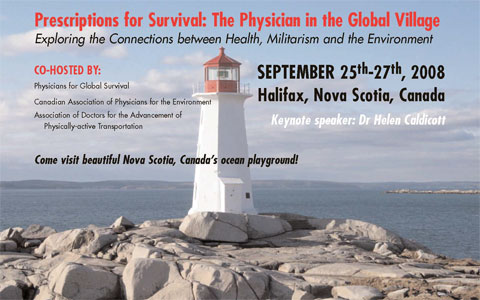
Objectives and specific outcomes:
- To offer reliable, unbiased, user-friendly information such that participants can appreciate the interconnections between major issues of environment and militarism and their effects on health.
- To support medical residents/students/fellows, our future physician leaders, and give them the tools they will need to communicate this knowledge to the broader public.
- To promote land-use planning and ‘built environments’ that support active, healthy lifestyles and improve community and environmental health.
- To renew public outrage that nuclear weapons are not only the ultimate weapon of war, but also can cause unfathomable environmental effects. Medical students are planning a “Target X” and soup kitchen campaign to coincide with this conference as a public awareness tool.
- To reconnect the larger medical community to the fact that nuclear weapons are a public health concern and hence draw attention to ways of nuclear war prevention.
- To recognize that climate change, sometimes described as a ‘threat multiplier’, is also a public health concern and look at ways of mitigating and adapting to these impacts.
- To produce, as a result of the conference activities, some ‘prescriptions for survival’ for future use, which will be in the form of a conference report summarizing the key learnings.
- To inspire and inform doctors and medical students to be more involved in their local communities and in the global village.
Contact Information
Andrea Levy, Physicians for Global Survival (Canada) national office
208-145 Spruce St., Ottawa, ON., K1R 6P1,
Phone: (613) 233-1982 Fax (613) 233-9028 Email: pgsadmin@web.ca
Nancy Covington, Halifax
Phone: (902) 479-3953 Email: nancy.covington@ns.sympatico.ca
Conference Web Site
Physicians for Global Survival (Canada) http://www.pgs.ca/

 Bimal Khadka
 Bjorn Hilt
 Charles K. Johnson
 Gunnar Westberg
 IPPNW
IPPNW John Loretz
 Lawrence Wittner
 Maria Valenti
 mollymcgint
 Sue Wareham
 Tilman Ruff
 Tim Wright
 Xanthe Hall


 IPPNW peace and health blog