Extended deterrence: Outdated, dangerous, wrong for Australia
Barack Obama has issued a massive challenge to the world.
It is a challenge to rid the world of its worst weapons of terror.. It is a challenge to banish one of humanity’s greatest fears– the threat posed by nuclear weapons.
President Obama’s chairing of the UN Security Council on nuclear disarmament and non-proliferation on September 24 served to focus the nuclear spotlight where it is most needed, on the Council’s five permanent members.
Between them – Russia, USA, France, China and the UK are responsible for all but a fraction of the world’s 26,000 nuclear weapons. The President spoke of the need for “new strategies and new approaches” to reach the goal of a world without nuclear weapons, with every nation playing a part.
Notwithstanding the enormous responsibility of the nuclear weapon states to get rid of their own weapons, the barriers to disarmament go further than just these nations, and far beyond the usual suspects such as Iran and North Korea.
That challenge includes Australia, and our subservience to an out-dated and dangerous Cold War policy that lives on. The policy is “extended deterrence”. Read more…
Note to Security Council: The conditions for a nuclear-weapons free world already exist
How do we “create the conditions” for a world without nuclear weapons?
The UN Security Council has resolved to do just that, at the urging of a nuclear superpower no less. SC1887, which lists a few concrete early steps toward the total elimination of nuclear weapons along with a lot of proposals related to proliferation, nuclear terrorism, and nuclear energy development, was adopted unanimously in the opening minutes of the special summit on nuclear non-proliferation and disarmament chaired by President Obama, who brought the US-drafted resolution to New York with him and deftly shepherded it through the process like the community organizer he remains at heart.

UN Security Council summit on nuclear disarmament. UN Photo/Mark Garten
While underscoring the difficulty of the task as he has whenever he has broached the subject, Obama said plainly that ridding the Earth of nuclear weapons is the responsibility of “a world that understands that no difference or division is worth destroying all that we have built and all that we love.” And he dug up yet another quote from that iconic abolitionist Ronald Reagan (because the post-Reykjavik Reagan is so quotable): “We must never stop at all until we see the day when nuclear arms have been banished from the face of the Earth.”
“That,” Obama said, “is our task.”
So as much as I want to believe we’re finally moving in the right direction, I’m still left wondering what conditions have to be created for the elimination of nuclear weapons that don’t already exist. Is it not enough, as President Obama himself said this morning, that a single nuclear weapon exploded in a major city would kill hundreds of thousands of people and “badly destabilize our security, our economies, and our very way of life?” Or that 100 bombs could kill tens of millions outright and damage the global climate so severely that a billion more would die from a nuclear famine? Or that 1,000 or more nuclear weapons —less than 5% of the world stockpile — could render the Earth itself unfit for life? Read more…
The Right Decision on Missile Defenses
The Obama administration’s decision to scrap plans for missile defense deployments in the Czech Republic and Poland is the first really substantial indication that changes in US nuclear policy are more than just rhetoric.
Abolitionists have been holding their breaths ever since January, wondering whether Obama would renounce a Bush administration priority that had been forced upon US allies, had met with significant domestic opposition, and had angered Russia to the point of threatening to hold further disarmament negotiations hostage.
Today’s answer comes as a relief, even though it was couched in somewhat ambiguous language about the possible development of a different kind of defensive system sometime in the future. I certainly would have been happier with an unequivocal repudiation of a scheme that traces its lineage back to the Star Wars fantasies of the Reagan years and has already wasted billions of dollars that could have been spent on more effective ways to prevent nuclear war. But I’ll gladly count this as one for our side (if all of humanity is a “side”). Read more…
Africa moves to halt the evolution of the Shaka spear into a nuclear warhead
By Dr. Walter Odhiambo – IPPNW Regional Vice President, Africa
Thirteen years after it officially opened for signature, the African Nuclear-Weapon-Free-Zone Treaty (Treaty of Pelindaba) finally came into force with the twenty-eighth deposit of its ratification instrument by Burundi on 15 July 2009. This is a major historical development applauded by the entire IPPNW fraternity and Africa region in particular. We congratulate the leaders of African States for this noble vision that sets the continent ahead in the right trajectory. A brief review of the history of conflicts in Africa will illustrate why this development is worthy of some jubilation.
“With passage of time and advancement in technology, weapons of war and violence have undergone unmatched metamorphosis. The discovery of the gunpowder marked a major but sad revolution, catapulting humanity to the age of firepower and replacing the traditional tools of war like swords, machetes and Shaka Zulu spears. These crude historical weapons had a limited range and were not as lethal as the gun.”
The above statement is an excerpt from an editorial I wrote in the December 2008 issue of The Annals of African Surgery entitled “The Burden of Firearm Injuries.” Shaka is the name of a fearless and ruthless Zulu warrior whose reign of terror in the Southern region of Africa is legendary. He lived at a time when man considered war the most popular, respectable and effective mode of settling disputes. Kings and Emperors attacked their neighbours simply for the purposes of expanding their Kingdoms or empires and to acquire the neighbour’s wealth and property. It was an era when, according to Chinua Achebe in “Things Fall Apart,” a man’s greatness was judged by “how many human heads he brought home from the battle field.” Read more…
IPPNW Interview: Homsuk Swomen and Ogebe Onazi
Medical students active with IPPNW’s Nigerian affiliate Society of Nigerian Doctors for the Welfare of Mankind (SNDWM) were inspired to create a radio show to promote peace. The program has been airing on Silverbird Rhythm FM broadcast from Jos, Nigeria. This interview is with Nigerian medical student leaders who helped develop and implement the program – Homsuk Swomen, national student representative of IPPNW Nigeria, and Ogebe Onazi, African co-regional student representative.

Homsuk Swomen, national student representative of IPPNW Nigeria with co-presenters
IPPNW: Why did you develop this radio program?
HS and OO: We were motivated to develop this program because of the recurrent violence that ravages Jos, a calm and peaceful city of middle belt Nigeria; sensitize the public on the health effect of guns and light weapons; and to advocate the need for tougher legislation on acquisition of small arms.
It was designed to influence the minds of our listening audience and the wider public on the need to practice peace. The media (that is, newspapers, radio and television) has had an incredible influence on the minds of people and the quality of livelihood across the entire world over many decades. This informed our decision to go upstream and use the radio as a means to disseminate relevant and worthwhile research-based health information that may help check the spread of violence and small arms in Nigerian society, particularly with Jos as the reference point.
IPPNW: Have you experienced any types of violence in your personal lives or in your communities?
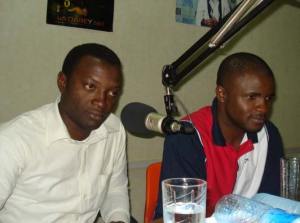
International medical student representative, Agyeno Ehase on left with radio show co-organizer, Onazi Ogebe.
OO: I have experienced violence personally and in my community. I remember an experience I had in my pre-clinical period when I was attacked at gun point on my way to my off-campus house and was subsequently robbed. And also, in the Jos community of Nigeria, we witnessed an ethno-politically engineered violence that left many injured, homeless and dead in recent times (28th November, 2008).
HS; yes! In my hometown Yelwa-Shendam, there was massive destruction of lives and property in 2004 which caused violence in neighbouring Kano state. I was living in fear during the last violence in November 2008 because my neighbourhood in Jos had a 50/50 religious population waiting to fight at the slightest provocation. It affected my state of mind. I witnessed the violence in September 2001 also as human beings were roasted and axed before my eyes.
IPPNW: What expertise as medical students do you bring to this issue? Read more…
A Giant Passes: Senator Edward M. Kennedy – 1932-2009
As the eulogies for United States Senator Ted Kennedy start to pour in following his death last night, we will be reminded what a tireless and effective champion he was for people’s health, for education, for the rights of working people, for immigrants’ rights, and for peace and social justice across the board, not only in the US but around the world.
He was all those things and more. In particular, he was an ardent and unwavering supporter of nuclear disarmament. In 1982, when the fear of a nuclear war between the US and the Soviet Union was the world’s nightmare, Kennedy and Senator Mark Hatfield sponsored the Nuclear Freeze amendment. The goal of the Freeze was to get the two nuclear superpowers to stop the relentless, massive buildup of their arsenals and to start disarmament negotiations. The legislation itself did not make it through the Senate (the US House passed its own version of the Freeze that year), but the Freeze concept galvanized a public movement to renounce nuclear weapons that claimed Ted Kennedy as a political leader.
Although he devoted himself primarily to other vital issues later in his Senate career, Kennedy’s voice and his vote on nuclear disarmament were always there when it counted. He led the fight for ratification of the Comprehensive Test Ban Treaty in 1998, and when the Senate rejected the CTBT he worked just as hard to support a moratorium on nuclear testing not only in the US but also worldwide. In 2002, he rejected the Bush administration’s false claims that Saddam Hussein was building nuclear weapons and stockpiling other weapons of mass destruction, and was one of 23 Senators who had the courage to vote against the Senate resolution authorizing the war against Iraq.
When the Bush/Cheney administration pulled out all the stops to get Congressional funding for low-yield nuclear weapons, Kennedy didn’t mince any words. Here’s what he said in May 2003, at a decisive moment in the debate about so-called mini-nukes:
This issue is as clear as any issue ever gets. You’re either for nuclear war, or you’re not. Either you want to make it easier to start using nuclear weapons, or you don’t.
“Our conventional weapons already have vast power and accuracy, and we can make them even more powerful. No one at the Pentagon and no one in the Administration has given us any example — none at all — of a case where a smaller nuclear weapon is needed to do what a conventional weapon can’t do.
“For half a century, our policy has been to do everything we possibly can to prevent nuclear war. And so far, we’ve succeeded.
“The hard-liners say things are different today. A nuclear war won’t be so bad if we just make the nukes a little smaller. We’ll call them mini-nukes. They’re not real nukes. A little nuclear war’s O.K.
“That’s nonsense. Nuclear war is nuclear war is nuclear war. We don’t want it anywhere, anytime, anyplace.
“Make no mistake. A mini-nuke is still a nuke.
“Is half a Hiroshima O.K.? Is a quarter of a Hiroshima O.K.? It’s a little mushroom cloud O.K.? That’s absurd.
“This issue is too important. If we build it, we’ll use it. No Congress should be the Congress that says, ‘Let’s start down this street,’ when it’s a one-way street that can lead only to nuclear war.”
Kennedy was on the winning side of that vote, and the world is better for it.
The best way to honor the memory of a person who brought this much passion and commitment to improving the quality of our lives – in the case of nuclear disarmament, to ensuring our very survival – is to complete the task he stayed with for some 30 years. If we could not abolish nuclear weapons in Ted Kennedy’s lifetime, let’s make sure we do it before another generation passes.
Halfway to a nuclear-weapons-free world?
On July 15 the entire Southern Hemisphere became a nuclear-weapons-free zone (NWFZ). That’s when the Pelindaba Treaty entered into force, obliging all African states to renounce nuclear weapons and to refrain from acquiring them, and prohibiting the nuclear weapon states from stationing them anywhere on the continent. All 52 African states have signed the Treaty (it opened for signature in 1996), and last month Burundi became the 28th country to ratify – the magic number for entry into force.
 Pelindaba now joins the Treaty of Tlatelolco (South America), the Treaty of Rarotonga (South Pacific), the Treaty of Bangkok (Southeast Asia), and the Antarctic Treaty in banning nuclear weapons south of the equator. Even better, most of Africa is north of the equator. So are substantial geographic areas covered by nuclear-weapons-free zones in Central Asia and Mongolia. In all, 114 countries – 60% of the world – have now banned nuclear weapons from their territories as a matter of international law.
That’s not a bad start.
One of the criticisms of NWFZ treaties is that they are largely symbolic – that the nuclear-weapon states will station and transport weapons wherever they want (especially on submarines) and that no treaty will protect the parties from the effects of a nuclear war between non-parties. The latter point is certainly correct, as the nuclear winter studies and more recent findings about the global climate effects of regional nuclear wars have made painfully clear.
It’s worth pointing out, however, that some nuclear-weapons states – including the two largest – have signed and ratified additional protocols to some of the NWFZ treaties and are being pressed to commit themselves to the terms of all of them. That may be symbolism, but it’s symbolism with the weight of international law behind it.
The texts of all the NWFZ treaties, lists of members, and other useful information for anyone wanting to learn more about the role of these zones in helping to achieve a nuclear-weapons-free world can be found at the James Martin Center for Nonproliferation Studies.
The Strategic Value of Remembering
 I visited Hiroshima and Nagasaki for the first time some 40 years after reading John Hersey’s account of the US atomic bombing of Hiroshima as a teenager growing up on Long Island during the early years of the Cold War. Thinking about what I might write this morning—the 64th anniversary of the world’s horrifying introduction to nuclear weapons—I opened my fragile old copy of Hersey’s book at random and came upon this description:
Mr. Tanimoto, fearful for his family and church, at first ran toward them by the shortest route, along Koi Highway. He was the only person making his way into the city; he met hundreds and hundreds who were fleeing, and every one of them seemed to be hurt in some way. The eyebrows of some were burned off and skin hung from their faces and hands. Others, because of pain, held their arms up as if carrying something in both hands. Some were vomiting as they walked. Many were naked or in shreds of clothing. On some undressed bodies, the burns had made patterns—of undershirt straps and suspenders and, on the skin of some women (since white repelled the heat from the bomb and dark clothes absorbed it and conducted it to the skin), the shapes of flowers they had had on their kimonos. Many, although injured themselves, supported relatives who were worse off. Almost all had their heads bowed, looked straight ahead, were silent, and showed no expression whatever.” *
 On a sweltering August day in 2005, the only physical evidence of the Hiroshima bombing was the A-bomb Dome—the twisted and bizarre wreckage of the former Industrial Promotion Hall, which had sustained overpressures of 35 tons per square meter, about 100 meters from the hypocenter of the explosion. Seeing the dome for the first time is a shock for which photos and film clips cannot prepare one. It’s grotesque, but strangely beautiful, like the mushroom cloud itself.
I’d heard that a kind of identity fatigue was starting to set in among younger people in Hiroshima and Nagasaki—they understood the unique place of their cities in history, but no longer wanted to be defined by events so distant from their experience and their hopes. I saw a small example of this during a visit to the Nagasaki Peace Museum a few days later. Two teenage girls, looking at a diorama of injured people fleeing from the fires ignited by the Nagasaki bomb, pointed at a model of a man whose flesh was dripping from his arm and started to giggle. They had undoubtedly seen more “realistic” images in video games. But they kept looking, and the meaning of what they were seeing began to register on their faces. By the time they moved on, mockery had been replaced by something a lot more thoughtful. These images, as far removed in time as they are from most of our personal memories, still have the power to move us. Read more…
Apollo or Extinction
by Tad Daley
On December 31st, 1999, National Public Radio interviewed the futurist and science fiction genius Arthur C. Clarke. Since the author had forecast so many of the 20th Century’s most fundamental developments, the NPR correspondent asked Clarke if anything had happened in the preceding 100 years that he never could have anticipated. “Yes, absolutely,” Clarke replied, without a moment’s hesitation. “The one thing I never would have expected is that, after centuries of wonder and imagination and aspiration, we would have gone to the moon … and then stopped.”
Were Clarke alive today, he undoubtedly would have added, “and then lost so much interest that we erased the tapes of our epochal voyage because of a shortage of blank cassettes.”
This month, the 40th anniversary of Buzz Aldrin and Neil Armstrong’s first footsteps on the moon, you will hear many rationales for sending humans into space, many noble goals that the challenge of space can help humanity to fulfill. However, in cosmological consequence, one, and only one, stands paramount above all others — human immortality. Space is the only place where we can ensure ourselves against extinction. Read more…
Nuclear Deterrence in the 21st Century: Getting It Wrong
Admiral Halsey notified me
He had to have a berth or he couldn’t get to sea.
I had another look and I had a cup of tea and a butter pie.
I always liked that song. A little bit of Beatlesque story telling, presumably floating out of Paul McCartney’s hash pipe. I always assumed if there was an Admiral Halsey, he was simply a character in a pop song, like Father McKenzie or the pretty nurse selling poppies on Penny Lane.
Then I came across his name in the first volume of Larry Wittner’s authoritative history of the nuclear disarmament movement [1], and learned that British Admiral William Halsey had publicly criticized the use of the atomic bomb against Japan a little more than a year after the event, only to be pilloried by the US State Department and Navy Secretary James Forrestal. Bernard Baruch, Wittner tells us, lashed out at Halsey for “putting America in the wrong on moral grounds in the eyes of the world.”
These were people who were determined to build as many bombs as possible, as fast as possible, and to ensure a US nuclear monopoly for as long as possible. Real paragons of morality. A little more than 60 years later, those advocating a nuclear-weapons-free world find themselves vilified by some intellectual heirs of the first bomb enthusiasts—a disgruntled collection of neocons in exile, including the likes of Frank Gaffney, Henry Cooper, and Troy Wade [2]. Unlike 60 years ago, however, one of the main objects of the nuclear priesthood’s ire happens to be the President of the United States.
Calling themselves the New Deterrent Working Group, they have published a white paper that recycles one old and bankrupt argument after another for retaining and modernizing the US nuclear arsenal [3]. I’m about as ardent a recycler as you can find, and even I understand that certain things just need to go into the trash or, like toxic waste, be permanently isolated from the environment. This paper is one of those things. Read more…

 Bimal Khadka
 Bjorn Hilt
 Charles K. Johnson
 Gunnar Westberg
 IPPNW
IPPNW John Loretz
 Lawrence Wittner
 Maria Valenti
 mollymcgint
 Sue Wareham
 Tilman Ruff
 Tim Wright
 Xanthe Hall


 IPPNW peace and health blog