A Nigerian doctor’s first experience at the ATT PrepCom
by Hakeem Ayinde, MD
Up until one year ago, I worked with the Nigeria Police Force as a medical officer, giving care to police, their families and jail inmates. We treated many policemen who were wounded in the line of duty. In many cases, they were wounded by heavy guns and I often wondered how the criminals got those guns. It was frustrating to feel as though I could not do anything about it. Knowing I could add my medical voice and act as an advocate for my patients led me to join IPPNW. Participating in the Arms Trade Treaty (ATT) Preparatory Committee (PrepCom) meeting was my first experience with IPPNW`s Aiming For Prevention campaign. Read more…
By Shannon Gearhart, MD and Hakeem Ayinde, MD

US Ambassador Donald Mahley (on left) discussing the public health role health professionals can provide in the reporting and monitoring of arms activity.
Today, we welcomed Kathryn Hawk, an ER resident from Yale University who has been an active member of PSR since medical school in Philadelphia. She joined other attendees including:
● Robert Mtonga, M.D., official delegate of the Zambian delegation, IPPNW Co-president and medical director of the International Action Network on Small Arms (IANSA) Public Health Network;
● Donald Mellman, M.D., a neurosurgeon from Florida and IPPNW local leader;
● Cathy Falvo, M.D., former PSR-US board member and pediatrician;
●Maria Valenti, IPPNW Aiming for Prevention coordinator;
● Garrett FitzGerald, IPPNW Development Associate;
● Shannon Gearhart, M.D., preventive medicine resident at Mount Sinai School of Medicine;
● Omolade Oladejo, M.D., medical officer for the Nigerian Ministry of Defense;
● Gurshaant Singh, M.D. academic advisor, Monash Univeristy, Melbourne;
● Hakeem Ayinde, M.D., former medical officer with the Nigeria Police medical department
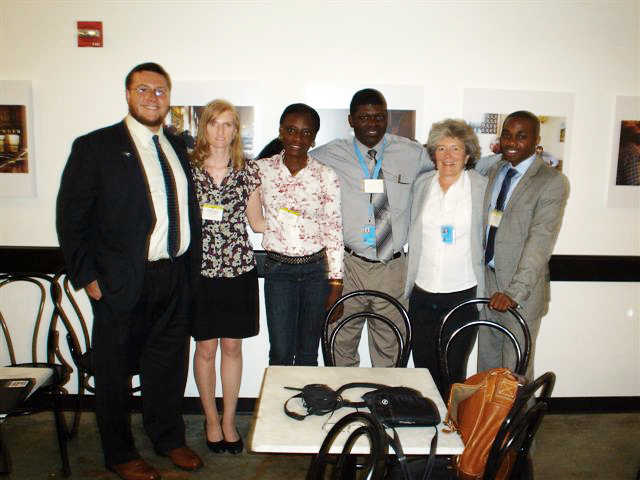 In the morning, several attendees met with US Ambassador Donald Mahley. During the informal meeting we discussed the public health role health professionals can provide in the reporting and monitoring of arms activity. According to Ambassador Mahley, collection of public health data on small arms activity, such as ED admissions of gun shot wounds, is currently sporadic and unorganized. However, the government believes in the use of data on the influx of weapons as an indicator of the amount of illicit trade.
IPPNW Health Panel at ATT Prepcom, United Nations
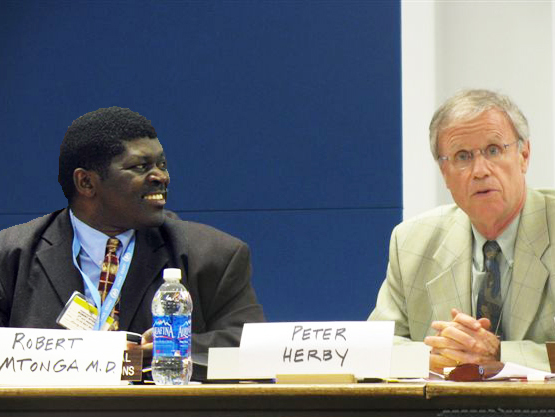
Dr. Robert Mtonga (left) panel moderator and IPPNW Co-president, and Peter Herby, Head, Arms Unit, Legal Division, International Committee of the Red Cross (ICRC) during IPPNW's side panel at the Arms Trade Treaty.
July 11, United Nations, New York City –– IPPNW organized and presented a panel of distinguished speakers to address “Implementing a Robust ATT: The Role of Health, Development, Women” at a side event to the 3rd PrepCom for the Arms Trade Treaty (ATT) at the United Nations in New York City. The panel was sponsored by the Mission of Zambia to the UN and was very well received by a standing room only crowd of over 75 attendees that included state delegates including a member of the US delegation, NGOs and representatives of UN and other agencies.
The session was led off by IPPNW’s co-president Robert Mtonga MD from Zambia, who also serves as Medical Director of the International Action Network on Small Arms (IANSA) Public Health Network, and is on the official Zambian delegation for the PrepCom. He set the stage by explaining that the goal of the forum was to provide practical suggestions on how to help support the implementation of a humanitarian-based ATT, with a special emphasis on how public health will both benefit from, and can contribute to, its success.
Read more…
ICAN-Africa launched in Livingstone
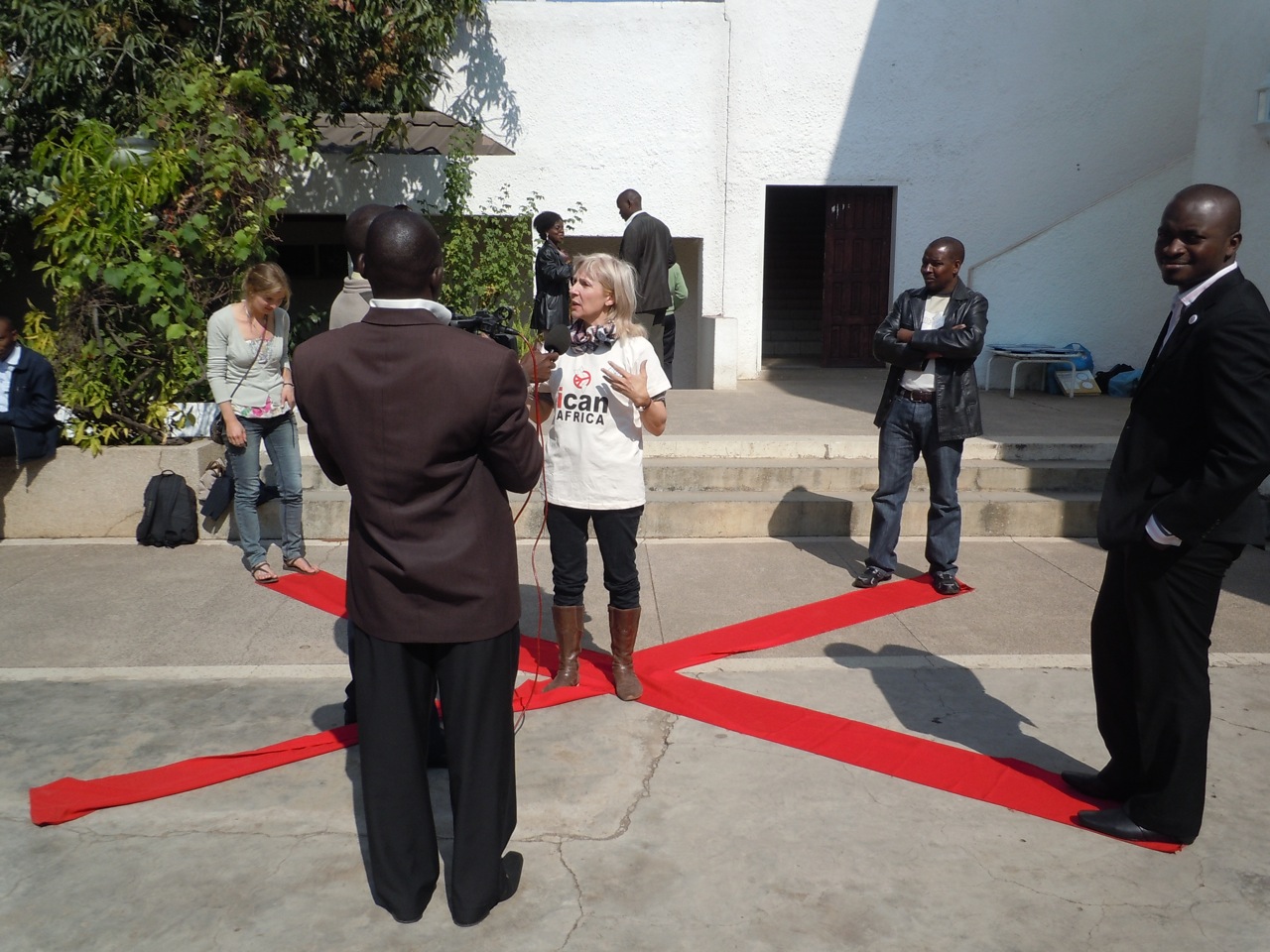
Senior ICAN campaigner Arielle Denis encourages participants at IPPNW's African Regional Meeting to work for a nuclear weapons convention during a Target X event in Livingstone, Zambia.
ICAN-Africa was launched at the 6th African Regional Safe Communities Conference in Livingstone, Zambia, during the week of July 4. Senior campaigner Arielle Denis joined IPPNW’s African leaders and representatives from the World Health Organization, the University of South Africa, Mozambique University, the Zambian Ministry of Health, and the Zambian Road Traffic Safety Agency to discuss the ways in which the nuclear abolition issue presents itself in the larger context of armed violence, human rights, and development in Africa, and to draft a campaign plan that can engage civil society groups and governments in the region to work for a Nuclear Weapons Convention.
The Safe Communities Conference itself, chaired by IPPNW Co-president Robert Mtonga, addressed a broad range of safety and security problems including landmines, domestic injuries, interpersonal violence, deaths and injuries from small arms and light weapons, and even traffic injuries, which are a growing problem in African countries. The conference drew more than 80 researchers, physicians, NGO representatives, and officials from the WHO and governments. Read more…
The people responsible for managing US cities—the ones elected to keep the schools open, to maintain roads and bridges, to ensure public health and safety, and to advocate for the needs of their communities—sent a message to the rest of the country this week about the costs of war and preparing for war. The message, contained in two resolutions adopted by the US Conference of Mayors, was that the wars in Iraq and Afghanistan have to end, that the US needs to lead the way in ridding the world of nuclear weapons, and that the hundreds of billions of dollars now being lost to these misplaced national spending priorities should be redirected “to meet vital human needs” at home.
The resolution on military spending noted a couple of obvious facts: that the wars started by President Bush and continued by President Obama are costing about $126 billion a year and that more than 6,000 American soldiers have died in Iraq and Afghanistan. The mayors went a step further, pointing out in the same sentence that at least 120,000 civilians have been killed in those countries since these wars began. Americans don’t hear that fact often enough.
The nuclear disarmament resolution reproves the Obama administration for its plan to spend $185 billion on nuclear weapons modernization and infrastructure programs between now and 2020—amounts even greater than the Reagan administration spent on nuclear weapons at the height of the Cold War. The mayors called for a halt to this spending and urged the administration, instead, to work for the implementation of UN Secretary-General Ban Ki-Moon’s five-point plan for global nuclear disarmament, including the completion of a nuclear weapons convention by 2020. In strong contrast with those Americans who take an isolationist attitude, the US mayors spoke proudly of their participation in Mayors for Peace and aligned themselves with their colleagues in 4,700 cities and 150 countries who have declared that “cities are not targets” of nuclear weapons and have set their sights on a world free of nuclear weapons by 2020.
The contrast between two visions of where the world will stand in 2020—ramped up to produce, maintain, and endanger all of us with nuclear weapons for the rest of the 21st century; or free of a catastrophic threat to human survival that only exists because we allow it to exist—could not be starker. Both these resolutions reflect a growing sense of interconnectedness among municipal leaders in many countries who face similar challenges, are increasingly making common cause with each other across national boundaries, and know from experience that every dollar spent on war and the weapons of war is a dollar that cannot be spent, in the mayors’ own words, “to meet vital human needs, promote job creation, rebuild our infrastructure, aid municipal and state governments, and develop a new economy based upon renewable, sustainable energy and reduce the federal debt.”
The mayors may have gotten through to President Obama, who announced an accelerated schedule for troop withdrawals from Afghanistan a few days later, echoing what the country’s municipal leaders had said about the need to redirect national spending priorities. Let’s hope he heard them about nuclear weapons, as well.
IPPNW, which launched the International Campaign to Abolish Nuclear Weapons (ICAN) in 2007, and Mayors For Peace, whose Cities Are Not Targets campaign is part of the 2020 Appeal for a nuclear-weapons-free world, work collaboratively to build public and governmental support for a nuclear weapons convention.
USA and Iran: Pride and Prejudice
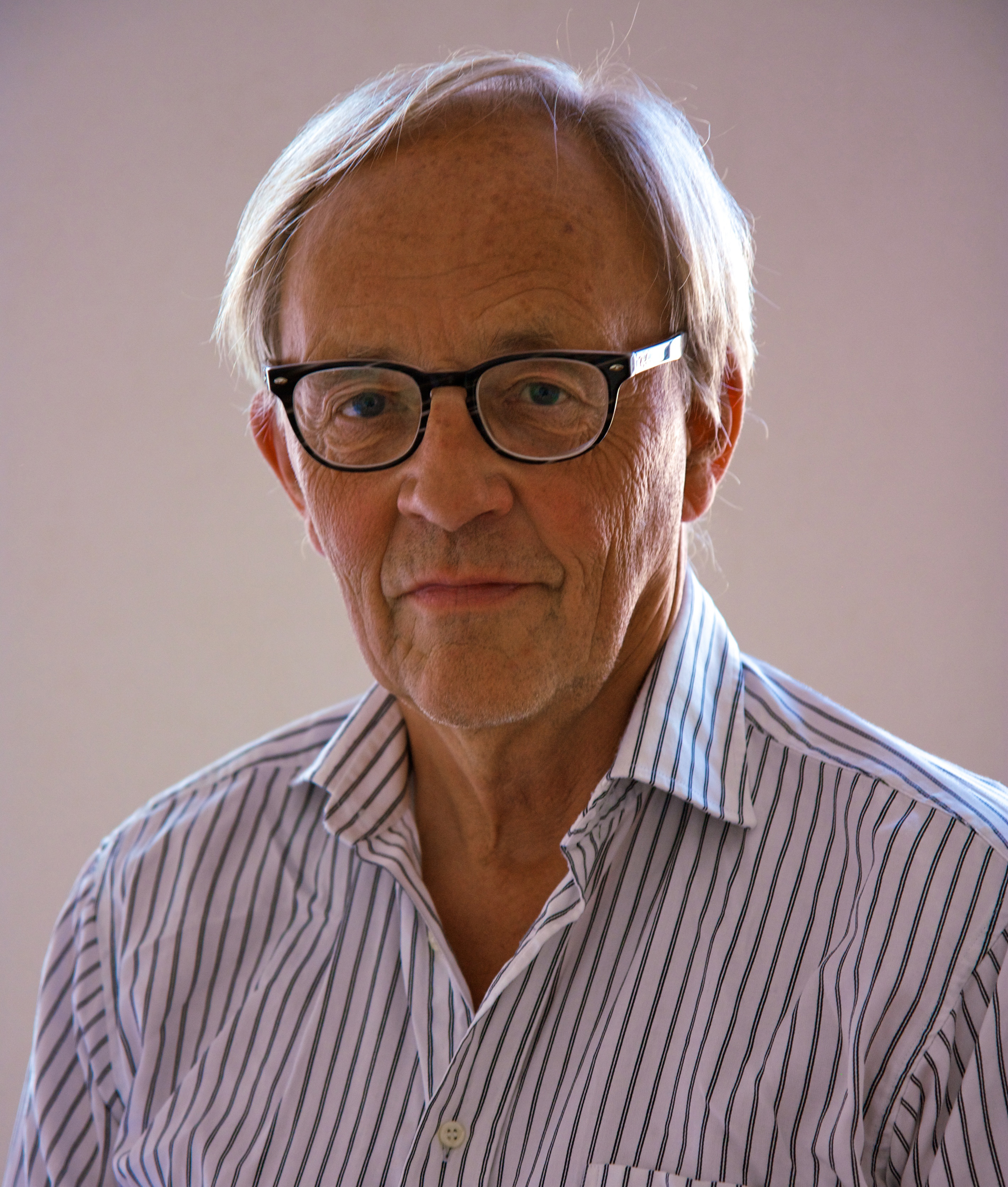
Gunnar Westberg
The most frequent question to me during my three visits to Iran was: How can we convince the West that our country is not going to produce nuclear weapons? The question I hear in Europe and USA is: When will Iran have nuclear weapons? There seems to be a need for a dialogue. No one wants a war. It might still happen and may escalate into a nuclear genocide.
Why does Iran have a nuclear program? The country has enormous reserves of oil and gas. Why then nuclear power? During the sixties and seventies, the time of the Shah, the reason was probably first of all a part of the “Westernization” of the country. After the Islamic revolution in 1979 it became a symbol of the nation’s independence and defiance against foreign pressure. Read more…
How to save $100 billion per year
Bruce Blair of Global Zero has just provided a long-needed estimate of global nuclear weapons spending. We’ve known the US numbers for many years, thanks to Stephen Schwartz’s Atomic Audit and groups such as the Natural Resources Defense Council and The Western States Legal Foundation. The former has documented some $6 trillion in US spending on nuclear weapons and their infrastructure since 1946; while WSLF estimates that more than $200 billion has been budgeted over the next decade to modernize the US arsenal.
Comparable figures for the other nuclear-weapon states have always been hard to find. According to Blair’s new estimates, the nine nuclear-weapon states—China, France, India, Israel, North Korea, Pakistan, Russia, the United Kingdom and the United States—plan to spend $1 trillion over the next 10 years to acquire new weapons and to update their systems. They will spend $100 billion in this year alone. Blair says that is “more spending on nuclear weapons than at any time since the Cold War.”
We’re often told that nuclear weapons spending is only a fraction of total military spending, but the fraction for these nine countries turns out to be 9 percent on average. That’s pretty substantial, considering the way nearly all of their governments are using the sorry state of the global economy as an excuse to slash spending on education, social services, environmental protection, health care programs, and everything else that people depend on for a decent quality of life.
What this means is that a nuclear weapons convention is good economic policy in addition to all the other reasons it makes sense.
Prof. Ulrich Gottstein, a leader of IPPNW-Germany and an elder statesman of the international physicians movement to prevent war and to abolish nuclear weapons, was awarded the Paracelsus Medal—the highest honor given by the German medical profession—on May 31, 2011. The first recipient of the medal was Albert Schweitzer, in 1952.
His friends and colleagues throughout the IPPNW federation congratulate Dr. Gottstein and thank him for his dedication and leadership. Following are his remarks upon receiving the award.
—
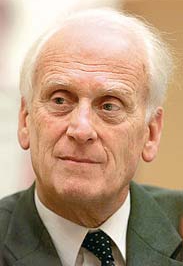 Honourable President Prof. Hoppe, respected members of the board of the German Medical Association, colleagues, ladies and gentlemen,
After having been honoured by being awarded the Paracelsus medal, I would like to express my particular thanks and also sorrows on this day, which is so important for all of us.. What is it that moves me especially and probably many of you too?: There are wars and terrorism every day, the climate crisis endangers our planet, the man made destruction of our environment is to be observed year by year, and there are the increasing risks through nuclear weapons and nuclear power plants. Read more…
Day two in Tehran
Second day.
I woke up with PressTV, and the first thing I saw was my own face in an interview. In response to the question “can nuclear weapons really be abolished” I answered the usual things such as “We must abolish them before they abolish us” etc. They must have liked it as they asked me for a second interview today, and so did a couple of other TV companies. So hopefully I gave some arguments to those in the country who do not want nuclear weapons – at this time probably a great majority. I have not been able to record this video. Read more…
Taking an opportunity to speak in Tehran
Second International Conference on Disarmament and Non-Proliferation
Tehran June 12-13
Arranged by the Institute for International and Policy Studies
Participation: Representatives of a number (20?) Islamic states and Non-aligned states, Russia, Venezuela a s o. Not China, no EU country.
NGOs: Pugwash, BASIC, Danish Institute for International Studies a s o.
In all maybe 100 persons plus journalists in the morning, somewhat decreasing during the day
First Day
The format was smaller than last year., and less prestigious. Last year the President and the Supreme Leader spoke, this year the Minister of Foreign Affairs was highest ranking. Still there were at least 20 TV-cameras and even more reporters. These gradually left during the morning. I was interviewed by three TV-channels and a number of radio stations and a couple of news agencies, fewer than last year. Many questions were about Iran’s right to nuclear energy and the injustice that Israel was not criticized for having nuclear weapons or for bombing Syria, US not censored for not reporting to IAEA about the alleged Syrian reactor a s o. Read more…

 Bimal Khadka
 Bjorn Hilt
 Charles K. Johnson
 Gunnar Westberg
 IPPNW
IPPNW John Loretz
 Lawrence Wittner
 Maria Valenti
 mollymcgint
 Sue Wareham
 Tilman Ruff
 Tim Wright
 Xanthe Hall


 IPPNW peace and health blog