“The Path to Zero: Dialogues on Nuclear Dangers”
 About a third of the way through The Path to Zero, David Krieger, one of the authors, suggests a Zen koan — a mind-bending riddle designed to foster enlightenment — that runs as follows: “What casts a dark shadow when dormant and a fiery cloud of death when brought to life?” The answer is nuclear weapons, the subject of this book.
It is certainly a crucial subject. The contradiction between the potential of nuclear weapons to destroy the world and the determination of nations to possess them is a central dilemma of modern times. More than sixty-seven years after U.S. atomic bombs killed much of the population of two Japanese cities, some 20,000 nuclear weapons — thousands of them on alert — remain housed in the arsenals of nine countries. Read more…
The sad legacy of nuclear testing

The city of Astana has something of “Truman’s World.” Everything glitters and shines, is modern, a show world. You get the feeling that people were put here to be seen by us. The most famous architects of the world strut their stuff on every corner. Looking out from the bar on the 25th floor of the Beijing Palace Hotel Astana one is overwhelmed by the panorama of this new, modern Kazakhstan.
Behind it is the steppe. A flat grassland that extends in all directions as far as you can see. In winter it is cold, colder than most of us can imagine. I ask “how cold?” My Kazakh companion smiles and replies: “Don’t ask, it is very cold.” But the sun is shining now, reflected from the many white surfaces and tinted windows of skyscrapers. It dazzles. Read more…
Graduating from war culture to peace culture
By Mathias Pollock
Peace culture – a novel concept introduced today at the IPPNW Student Congress. Not a culture of peace, a culture defined by peace. Inspiring words today from keynote speaker Steve Leeper, the chairman of the Hiroshima Peace foundation. His message was not that this is something we need to aspire to; rather it’s something we can no longer afford not to attain. We need to graduate from the war culture, the dominance hierarchy that we live in, to peace culture. We need to evolve as a global society. Read more…
20th World Congress: From Hiroshima to Future Generations
Hiroshima, Japan
24 August 2012
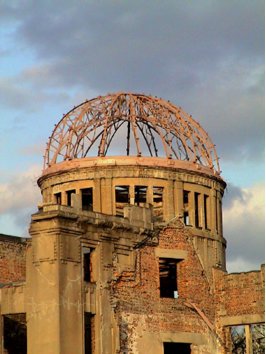
The A-Bomb Dome in Hiroshima
On the historic occasion of IPPNW’s 20th World Congress, we are witnessing a sea change in global demand for a world free of nuclear weapons and free of the threat they pose to human survival. An emergent movement focused on the catastrophic humanitarian consequences of nuclear weapons is bringing States and civil society together as partners in working for a global treaty to ban and eliminate the most abhorrent weapons ever created.
We are equally encouraged by the growing demand for action to arrest the global crisis of armed violence that kills hundreds of thousands of people and maims millions more every year in countries around the world. The prevention of war is a public health imperative that extends from the carnage inflicted by small arms and light weapons to the extinction of humanity itself in a nuclear war. These signs of change are cause for hope that the international community can create a healthier, more peaceful future, where human security is based upon mutual respect and cooperation rather than the force of arms. Read more…
A walk through Hiroshima
By Mathias Pollock
As I sat reading John Hersey’s recounting of individual experiences in his book Hiroshima on the transpacific flight, I was struck by how much the event sounded like a natural disaster. It was a horrible event that devastated an innocent civilian population. But unlike tsunamis, floods, earthquakes and hurricanes, this wasn’t unfortunate chance- this was preventable. Read more…
Hiroshima a living symbol of world we must protect
By Ira Helfand
Walking from the Hiroshima bus station to the Conference Center, the path goes directly past the A-Bomb Dome and the hypocenter, the point directly beneath the where the bomb went off. Ground Zero. It is a little after 8 AM on a hot August morning, so like that other August morning 67 years ago. I keep looking up at the sky as so many thousands of people did that other morning, and I imagine the sudden bright flash that was the last thing they ever saw. Read more…
Medical/humanitarian focus at heart of ICAN
By Ira Helfand
ICAN meeting began this morning. Extraordinarily exciting presentation of the progress ICAN has made to date. In just 5 years since its inception, the campaign has succeeded in making a Nuclear Weapons Convention a mainstream issue throughout the world (if not yet here in the US…).
In 2010, for the first time, a call for a nuclear weapons convention was included in the summary statement issued by the Non Proliferation Treaty (NPT) Review Conference. Now, just 2 years later, 147 nations support a nuclear weapons convention according to the Norwegian Foreign Ministry.
While the campaign now includes organizations beyond IPPNW, the medical/humanitarian focus which PSR and IPPNW bring to this movement remains the heart of its message. At the NPT prep conference in Vienna this May 16 nations issued a joint statement calling for the humanitarian consequence of nuclear war to be the central consideration in international negotiations about nuclear weapons. The Norwegian government is convening an international conference on the humanitarian consequences of nuclear war March 4 and 5 2013 which it hopes will reframe the debate about nuclear weapons and lead to a nuclear weapons convention.
Arriving in Hiroshima for the 20th World Congress
[IPPNW’s 20th World Congress opens in Hiroshima, Japan on August 24. A number of people will be blogging from the Congress, including members of the US affiliate, Physicians for Social Responsibility. Those pieces will be published on the PSR blog and reposted here.]
By Andy Kanter
It seems a little strange returning to Japan after 23 years. I attended the Ninth World Congress of IPPNW which was held in Hiroshima and Nagasaki in 1989. I was a medical student at the time. I had been Medical Student Liaison for IPPNW in 1985 when we won the Nobel Peace Prize, but it had been several years since I left the central office and was nearing the end of my medical school training. IPPNW still meant a lot to me and I endeavored to make the protection of the planet one of my primary goals in life. Since graduating from medical school and traveling the world, I have returned to the US and have been working to achieve the Millennium Development Goals at the Earth Institute, and have continued with my advocacy work with PSR in Chicago and currently New York City. Now, as current President of Physicians for Social Responsibility, I return to Japan and the 20th World Congress of IPPNW!
In some ways the world is very different now. There are even more threats to our very existence. In our highly integrated and interdependent ecosystem, we continue to threaten everything with nuclear extinction. But now we can add climate change, toxic degradation and even nuclear famine to the list of ills that we must solve if we are to survive. I return to Japan with the toxic legacy of Fukushima still smoldering to the northeast. Its radioactive poisons will leech out for decades to come. And I return to Japan as a new father, contemplating the future not only of the Japanese people, but the future of everyone including my son. The situation seems very bleak and the future dark. But I have hope, and believe that we will come together to turn things around.
World Congresses are an important time to come together and take stock of the situation, revitalize ourselves and gain strength from the common bonds which bring together our global community of IPPNW affiliates. We have a busy week planned, with a meeting of the ICAN movement on Tuesday, followed by the medical student congress on Wednesday and Thursday and the full congress on Friday through Sunday. On Friday afternoon, I will be giving a workshop with PSR President-Elect, Jeff Patterson and PSR Board member, Ed Ifft on a critical review of the nuclear-industrial complex by looking at the 3 poisonous “P’s” (Pollution, Proliferation, and Price) of the nuclear age. Following the Congress, several PSR members, including myself, will be traveling to Tokyo to take part in a side-meeting on the Fukushima Daiichi situation.
I am excited to see old friends, learn new skills, and help to add new energy which will help catalyze a fundamental shift in our planet’s history. Stay tuned for more from Hiroshima and Japan.
by Bob Mtonga, MD, Shannon Gearhart, MD, Don Mellman, MD
The ATT discussion collapsed in the mid-afternoon of July 27, the final day, when the US delegation head, Tom Countryman, announced the US needed “more time” to study the treaty. Then Russia, the Democratic People’s Republic of Korea (North Korea), and Canada followed with similar statements. According to Jeff Abramson, director of the Control Arms secretariat, the president of the ATT negotiations conference Ambassador Moritan reportedly had the promise of the ATT skeptics (i.e. DPRK, Cuba, etc.) to not block the passage and thus was “furious” (Jeff’s word) at the US. The reason(s) for the US final position remain unclear but media reports suggest it could be pressure from the NRA and/or the appearance of weakness in foreign affairs in this election year. We still need to learn more from them and their public answers are insufficient. (I am on multiple US State Department list serves and have copied and pasted its 07/28/2012 press release re the ATT below. – dlm) Read more…
Note from Maria Valenti: IPPNW Austria and Zambia have teamed up on a Victim Assistance Pilot Clinic project in Lusaka, Zambia. This blog reports on the training day for medical students organized and conducted by Drs. Michael Schober and Stephanie Hametner, IPPNW Austrian physician leaders of the project. Dr. Bob Mtonga is the Zambia investigator on the project.
by Barbara Larcher, medical student, IPPNW Austria
Preparation Day – Linz, Austria
Sunday, 8 July, 9.15 o clock in front of the train station in Linz: a group of medical students from Vienna, Graz and Innsbruck meet. Very few know each other beforehand, but the ice is broken quickly – after all, we all share the same goal: the participation in the Victim Assistance Pilot Project of IPPNW Austria/Zambia in Lusaka, Zambia. Read more…

 Bimal Khadka
 Bjorn Hilt
 Charles K. Johnson
 Gunnar Westberg
 IPPNW
IPPNW John Loretz
 Lawrence Wittner
 Maria Valenti
 mollymcgint
 Sue Wareham
 Tilman Ruff
 Tim Wright
 Xanthe Hall


 IPPNW peace and health blog