“Each of us is responsible”
Civil society statement to the UN high-level meeting on nuclear disarmament
Delivered by Joseph Gerson of the American Friends Service Committee on behalf of civil society
26 September 2013, New York
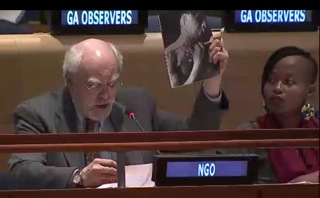
Joseph Gerson follows Nosizwe Baqwa (right) as a civil society speaker at the High Level Meeting
I want to begin by invoking the words of Yamaguchi Senji, one of the most seared and courageous Nagasaki A-bomb survivors, who passed away this summer. Speaking to the Second Special Session on Disarmament thirty-one years ago, he said:
Look at my face and hands. We should never allow people in the world or succeeding generations to suffer deaths and agonies from nuclear war as we, the Hibakusha, have done.
We appeal that now is the time for the UN to draw a comprehensive disarmament program with a specific timetable and with a ban on nuclear weapons as its toppriority, and do its utmost to uproot the crisis of nuclear war.” Read more…
“It is time we ban nuclear weapons”
Civil society statement to the UN high-level meeting on nuclear disarmament
Delivered by Nosizwe Lise Baqwa of the International Campaign to Abolish Nuclear Weapons (ICAN) on behalf of civil society
26 September 2013, New York
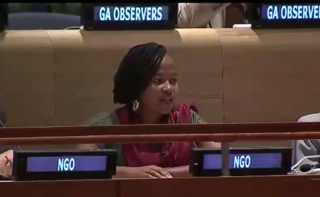
Nosizwe Lise Baqwa addresses the High Level Meeting
The use of a nuclear weapon on a major populated area would immediately kill tens if not hundreds of thousands of people—women, men, and children.
Hundreds of thousands more would be alive—but severely injured. Blinded, burned, crushed. The immediate effects of even a single nuclear weapon are shocking and overwhelming. Its destructive force capable of nightmarish scenes of death and despair. Of suffering. They go far beyond what is considered acceptable, even in the context of war. Read more…
U.S. Signs Historic Arms Trade Treaty – Over 100 countries have now signed

Secretary of State John Kerry signed the UN Arms Trade Treaty on Wednesday September 25th (Photo: Hayes Brown, ThinkProgress.)
Today U.S. Secretary of State John Kerry signed the international Arms Trade Treaty at the United Nations (UN). The U.S. joins over 100 countries who have now signed this historic treaty less than four months since the treaty opened for signature on June 3rd. Read more…
IPPNW to Prime Minister Abe: “Cancel Rokkasho”

The Rokkasho nuclear reprocessing plant, when operating at full capacity, could produce nine tons of weapons-grade plutonium per year, enough for 1,000 or more nuclear weapons.
IPPNW’s co-presidents have sent the following letter to the Prime Minister of Japan, Shinzō Abe, urging him to halt plans for nuclear fuel reprocessing, calling the program “unnecessary and hazardous” and “not consistent with Japan’s stated support for achieving a world freed from nuclear weapons.”
——-
September 23, 2013
Your Excellency,
We write on behalf of physicians in 62 countries to express our concern at Japan’s intention to start commercial operation of the Rokkasho spent nuclear fuel reprocessing plant next year, and to urge your government not to proceed with the operation of the Rokkasho plant. Read more…
Nuclear weapons are decreasing in numbers, but not on their way out

Global nuclear arsenals, 2013. Table by Hans Kristensen and Robert Norris, Federation of American Scientists.
About 125,000 nuclear warheads have been built in the world. Is there a better proof of how little wisdom there is in the running of the world? Today about 17,000 remain. That gives a picture that the nukes are on their way out. Unfortunately not. All nuclear weapon states are modernizing their nukes, spending large sums of money. Read more…
The apparent employment of chemical weapons in Syria should remind us that, while weapons of mass destruction exist, there is a serious danger that they will be used.
That danger is highlighted by an article in the September/October 2013 issue of the Bulletin of the Atomic Scientists. Written by two leading nuclear weapons specialists, Hans Kristensen and Robert Norris of the Federation of American Scientists, the article provides important information about nuclear weapons that should alarm everyone concerned about the future of the planet. Read more…
World’s doctors: “Let us treat patients in Syria”
[IPPNW Co-Presidents Ira Helfand, Robert Mtonga, and Tilman Ruff, former Co-President Sergey Kolesnikov, and a number of affiliate leaders have signed the following call for medical neutrality in Syria. Updates about the appeal can be followed on Twitter at #Doctors4Syria. The same hashtag can be used to comment on the appeal and to forward it to others.]
The conflict in Syria has led to what is arguably one of the world’s worst humanitarian crisis since the end of the Cold War. An estimated 100,000 people have been killed[1] – most of them civilians – and many more have been wounded, tortured or abused. Millions have been driven from their homes; families have been divided; and entire communities torn apart. We must not let considerations of military intervention destroy our ability to focus on getting them help. Read more…
Syria today. What to do?
by Ernesto Kahan
Catherine Thomasson, MD, the Executive Director of Physicians for Social Responsibility (PSR) of the USA, in a letter dated September 5, 2013 wrote “The use of chemical weapons, like any weapon of mass destruction, needs a strong response. However, the use of military force in Syria is not the answer” and added that “International action against a war criminal should be united and targeted; and justice for President Assad and his military should be delivered in the International Criminal Court.” This policy was based on the paper OP-ED: Defining Appropriate Action in Syria.
The Syrian present civil war is terrible, producing until now at least more than 110,000 killed, two million refugees, and seven millions of people in need of urgent humanitarian help. Read more…
The Syrian problem — and an international solution
Let us consider the worst: that, in violation of the 1925 Geneva Protocol and the subsequent Chemical Weapons Convention, the Syrian government has used chemical weapons to massacre large numbers of people. If true, that is a real problem, for it is not only a dastardly act, but a clear violation of international law that, if left unopposed, will encourage further use of these abhorrent weapons.
But will the US government’s lobbing cruise missiles into Syria provide a solution to the problem? Read more…
Volcanoes and nuclear war

Rutgers climate scientist Alan Robock at the ICAN Civil Society Forum in Oslo.
Alan Robock, Distinguished Professor of Climatology at Rutgers University and a consultant with IPPNW on the climate effects of nuclear weapons, has posted an informative blog for the American Geophysical Union on the lessons of volcanoes for both global warming and the catastrophic global cooling that would result from nuclear war.
“While the world has banned cluster munitions, land mines, biological weapons, and chemical weapons,” Prof. Robock concludes, “the worst weapons of mass destruction, nuclear weapons, are still not banned. They cannot be used, they do not serve as a deterrent, and their use would be suicide. We can rid the world of nuclear weapons so we have the luxury of working to address global warming without the fear of global catastrophe. For more information, please visit my website and join the International Campaign to Abolish Nuclear Weapons.”

 Bimal Khadka
 Bjorn Hilt
 Charles K. Johnson
 Gunnar Westberg
 IPPNW
IPPNW John Loretz
 Lawrence Wittner
 Maria Valenti
 mollymcgint
 Sue Wareham
 Tilman Ruff
 Tim Wright
 Xanthe Hall


 IPPNW peace and health blog