A passionate abolitionist turns 100
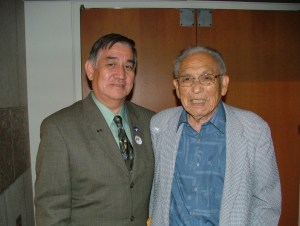
Dr. James Yamazaki (right) with PSR-LA board member Jimmy Hara
I got a phone call in the early spring of 1995 from a doctor in California who introduced himself as Jim Yamazaki. Dr. Yamazaki had just written a book about the US atomic bombings of Hiroshima and Nagasaki and wondered if I’d be interested in reviewing it in Medicine & Global Survival. Read more…
Gun Runners, Poaching and Armed Violence Prevention Featured at Nairobi Strategy Session on #ArmsFreeAfrica
By Dr. Peter Mburu, IPPNW-Kenya
On the 17th of June 2016, I had the privilege of representing IPPNW-Kenya at an #ArmsFreeAfrica NGO strategy meeting in Nairobi hosted by the Control Arms coalition. The working meeting was preceded by an evening premiere screening of the movie “Gun Runners” featuring former Kenyan cattle-rustler- turned-peace activist and elite professional runner Julius Arile.
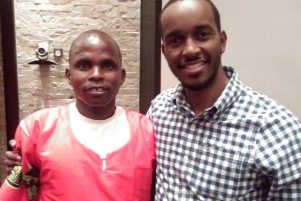
Gun Runners star Julius Arile (l) and Dr. Peter Mburu of IPPNW Kenya
More than 450 units of blood collected during “Don’t Shed Blood, Donate Blood” drives
IPPNW’s affiliate Indian Doctors for Peace and Development (IDPD) has launched a year-long series of creative activities in cooperation with student and state chapters under the banner of “Health through Peace.” They are engaging medical students, colleagues and communities in innovative initiatives to prevent violence and promote peace and sustainability. Read more…
Shadows of doom

Soviet MIG-21s at Rumbula airfield in Latvia, abandoned at the end of the Cold War
Peter Handberg, a writer and translator, has in the years since the end of the Cold War traveled many times in the Baltic states, Estonia, Latvia and Lithuania. He has visited many sites where nuclear weapons were kept, ready to destroy the world. Handberg has also spoken to military officers who once watched over these instruments of Armageddon. He has written an important book on the subject, Undergångens skuggor (Shadows of Doom). The book is not translated but a documentary film is planned.
Recently he led a group from Sweden to some of these bases, abandoned since 1987. Read more…
In wake of Orlando slaughter, medical calls to action to prevent more killing by gun violence
The IPPNW delegation to last week’s United Nations Programme of Action on Small Arms and Light Weapons 6th Biennial Meeting of States returned to our homes this past weekend to the horrifying news of the slaughter of 49 innocent people at a nightclub in Orlando, Florida, and the wounding of another 50 or more. The weapons used by a lone gunman to wreak this carnage against members of the LGBT community included a semi-automatic assault rifle designed to kill many people quickly and easily. It was purchased legally under current US firearm regulations, by a person with a known propensity for violence. Read more…
The theme connecting the dots between health, human security and sustainable development resonated throughout yesterday’s side event to the Sixth Biennial Meeting of States on the Programme of Action (PoA BMS6) on Small Arms co-organized by IPPNW. The panel, featuring doctors and parliamentarians, was hosted by the Swedish Mission to the United Nations and co-convened with the Stockholm-based Parliamentary Forum on Small Arms and Light Weapons (PFSALW). How health professionals and parliamentarians can work together to reduce armed violence and advance the PoA and the Sustainable Development Goals, specifically SDG 16 on reducing all forms of violence, was the starting point for the conversations. Read more…
IPPNW responds to Obama Hiroshima visit
[IPPNW’s co-presidents have sent the following letter to US President Barack Obama in response to his speech in Hiroshima on May 27.]
Dear President Obama:
We applaud your decision to bear witness to the ghastly horrors that befell the citizens of Hiroshima, and to meet with Hibakusha. However, we deeply regret that you made no commitments to ensure that nuclear weapons are never used again. Read more…
A call to do things differently
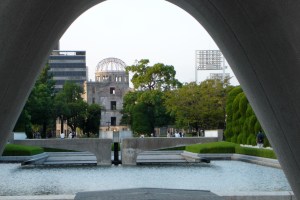
The A-Bomb Dome seen through the Cenotaph in Hiroshima.
President Obama made an historic visit to Hiroshima today—the first sitting US president to do so since the US atomic bombing of that city on August 6, 1945, followed three days later by the atomic bombing of Nagasaki.
As he did in Prague, in 2009, President Obama gave a very moving and meaningful speech about the impact of nuclear weapons, reflecting upon the experience of the victims of nuclear warfare—the Hibakusha.
“Their souls speak to us,” he said. “They ask us to look inward, to take stock of who we are and what we might become.” Read more…
“The proposition that nuclear weapons can be retained in perpetuity and never used — accidentally or by decision — defies credibility”
This unanimous statement was published by the Canberra Commission in 1996. Among the commission members were internationally known former ministers of defense and of foreign affairs and generals.
The nuclear-weapon states do not intend to abolish their nuclear weapons. They promised to do so when they signed the Nuclear Non-Proliferation Treaty (NPT) of 1970. Furthermore, the International Court in The Hague concluded in its advisory opinion more than 20 years ago that these states were obliged to negotiate and bring to a conclusion such negotiations on complete nuclear disarmament. The nuclear-weapon states disregard this obligation. On the contrary, they invest enormous sums in the modernization of these weapons of global destruction. Read more…
The more we know, the worse it looks
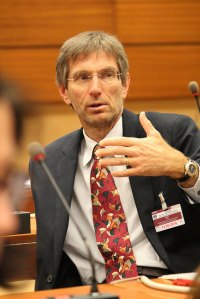
IPPNW co-president Tilman Ruff
[Co-president Tilman Ruff addressed the Open-Ended Working Group on nuclear weapons on May 13 in Geneva, on behalf of IPPNW’s Australian affiliate, MAPW, and ICAN. His remarks follow.]
Given some views expressed here in recent days, I feel a medical responsibility to highlight for representatives in this room some crucial evidence on the weapons under discussion.
Public policy should be based on evidence—especially in relation to the most acute existential threat that has ever lain in human hands. Read more…

 Bimal Khadka
 Bjorn Hilt
 Charles K. Johnson
 Gunnar Westberg
 IPPNW
IPPNW John Loretz
 Lawrence Wittner
 Maria Valenti
 mollymcgint
 Sue Wareham
 Tilman Ruff
 Tim Wright
 Xanthe Hall


 IPPNW peace and health blog