IPPNW condemns the withdrawal of the United States from the international nuclear weapons agreement with Iran, announced today by Donald Trump.
The decision by the US President to ignore key advisers and allies and to pull out of the nuclear agreement with Iran immediately increases the chances of new and intensified conflict in the Middle East and could provoke Iran into resuming its nuclear weapons program. Read more…
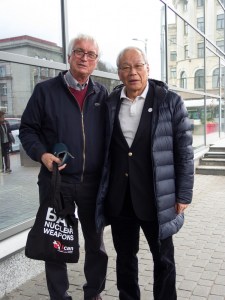
IPPNW board chair Bjorn Hilt (left) with WMA president Yoshitake Yokokura, in Riga for the 209th WMA Council meeting.
Medical doctors of the World Medical Association (WMA) met in Riga in Latvia at the end of April for their 209th Council meeting. I was privileged to be there as an invited guest to represent IPPNW and to discuss a proposed revised statement on nuclear weapons. The meeting issued an immediate Council resolution that focused on the humanitarian impact of nuclear weapons and protested against the so-called modernization of nuclear weapons. The WMA urged all states to sign and ratify the UN Treaty on the Prohibition of Nuclear Weapons (TPNW). Read more…
[Ed. note: Following is the text of the Declaration issued at the conclusion of the historic Summit between President Moon Jae-in of the Republic of Korea and Chairman Kim Jong Un of the Democratic People’s Republic of Korea on April 27.]

Photo: Korean Herald
During this momentous period of historical transformation on the Korean Peninsula, reflecting the enduring aspiration of the Korean people for peace, prosperity and unification, President Moon Jae-in of the Republic of Koreaand Chairman Kim Jong Un of the State Affairs Commission of the Democratic People’s Republic of Korea held an Inter-Korean Summit Meeting at the ‘Peace House’ at Panmunjeom on April 27, 2018. Read more…
Global health leaders rally behind the Ban Treaty
The International Committee of the Red Cross and the World Medical Association have issued important and very timely calls for states to join and implement the Treaty on the Prohibition of Nuclear Weapons. Read more…
[Dr. Carlos Umaña, a member of the IPPNW Board and president of IPPNW-Costa Rica, delivered the following statement to the 2018 Preparatory Committee of the Nuclear Non-Proliferation Treaty in Geneva on April 25.]
On the humanitarian consequences of nuclear weapons
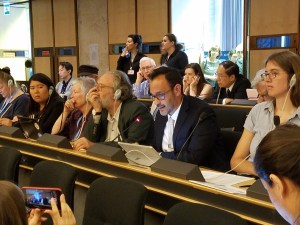
Carlos Umana warns NPT delegates and NGOs that “there is no cure for the effects of nuclear weapons.”
I speak on behalf of the International Physicians for the Prevention of Nuclear War, founding member of ICAN.
The need to place the catastrophic humanitarian consequences at the center of discussions regarding nuclear weapons has been manifested many times, most notably at the 2010 NPT Review Conference in its outcome document, at the Humanitarian Conferences in Oslo, Nayarit and Vienna, and as part of the preamble of the Treaty to Prohibit Nuclear Weapons. Read more…
An insight into Pakistan
by Franca Brüggen, International Student Representative

Presenting Hibakusha Worldwide exhibition posters to PDPD leader Dr. Tipu Sultan
After Kelvin Kibet and I attended the international seminar on “the landmark treaty prohibiting nuclear weapons” in Delhi from 24-25 March, we wanted to extend our trip to Pakistan. Our intention was to revive the student chapter there and to improve international networking, but also to better understand the circumstances in Pakistan. Read more…
Bringing ban treaty momentum to India
by Kelvin Kibert, International Student Representative

Kelvin and Franca co-chair a session at the IDPD seminar in Delhi
Our journey to India began way back in Oslo during the 2017 Nobel Peace Prize events. To be precise, 11 December at Brigg restaurant during the informal ICAN campaigners’ get together. The atmosphere was filled with the frenzy of happy moments and fulfillment for many gathered there. However, Dr Arun Mitra and Dr Jeetendra Singh of the Indian Doctors for Peace and Development (IDPD- IPPNW India) were really keen on using the Nobel momentum to urge their government to sign the Nuclear Ban Treaty. Read more…
Roots of Conflicts and Lasting Peace in Africa: IPPNW Affiliates Prioritize Prevention
by Kelvin Kibet, IPPNW International Student Representative
The hope for future sustainable peace in Africa is prevention. Amidst all the violent conflicts in multiple countries, including but not limited to Mali, Somalia, Central African Republic, Nigeria, South Sudan and Ethiopia, we have to realize that without addressing the very roots of conflicts in these countries we may not stand a chance at lasting peace. We will perennially have long, drawn out wars as is the case in some of the aforementioned countries. Read more…
Taxes, death, and nuclear weapons
by Robert Dodge
We live in a world where, as Benjamin Franklin said in 1789, “Nothing can be said to be certain, except death and taxes.” That statement remains true and the paradox today is the amount our taxes pay toward the death and destruction of mankind through the continued funding of nuclear weapons. Read more…
Need to divest funds from arms to health care

Participants in the IDPD seminar, The Landmark Treaty Prohibiting Nuclear Weapons: Opportunities and Challenges
by Arun Mitra
Saddened and disturbed on hearing about the devastation caused by the atom bombs thrown on Hiroshima and Nagasaki, Mahatma Gandhi had said “I regard the employment of the atom bomb for the wholesale destruction of men, women and children as the most diabolical use of science. What is the antidote? Has it antiquated non-violence? No. On the contrary, non-violence is the only thing that is now left in the field. It is the only thing that the atom bomb cannot destroy. I did not move a muscle when I first heard that the atom bomb had wiped out Hiroshima. On the contrary, I said to myself, ‘unless now the world adopts non-violence, it will spell certain suicide for mankind.’” Read more…

 Bimal Khadka
 Bjorn Hilt
 Charles K. Johnson
 Dr. Ghassan Shahrour
 Gunnar Westberg
 IPPNW
IPPNW John Loretz
 Lawrence Wittner
 Maria Valenti
 mollymcgint
 Sue Wareham
 Tilman Ruff
 Tim Wright
 Xanthe Hall