2017 Nobel Peace Prize to ICAN is wake up call to humanity
Breaking news
The Norwegian Nobel Committee has awarded the 2017 Nobel Peace Prize to the International Campaign to Abolish Nuclear Weapons
Announcement and explanation of award at nobelpeaceprize.org
In honoring the International Campaign to Abolish Nuclear Weapons (ICAN) as this year’s Nobel Peace Laureate, the Norwegian Nobel Committee has reaffirmed that prohibiting and eliminating nuclear weapons is the most urgent security priority of our time. Read more…
A negotiated curbing of North Korea’s nuclear capabilities is good, but not good enough
The North Korean government’s progress toward developing a long-range nuclear weapons capability, accompanied by bellicose pronouncements, has been alarming enough to spark worldwide public dismay and new sanctions by a unanimous UN Security Council. But even if, at the very best, sanctions (which, so far, have not worked) or diplomatic negotiations (which have yet to get underway) produce a change in North Korea’s policy, that change is likely to be no more than a freeze in the regime’s nuclear weapons program.
And that will leave us with a very dangerous world, indeed. Read more…
[The following article, originally published in Australia by Power to Persuade, a discussion blog and annual symposium focused on social policy, is reposted here with permission.]
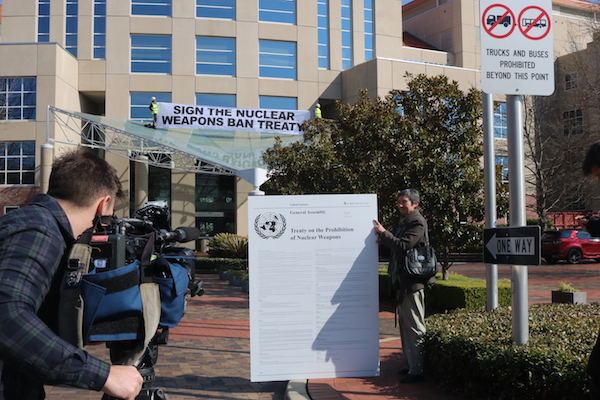
Sue Wareham holds copy of Ban Treaty during ICAN Australia action at the Foreign Affairs Department in Canberra in September.
In my first article about the Treaty on the Prohibition of Nuclear Weapons (the Treaty), published on Power to Persuade on 28 July, I described how the Treaty came about, how it is based in humanitarian and human rights norms, what’s in it, and that the next step would be the opening for signature at the UN in New York on 20 September 2017.
Because the Treaty text was adopted only on 7 July, it had to be squeezed into an extra early morning slot during ‘leaders’ week’, the opening week of the new annual UN General Assembly (UNGA) session, when many heads of government and state and foreign ministers are in town. So many were keen to sign at this earliest possible opportunity that each was allocated just one minute for the formal signature on behalf of their nation. Read more…
Big on Process, Short on Substance
Stop arms transfers that fuel atrocities: Reduce human suffering. That was the urgent call to governments from Control Arms members from Africa, Americas, Asia, Caribbean, Europe, Middle East and the Pacific as they gathered in Geneva last week for the third annual Conference of States Parties to the Arms Trade Treaty (CSP 2017). Read more…
Health federations call Ban Treaty a “significant forward step” toward elimination of nuclear weapons
 [The following joint statement has been released by IPPNW, the World Medical Association, the International Council of Nurses, and the World Federation of Public Health Associations. The Treaty on the Prohibition of Nuclear Weapons opens for signature at the United Nations on September 20.]
The landmark Treaty on the Prohibition of Nuclear Weapons (TPNW), adopted on July 7 by 122 non-nuclear-weapon states following negotiations earlier this year, prohibits the development, testing, production, possession, stockpiling, use, or threatened use of nuclear weapons. The Treaty completes the process of stigmatizing and delegitimizing nuclear weapons on the basis of their catastrophic health, environmental, and humanitarian impacts. Read more…
Physicians call for urgent negotiations to resolve Korean nuclear crisis
[IPPNW released the following statement on September 5 from the 22nd World Congress at York University, after consultations among members of the Executive Committee, key affiliate leaders who have visited the DPRK, and members of Korean Anti-War Peace Physicians, the DPRK affiliate.]
Physicians from more than 30 countries, gathered in York for the World Congress of International Physicians for the Prevention of Nuclear War, the recipient of the 1985 Nobel Peace Prize, issued the following appeal today (September 5, 2017):
There is no military solution to the nuclear confrontation between the United States and the Democratic People’s Republic of Korea. Any military action will lead to massive civilian casualties. If nuclear weapons are used the casualties could be in the tens of millions with widespread radioactive contamination and the possibility of global climate disruption.
We urgently call on the United States and the Democratic People’s Republic of Korea to enter into direct negotiations without preconditions to resolve this dangerous crisis.
The critical situation in Korea underlines the importance of the Treaty on the Prohibition of Nuclear Weapons which was adopted at the United Nations on July 7 and which will be open for signature there on September 20. The nuclear-armed states can no longer hold the peoples of the world hostage to the terrible destructive power of their nuclear arsenals. The national security of all nations demands that they accept the prohibition on nuclear weapons embodied in this treaty and enter into negotiations for a verifiable, enforceable, time-bound agreement to eliminate their nuclear weapons.
York Congress statement: A milestone for nuclear abolition
[IPPNW has released the following declaration from its 22nd World Congress at York University, held jointly with the Health Through Peace 2017 forum organized by the UK affiliate, Medact.]
September 4, 2017
As doctors, medical students, other health professionals, and other concerned citizens gathered at York University for the international conference Health Through Peace 2017 and IPPNW’s 22nd World Congress, we celebrate a milestone in the global campaign to rid the world of nuclear weapons. Read more…
Faslane to York: The “Health Through Peace” bike tour

IPPNW cyclists at the starting line in Faslane, on their way to York.
by Aino-Ritva Weyers, International Student Represenative
A group of medical students and doctors from all over the world (Kenya, India, Pakistan, Germany, Nepal, Nicaragua and Russia) came together here in Scotland today to cycle to this year’s “Health Through Peace” conference and IPPNW Congress in York. On the way we aim to discuss global nuclear disarmament, causes of conflicts and weapons, and the affects on individual and population health with people we meet on the way. We start our cycle the 26th of August from Faslane ( the harbour of the UK trident fleet) and finish in York where the conference is taking place. Read more…
Lessons from the North Korea crisis: Nuclear weapons lead to war
“If your country continues to develop nuclear weapons, you will be attacked, maybe with nuclear weapons.” This what we have told our colleagues from North Korea, at visits to Pyongyang or at international meetings. “Oh no,” they said. “Look at Saddam Hussein and Moammar Khadafy. They gave up their plans for nuclear weapons, and they were attacked.”
“Nuclear weapons development is not the only reason for the USA to attack. Oil is the other,” we said.
It turns out we were right. North Korea—DPRK—continued on the path to nuclear weapons and the President of the United States threatened to attack. The crisis is fading, for the moment, but is likely to increase when DPRK makes its next move. A misunderstanding on either side may provide the spark causing a devastating war. Read more…
Playing nuclear “chicken” with our lives
What kind of civilization have we developed when two mentally unstable national leaders, in an escalating confrontation with each other, threaten one another―and the world―with nuclear war?
That question arises as a potentially violent showdown emerges between Kim Jong Un of North Korea and Donald Trump of the United States. In recent years, the North Korean government has produced about 10 nuclear weapons and has been making them increasingly operational through improvements in its missile technology. Read more…

 Bimal Khadka
 Bjorn Hilt
 Charles K. Johnson
 Gunnar Westberg
 IPPNW
IPPNW John Loretz
 Lawrence Wittner
 Maria Valenti
 mollymcgint
 Sue Wareham
 Tilman Ruff
 Tim Wright
 Xanthe Hall


 IPPNW peace and health blog