ICAN partner organization PAX has published a new edition of the landmark report detailing global investments in companies that produce nuclear weapons. The 2018 update of Don’t Bank on the Bomb shows that 329 financial institutions from around the world have invested US $525 billion into 20 companies involved in the production, maintenance and modernization of nuclear weapons in France, India, the United Kingdom, and the United States since January 2014. Fourteen country profiles provide details about nuclear-weapons-related work of identified producers and the financial institutions that support this work. On the positive side, Pax researchers found that the number of institutions that have financial relationships with nuclear weapon producers has decreased since the adoption of the Treaty on the Prohibition of Nuclear Weapons. The complete 2018 Don’t Bank on the Bomb, as well as individual country profiles, are available online.
The French Red Cross and the Ban Treaty
Last month, the French Red Cross (CRF) organized its first panel discussion on the Treaty on the Prohibition of Nuclear Weapons at its headquarters in Paris.
Kathleen Lawand, the legal advisor and head of the arms unit at the International Committee of the Red Cross (ICRC), joined Patrice Richard and Abraham Behar of IPPNW’s French affiliate, AMFPGN, and Jean Marie Colin of Initiatives for Nuclear Disarmament (IDN). Ms. Lawand recalled the ICRC’s constant struggle for the abolition of nuclear weapons since 1945. She explained that the humanitarian consequences of nuclear weapons and nuclear war, and the disproportionate nature of the nuclear threat were her reasons for supporting the Ban Treaty. Read more…
US Nuclear Posture Review gives strong arguments for a prohibition of all nuclear weapons
This is how I would summarize the new US Nuclear Posture Review, issued last week by the Trump administration:
- We can fight and win a nuclear exchange
- We are prepared to use nuclear weapons against a conventional attack, e.g. a cyberattack
- We may consider using nuclear weapons against a nuclear-weapons-free country
- We care not to mention our obligations under NPT Art VI
- We have never heard of the climate effects of nuclear war
“Service to humanity” is heartbeat of IPPNW Nigeria Radio Project
by Dr. David O. Onazi (IPPNW Board Member 2010-2014 & International Councilor SNDWM)
The IPPNW Nigeria Radio Project has at its heartbeat “service to humanity”- creating awareness of the threat armed violence poses to health and healthy communities and providing relevant information about public health approaches to preventing armed violence, thus equipping the public with knowledge that can drive peace building in society. Read more…
A gold-plated blueprint for nuclear war
The cover of the 2018 NPR conveys the Trump-brand obsession with gold. The “gold standard” motif frames the numerous photos of gleaming military hardware that accompany the report and that reinforce its hyper-aggressive posturing.
You’d be hard pressed to find a stronger case for the Nuclear Weapons Ban Treaty than the new US Nuclear Posture Review released last week by the Trump administration.
Not that the gloomy, unreconstructed apologists for US geopolitical, economic, and military dominance who authored this frontal assault on nuclear disarmament intended to make that argument. To the contrary, after portraying a world so relentlessly hostile to US interests that only a multi-billion dollar “recapitalization” of the nuclear weapons enterprise can keep the country’s adversaries from wreaking havoc, the authors dismiss the Treaty as an unrealistic and polarizing diversion that undermines the whole principle of nuclear deterrence.
Of course, they’re right about that last bit, which they know is the whole point. Read more…
IPPNW supports WMA condemnation of the arrest of Turkish Medical Association leaders
Since issuing the following statement on February 2, 2018, IPPNW has learned that the Turkish government has released the members of the Turkish Medical Association who were arrested last week.
International Physicians for the Prevention of Nuclear War (IPPNW) joins the World Medical Association in expressing grave concern over the arrests of leaders of the Turkish Medical Association (TMA). Read more…
Remembering Victor W. Sidel
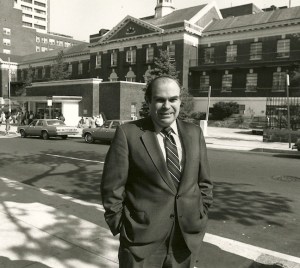 Victor W. Sidel, MD, a founder and president of Physicians for Social Responsibility (PSR), a former co-president of IPPNW, and one of the world’s foremost experts on the medical consequences of nuclear war, died on January 30, 2018. Dr. Sidel was Chair of the Department of Social Medicine at Montefiore Medical Center in the Bronx from 1969-1985. He then became Distinguished University Professor of Social Medicine at Montefiore and the Albert Einstein College of Medicine. In 1985 he was elected President of the American Public Health Association. He was the author of numerous books and articles about the human consequences of war, international health, and the impact of poverty and deprivation on health and well being, including War and Public Health and Terrorism and Public Health, both co-edited with long-time collaborator Barry Levy. Read more…
Two minutes to midnight
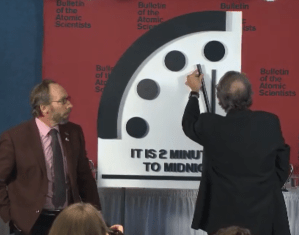
Robert Rosner, the chair of the Bulletin Science and Security Board moves the Doomsday Clock up to 2 minutes to midnight as Lawrence Krauss, the chair of the Board of Sponsors, looks on.
Citing “looming threats of nuclear war,” the Science and Security Board of the Bulletin of the Atomic Scientists has reset the Doomsday Clock to two minutes to midnight—the closest the world has been to catastrophe since 1953.
While the Clock has come to represent the level of a number of global threats, including global warming and emerging technologies, the Bulletin attributed this year’s warning almost entirely to the urgent and growing risk of nuclear war. Read more…
 On April 5, 2009 the newly elected, young, and promising US President Barack Obama made a speech in Prague about nuclear dangers. He said:
“…This matters to all people, everywhere. One nuclear weapon exploded in one city – be it New York or Moscow, Islamabad or Mumbai, Tokyo or Tel Aviv, Paris or Prague – could kill hundreds of thousands of people. And no matter where it happens, there is no end to what the consequences may be – for our global safety, security, society, economy, and ultimately our survival…So today, I state clearly and with conviction America’s commitment to seek the peace and security of a world without nuclear weapons…”
With these words President Obama surprised and impressed the world, and he filled us with hope. For these words, he was awarded the Nobel Peace Prize in 2009.
Did he mean the words he spoke? In retrospect, it’s hard to know. Read more…
This October, the non-partisan Congressional Budget Office (CBO) reported that its estimate of the cost for the planned “modernization” the U.S. nuclear weapons complex over the next three decades has risen to $1,200,000,000,000.00. For those of you not familiar with such lofty figures, that’s $1.2 trillion. Furthermore, when adjusted for inflation, the cost of the program―designed to provide new weapons for nuclear warfare on land, in the sea, and in the air, plus upgraded or new facilities to produce them―grows to $1.7 trillion. Read more…

 Bimal Khadka
 Bjorn Hilt
 Charles K. Johnson
 Gunnar Westberg
 IPPNW
IPPNW John Loretz
 Lawrence Wittner
 Maria Valenti
 mollymcgint
 Sue Wareham
 Tilman Ruff
 Tim Wright
 Xanthe Hall


 IPPNW peace and health blog