What we can learn from the North Korea nuclear story
The North Korea – USA nuclear crisis should teach us several lessons regarding nuclear weapons:
- Nuclear weapons do not prevent nuclear proliferation.
The nuclear weapon states accepted in 1970 in the Nuclear Non-proliferation treaty, NPT. In this treaty these states agree to negotiate the complete disarmament of their nuclear weapons. They have completely disregarded this pledge and insist that they must retain nuclear weapons in order to prevent other countries from acquiring them. The North Korea example shows us that this does not work. Read more…
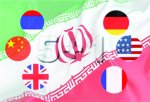 [The national affiliates of IPPNW in France, Germany, and the UK, and IPPNW’s international leadership, have appealed to officials in the three governments to stand by the agreement that they made with Iran on their nuclear program. In a letter to President Macron, Chancellor Merkel, and Prime Minister May, reprinted here, IPPNW has urged the leaders to continue working closely with Iran’s government to ensure the obligations of the agreement continue to be met by all remaining parties to it.]
by James Muller and John Pastore
North Korea’s UN ambassador for American affairs, his aide, and the two of us sat around a small circular table at the Mennonite office in New York. Our book on the medical consequences of nuclear war, with its cover picture of a devastated Hiroshima, sat between us. The United Nations building loomed in the background, and the East River beyond it.
We discussed what would happen if a single nuclear bomb exploded over our location in Manhattan: a massive blast and firestorm engulfing most of the city, the crush, the fire, the radiation injuries that would afflict hundreds of thousands, the destruction of the hospitals and deaths of healthcare workers. Read more…
Confessions of a nuclear war planner
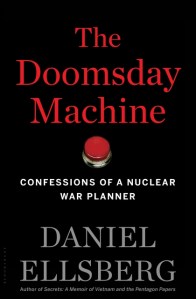 It’s not every day that an insider tells us how preparations for nuclear war have been proceeding. So, when one does, it’s worth sitting up and taking notice.
Although Daniel Ellsberg is best-known for his 1971 role in delivering the Pentagon Papers (the Top Secret Defense Department study of U.S. involvement in Vietnam) to the American people, he spent much of his 13-year career as a military analyst at the highest levels of the U.S. national security apparatus grappling with issues of nuclear war. Read more…
Korean sanctions are a humanitarian disaster
[Dr. Mary-Wynne Ashford, a former co-president of IPPNW and Honorary Board Member of Canadian Voice of Women for Peace, gave the following talk in Seoul in May 2018, as part of the event Women Cross the DMZ.]
by Mary-Wynne Ashford
“It was the best of times; it was the worst of times”. Charles Dickens wrote about Paris and London in the French Revolution, but his words echo today for North and South Korea. It is the best of times because there is finally hope for the peaceful reunification of the Korean Peninsula, and hope for an end to sixty-five years of war. Read more…
Peace prospects in Korea
by Mary-Wynne Ashford
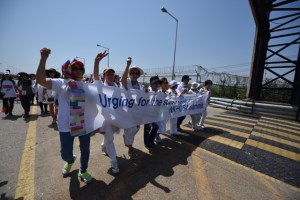
Dr. Ashford, third from left, marches with women at the DMZ
In spite of plans for a summit between US President Trump and North Korean Chairman Kim lurching forward and back, in Korea there is a great sense of hope for peace between North and South. In fact two historic events unfolded in the Demilitarized Zone (DMZ) on May 26th. Read more…
The end of nuclear weapons…or the end of us?
 In an important new article published today by the New England Journal of Medicine (The 2017 Nobel Peace Prize and the Doomsday Clock—The End of Nuclear Weapons or the End of Us?), former IPPNW executive director Lachlan Forrow, co-president Tilman Ruff, and Hiroshima survivor Setsuko Thurlow warn that “a nuclear strike remains only a computer malfunction, other human or technical error, or military escalation away.” Read more…
Global Week of Action Against Gun Violence
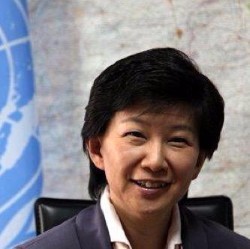 Statement by the High Representative of the United Nations Office for Disarmament Affairs
A message from Izumi Nakamitsu, the United Nations High Representative for Disarmament Affairs, in support of the Global Week of Action Against Gun Violence
“Every day, hundreds of lives are lost due to gun violence worldwide. Guns are responsible for about half of all violent deaths – nearly a quarter million each year. But the dire consequences of gun violence are not limited to those slain by guns. For every person killed by a gun, many more are injured, maimed, and forced to flee their home and community. Still many more live under constant threats of gun violence. Read more…
IPPNW condemns the withdrawal of the United States from the international nuclear weapons agreement with Iran, announced today by Donald Trump.
The decision by the US President to ignore key advisers and allies and to pull out of the nuclear agreement with Iran immediately increases the chances of new and intensified conflict in the Middle East and could provoke Iran into resuming its nuclear weapons program. Read more…
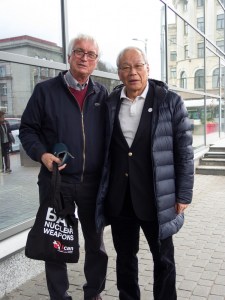
IPPNW board chair Bjorn Hilt (left) with WMA president Yoshitake Yokokura, in Riga for the 209th WMA Council meeting.
Medical doctors of the World Medical Association (WMA) met in Riga in Latvia at the end of April for their 209th Council meeting. I was privileged to be there as an invited guest to represent IPPNW and to discuss a proposed revised statement on nuclear weapons. The meeting issued an immediate Council resolution that focused on the humanitarian impact of nuclear weapons and protested against the so-called modernization of nuclear weapons. The WMA urged all states to sign and ratify the UN Treaty on the Prohibition of Nuclear Weapons (TPNW). Read more…

 Bimal Khadka
 Bjorn Hilt
 Charles K. Johnson
 Gunnar Westberg
 IPPNW
IPPNW John Loretz
 Lawrence Wittner
 Maria Valenti
 mollymcgint
 Sue Wareham
 Tilman Ruff
 Tim Wright
 Xanthe Hall


 IPPNW peace and health blog