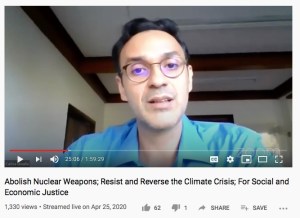
 An online international conference sponsored by the Rosa Luxembourg Stiftung NYC on April 25 provided a unique opportunity for the world’s nuclear disarmament campaigns, allied movements and organizations, and diplomats committed to banning and eliminating nuclear weapons to amplify nuclear abolition demands and to show how the nuclear dangers interconnect with the threats posed by climate change, the Covid-19 pandemic, and the injustices of our world.
Will the Coronavirus pandemic help curb war and militarism?
 Decades ago, when I began teaching international history, I used to ask students if they thought it was possible for nations to end their fighting of wars against one another. Their responses varied. But the more pessimistic conclusions were sometimes tempered by the contention that, if the world’s nations faced a common foe, such as an invasion from another planet, this would finally pull them together.
I was reminded of this on March 23, when the UN Secretary-General, António Guterres, called for “an immediate global ceasefire.” The time had come, he said, to “end the sickness of war and fight the disease that is ravaging our world.” A UN summary noted that the Secretary-General had “urged warring parties across the world to lay down their weapons in support of the bigger battle against COVID-19: the common enemy that is now threatening all of humankind.” Read more…
The coronavirus pandemic, like other global catastrophes, reveals the limitations of nationalism
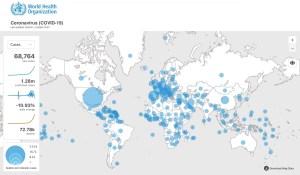 We live with a profound paradox. Our lives are powerfully affected by worldwide economic, communications, transportation, food supply, and entertainment systems. Yet we continue an outdated faith in the nation-state, with all the divisiveness, competition, and helplessness that faith produces when dealing with planetary problems. Read more…
We can’t afford another global health crisis
The year is 2025. The entire world is in disarray. In some parts of the world, medical facilities are overwhelmed; doctors and nurses are exhausted, and the rest of the world is struggling to help. The economy is crashing. No one knows how long it will last because no one has lived through something like this before. It happened in a couple of countries but it didn’t take long before the effects spread to every country on earth.
No, we’re not talking about another pandemic. We’re describing the aftermath of a very limited nuclear war. A full scale nuclear war would kill hundreds of millions the first day and plunge the world into a human-made nuclear ice age within a week, ending the world as we know it. Read more…
IPPNW Statement on COVID-19
Secretary-General appeals for global ceasefire
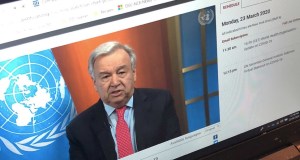 [In an appeal issued on Monday, March 23, UN Secretary-General António Guterres urged warring parties across the world to lay down their weapons in support of the bigger battle against COVID-19: the common enemy that is now threatening all of humankind. IPPNW wholeheartedly endorses the Secretary-General’s proposal, and urges all nations to “put armed conflict on lockdown.”]
TRANSCRIPT OF SG’s APPEAL
Our world faces a common enemy: COVID-19. The virus does not care about nationality or ethnicity, faction or faith. It attacks all, relentlessly. Meanwhile, armed conflict rages on around the world. The most vulnerable — women and children, people with disabilities, the marginalized and the displaced — pay the highest price. They are also at the highest risk of suffering devastating losses from COVID-19.
Let’s not forget that in war-ravaged countries, health systems have collapsed. Health professionals, already few in number, have often been targeted. Refugees and others displaced by violent conflict are doubly vulnerable. The fury of the virus illustrates the folly of war.
That is why today, I am calling for an immediate global ceasefire in all corners of the world. Read more…
Thyroid cancer increasing nine years after Fukushima
“The official rate of new cases of thyroid cancer in children under 25 years of age in Japan in the ten years 2000-2009 was 0.59 per 100,000 per year. Today, nine years after the beginning of the nuclear catastrophe in the investigated population of about 218,000 patients, 11.5 thyroid cancer cases would have been expected.
However, the actual number of thyroid cancer cases in Fukushima is significantly higher: the 197 diagnosed cases in the study cohort represent an increase by a factor of 17 compared to the expected number of cases (197:11.5).” A closer look at the numbers, Dr. Rosen says, suggests that the ratio may be 23:1 or even higher.
Dr. Rosen also cautions that the number of participants in the screenings has gone steadily down since 2011, resulting in an incorrect inference that the number of new cancers has gone down, when, in fact, they are merely going undetected or unreported.
“We continue to see a significant increase in new cases of thyroid cancer in children and adolescents in Fukushima,” Dr. Rosen concludes. “Currently, the ratio of diagnosed cases of thyroid cancer to expected cases is 23:1. Due to the developments outlined in this paper, these figures are likely to be a systematic underestimation, as became apparent by the newly published thyroid cancer cases diagnosed outside the study protocol.”
Dr. Rosen’s article was published this month by IPPNW-Germany.
Uranium is also a feminist issue
by Angelika Claussen
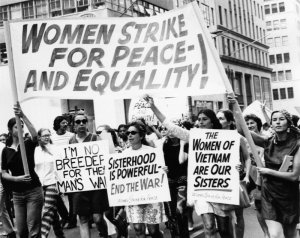
Women’s Strike for Peace-And Equality, Women’s Strike for Equality, Fifth Avenue, New York, New York, August 26, 1970. (Photo by Eugene Gordon/The New York Historical Society)
Around the world, women are resisting the civil and military use of nuclear technology
Women have always and everywhere been part of the history of uranium processing and nuclear technology—as workers in uranium production, as residents in the vicinity of mines, or as victims of military and civilian nuclear disasters. Women are particularly vulnerable to the health effects of uranium production because they are twice as sensitive to radiation as men. Indigenous women suffer doubly, because uranium extraction and nuclear weapons testing takes place in large part in (formerly) colonial areas. Resistance against uranium mining and nuclear technology is supported by female doctors, physicists, and journalists all over the world, who raise awareness about the consequences, which are otherwise often whitewashed or inadequately documented. Nevertheless, women’s role in organizing the struggle against nuclear weapons and energy remains extremely underexposed.
Read Dr. Claussen’s full paper, published online by the Rosa-Luxemburg-Stiftung
Dr. Angelika Claussen, a psychiatrist and psychotherapist, is IPPNW’s regional Vice President for Europe.
Guest Commentary
by Jason Sibert
This year marks the 50th anniversary of the Nuclear Non-Proliferation Treaty.
This fact has rarely been noted in the mainstream media. Naturally, the headlines are filled with predictions on the 2020 US election, the left-wing and right-wing populist movements that are rattling the democratic world, and the geo-political tug-of-war among China, the United States, Russia, the UK, and European Union. Some worry that the way of life we call the democratic republic is fading from our sight.
Few are talking about how the ideals of the democratic republic and nuclear arms control treaties like the NPT are connected. Read more…
 A survey of more than 16,000 millennials in 16 countries and territories last year – roughly half in peace, half experiencing conflict – commissioned by the International Committee of the Red Cross (ICRC) explored millennials’ views on conflict, the future of warfare and the values underpinning international humanitarian law, such as the use of torture against enemy combatants.
The results indicate that millennials are nervous about the future, and heightened tensions globally are likely to deepen these fears.
A plurality of respondents, 47 percent, think it’s more likely than not that there will be a third world war in their lifetime. And although 84 percent believe the use of nuclear weapons is never acceptable, 54 percent believe it is more likely than not that a nuclear attack will occur in the next decade.
Read the entire ICRC news release.

 Bimal Khadka
 Bjorn Hilt
 Charles K. Johnson
 Gunnar Westberg
 IPPNW
IPPNW John Loretz
 Lawrence Wittner
 Maria Valenti
 mollymcgint
 Sue Wareham
 Tilman Ruff
 Tim Wright
 Xanthe Hall


 IPPNW peace and health blog