Protect and support Dr. Denis Mukwege

Dr. Denis Mukwege
IPPNW expresses its concern, support and profound admiration for Dr. Denis Mukwege, our physician colleague and fellow Nobel Peace Laureate. Dr. Mukwege has worked for decades with great courage and compassion to address the needs of survivors of sexual violence and to stop the use of sexual violence as a weapon of war, in his homeland of Democratic Republic of Congo (DRC) and around the world.
We are pleased and grateful that UN (MONUSCO) peacekeepers returned on 9 September to Panzi Hospital where Dr. Mukwege works, following several weeks of threats and intimidation, both on social media and offline, including death threats, against Dr. Mukwege and his family. Read more…
Surviving the nuclear bomb at Nagasaki 75 years ago showed me nuclear weapons shouldn’t exist
Dr. Masao Tomonaga, IPPNW regional vice president
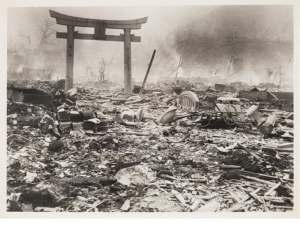
Nagasaki the day after the atomic bombing by the US. Photo by Yosuke Yamahata.
It has been 75 years since August 9, 1945, when the atomic bombing of Nagasaki opened the nuclear weapon age. I was 2 years old, and only 1 1/2 miles from ground zero of the nuclear explosion in there; I was, fortunately, unhurt by the blast itself. I was rescued by my mother from a half-destroyed wooden house just before it burned down.
I am one of a dwindling number of hibakusha — atomic bomb survivors; we are now, on average, 83 years old. Many of us still die of radiation-induced cancers and leukemia from the bombs dropped on our cities in 1945 because that exposure to radiation — when most of us were just 10 years old or younger — led to gene abnormalities in many organs that are still causing malignant diseases today….
Remember each and every person
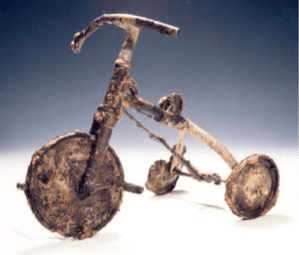
Shin’s Tricycle, courtesy of the Hiroshima Peace Memorial Museum
75 years ago the United States detonated an atomic bomb over the City of Hiroshima, instantly killing an estimated 80,000 people and changing the world forever. Just three days after the tragedy in Hiroshima, the United States detonated a second bomb over the City of Nagasaki, resulting in 40,000 immediate deaths. By the end of 1945, an estimated 200,000 lives were lost due to radiation exposure, lack of adequate medical care, and other health complications. We remember each and every person lost as a result of these inhumane bombings and reaffirm IPPNW’s commitment to do all that we can to abolish nuclear weapons, so that humanity never again sees the devastating consequences of their use. We vow to honor the Hibakusha, the survivors of the atomic bombings, with all our actions.
To mark the 75th anniversary of the US atomic bombings of Hiroshima and Nagasaki, a number of states will ratify the Treaty on the Prohibition of Nuclear Weapons as we approach the 50 countries needed for it to enter into force. We can think of no more appropriate way to honor the Hibashusha than this.
Please join Ambassador Elayne Whyte Gomez, Setsuko Thurlow, and Beatrice Fihn in saluting the newest states parties to the nuclear ban treaty!
When: Thursday, 6 August 2020, 9:30 AM (New York time)
Link to join the event
Making America feared again: the Trump administration considers resuming nuclear weapons testing
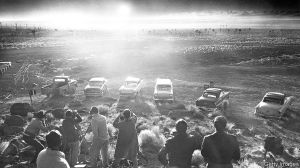
Nuclear tests, whether conducted in the atmosphere, in the oceans, or underground, have left a terrible legacy of health and environmental impacts. Resuming testing would exacerbate the damage, while also provoking new nuclear arms races.
Americans who grew up with nightmares of nuclear weapons explosions should get ready for some terrifying flashbacks, for the Trump administration appears to be preparing to resume US nuclear weapons tests.
The US government stopped its atmospheric testing of nuclear weapons in 1962, shortly before signing the Partial Test Ban Treaty of 1963. And it halted its underground nuclear tests in 1992, signing the Comprehensive Test Ban Treaty (CTBT) in 1996. Overall, it conducted 1,030 nuclear weapons test explosions, slightly more than half the global total.
Nuclear tests, of course, enabled the nine nuclear powers to develop bigger and more efficient nuclear weapons for the purpose of waging nuclear war. Along the way, millions of people in the United States and other nations died or developed illnesses caused by the radioactive fallout from these tests. Read more…
What’s up at NATO?

Chair of Joint Chiefs of Staff, Gen. Joe Dunford, at NATO HQ in Brussels, 2018. Photo: Dominique Pineiro / public domain
You could be excused for having missed the fact that NATO is in the process of updating its nuclear strategy, including substantial and significant steps. These include technologically more ambitious weapons that can be used more easily. This is the implementation of a decision made at the NATO Warsaw Summit in 2016 to revise nuclear strategy. In order to follow what’s going on, you have to dig deep on the internet. While this is a little easier because of Covid-19, as a lot more is happening online and NATO is just a little bit more transparent that before the pandemic, it is still difficult because NATO discussions are still shrouded in secrecy. Read more…
Joint IPPNW/IPB Statement on the 75th Anniversary of the bombings of Hiroshima and Nagasaki
Invitation to August 9 special worldwide screening
of “The Vow From Hiroshima”
As we recall the unprecedented horrors that the citizens of Hiroshima and Nagasaki experienced on August 6 and 9, 1945, we reaffirm the determination of our organizations to ensure that nuclear weapons are never used again.
In just two days, the two primitive atomic bombs dropped over Japan killed a quarter of a million women, children and men. Yet from the atomic ruins, an unwavering resolve has survived to bear witness to the personal human tragedy. For 75 years, the Hibakusha have spoken out as the voice of experience and hope for the urgent imperative of eliminating all nuclear weapons. Read more…
 Have you noticed recently that things are collapsing?
Sure, the rightwing, nationalist rulers of many countries never stop telling us that they have made their nations “great” again.
But we would have to be dislocated from reality not to notice that something is wrong―very wrong. After all, the world is currently engulfed in a coronavirus pandemic that has already infected over 12.5 million people, taken over 550,000 lives, and created massive economic disruption. And the pandemic is accelerating, while, according to scientists, new and more terrible diseases are in the offing. Read more…
by Angelika Claussen
 The global COVID-19 pandemic is making it clear that governments must rethink security. Our future challenges lie in establishing a good healthcare system in every country of our planet, in fighting climate change and in achieving the sustainable development goals defined by the United Nations. Read more…
Time to act on Dr King’s call to tackle evils of racism, economic exploitation, and war
Guest commentary
by Alice Slater

Dr Martin Luther King, Jr., speaking against the Vietnam War, St. Paul Campus, the University of Minnesota in St. Paul, April 27, 1967.
The Stockholm International Peace Research Institute (SIPRI) just issued its 2020 Yearbook, reporting on developments in armaments, disarmament, and international security. In light of the drumbeat of frightening news about growing hostility between the dominant nuclear-armed states vying for power, SIPRI describes a bleak outlook for arms control. It notes ongoing nuclear weapons modernization and new weapons development, space weaponization moving forward, without check or controls, and a disturbing increase in geopolitical tensions together with a rapid deterioration in practices and possibilities for cooperation and monitoring between the great powers.
All this is taking place against the background of a once in a hundred years global plague, and a rising tide of public revulsion against racism. Read more…
Let them eat weapons: Trump’s bizarre arms race
In late May of this year, President Donald Trump’s special envoy for arms control bragged before a Washington think tank that the US government was prepared to outspend Russia and China to win a new nuclear arms race. “The president has made clear that we have a tried and true practice here,” he remarked. “We know how to win these races and we know how to spend the adversary into oblivion.”
This comment was not out of line for a Trump administration official. Indeed, back in December 2016, shortly after his election, Trump himself proclaimed that the United States would “greatly strengthen and expand” the US government’s nuclear weapons program, adding provocatively: “Let it be an arms race. We will outmatch them at every pass and outlast them all.” In a fresh challenge to Russia and China, delivered in October 2018, Trump again extolled his decision to win the nuclear arms race, explaining: “We have more money than anybody else, by far.” Read more…

 Bimal Khadka
 Bjorn Hilt
 Charles K. Johnson
 Gunnar Westberg
 IPPNW
IPPNW John Loretz
 Lawrence Wittner
 Maria Valenti
 mollymcgint
 Sue Wareham
 Tilman Ruff
 Tim Wright
 Xanthe Hall


 IPPNW peace and health blog