Saving one life while working to save all our lives
Monday, December 9, 1985: As members of IPPNW’s executive committee met with the international press before the Nobel Peace Prize award ceremony in Oslo, a journalist suddenly slumped over in his chair and began convulsing—the victim of cardiac arrest. An international team of IPPNW physicians rushed to his aid as the press conference dissolved into a battle for the life of the stricken camera operator. The story became a parable for IPPNW’s work. When the press conference resumed Dr. Bernard Lown, who died this week at the age of 99, had this to say:
We have just witnessed what doctoring is about. When faced with a dire emergency of sudden cardiac arrest, doctors do not inquire whether the patient was a good person or a criminal. We do not delay treatment to learn the politics or character of the victim. We respond not as ideologues, nor as Russians nor Americans, but as doctors. The only thing that matters is saving a human life. We work with colleagues, whatever their political persuasion, whether capitalist or Communist. This very culture permeates IPPNW. The world is threatened with sudden nuclear death. We work with doctors whatever their political convictions to save our endangered home. You have just witnessed IPPNW in action.
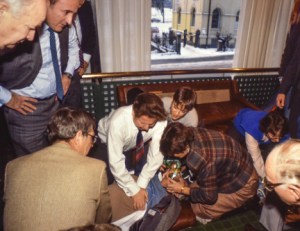
Dr. Eugueni Chazov administers CPR to a Soviet journalist in Oslo as Dr. Bernard Lown looks on at upper left.
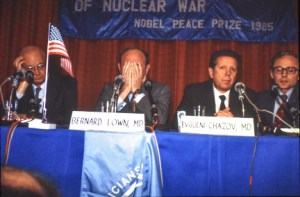
Drs. Lown and Chazov respond emotionally after the event.
IPPNW mourns co-founder Dr. Bernard Lown (1921-2021), calls on people worldwide to continue his legacy
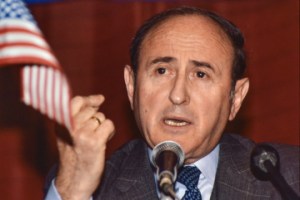
IPPNW’s founding co-president Dr. Bernard Lown, 1921-2021.
International Physicians for the Prevention of Nuclear War (IPPNW), 1985 Nobel Peace laureate organization, mourns the loss yesterday of our co-founder Dr. Bernard Lown, just months short of his 100th birthday.
Dr. Lown was a tireless visionary and pragmatic activist whose example continues to inspire countless physicians, students, and citizens worldwide. Those who knew Dr. Lown know that he would insist that the most meaningful way to honor his memory will be to carry on his work. Read more…
Nuclear weapons ban treaty is now international law
by Arjun Makhijani
Today, January 22, 2021, is a historic day. The Treaty on the Prohibition of Nuclear Weapons enters into force, three months after the 50th country, Honduras, ratified it. Nuclear weapons are now illegal under international law in every aspect. Possession is illegal; manufacture is illegal; use is illegal; threatening to use is illegal; transfer is illegal; aiding and abetting any of these things is illegal.
I salute the International Physicians for the Prevention of Nuclear War, where the idea for this treaty originated — though its antecedents go much farther back — to the 1990s, when many non-government organizations, including IPPNW, created a mock treaty to ban nuclear weapons. Read more…
 The multinational Treaty on the Prohibition of Nuclear Weapons entered into force today, meaning that its prohibitions against developing, testing, producing, acquiring, possessing, stockpiling, and using or threatening to use nuclear weapons have now become part of the body of international law. Those prohibitions are binding on the 51 states that have joined the Treaty and on those that will join in the future. While the nuclear-armed states and their allies have so far resisted joining the TPNW, experience with similar treaties suggests that, over time, these prohibitions will increasingly influence the policies and practices of even the most recalcitrant governments, especially as the numbers of ratifications increase.
A coalition of the world’s largest health federations welcomed the TPNW’s entry into force with a joint statement hailing the Treaty as “an essential step towards preventing the catastrophic humanitarian consequences of the use of nuclear weapons and a big win for planetary health.” Read more…
The great evasion
Two related events—the 75th anniversary of the January 24, 1946 UN General Assembly Resolution 1 (which established a commission to plan for the abolition of nuclear weapons) and the January 22, 2021 entry into force of the UN Treaty on the Prohibition of Nuclear Weapons (designed to finally implement that goal)—should be a cause for worldwide celebration.
In fact, however, they are a cause for shame. The nine nuclear powers have refused to sign the treaty and, instead, today continue to engage in a nuclear arms race and to threaten nuclear war—a war capable of destroying virtually all life on earth. Read more…
Farewell to a friend and mentor: H. Jack Geiger, 1925-2020
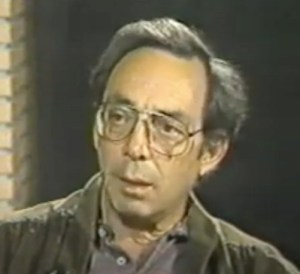 When I met Jack Geiger in 1987, he was already legendary. One of the founders of Physicians for Social Responsibility and a co-author—along with Vic Sidel, Bernard Lown, and others—of a series of groundbreaking articles about the medical consequences of nuclear war published by the New England Journal of Medicine in 1962, he had just finished his term as PSR’s president when I joined the staff as communications director. I had no sooner arrived in Washington when my new boss, Jane Wales, sent me back to Boston to slow down, if not outright stop, a plan that Jack was developing with Vic and another board member, Jennifer Leaning, to start a new PSR journal. Much to Jane’s chagrin, I returned to Washington persuaded that the journal was a great idea. Much more important for me, I had met the three people who would be my mentors and, not infrequently, my most relentless taskmasters for many years to come. Read more…
Is the nationalist tide receding?
Nationalism—placing the interests of one’s own nation above the interests of other nations—has been a powerful force in world affairs for centuries.
But it seemed on the wane after 1945, when the vast devastation of World War II—a conflict fostered by rightwing, nationalist demagogues—convinced people around the globe of the necessity to transcend nationalism and encourage international cooperation. Indeed, the widespread recognition of the interdependence of nations led to the creation of institutions like the United Nations (which established a modicum of global governance) and the European Union (which established a regional federation).
Thus, it came as a shock when, during the second decade of the twenty-first century, a new generation of nationalists, invariably rightwing populists, made startling political breakthroughs in their countries. Read more…
Always immoral, now a new treaty bans nuclear weapons
JOINT STATEMENT 16 November 2020
IPPNW, PEAC Institute and CoNGO welcome 50 states ratifications and imminent entry into legal force of the UN Treaty on the Prohibition of Nuclear Weapons
On October 24, 2020, exactly 75 years to the day the United Nations opened for business, Honduras became the 50th member state to ratify the UN Treaty on the Prohibition of Nuclear Weapons (TPNW). By crossing the 50 ratifications threshold, this means that in 90 days, on 22 January 2021, the treaty will enter into legal force and become international law, binding on the states that have already ratified it, and all those which subsequently ratify the treaty. Read more…
Nuclear disarmament for health: time to rejoice
by Mary-Wynne Ashford
The dream of the founders of the United Nations has finally come to fruition. The first resolution of the General Assembly on January 24, 1946 called for the peaceful uses of atomic energy and the elimination of atomic and other weapons of mass destruction. Now at last, the Treaty on the Prohibition of Nuclear Weapons became law when the 50th country ratified it. The Treaty will come into force January 22, 2021, almost exactly 75 years after the first resolution. Canada has not yet signed. Read more…
The most consequential election
There has never been an election—or probably any single national event—of greater global moment than the impending US election. This could hardly be more evident than from the perspective of planetary health. If Trump is returned to the White House for another four years and the Republican Party retains control of the US Senate, the prospects for reducing the growing danger of nuclear war appears bleak; and the decisive turn towards a low carbon future within the narrow time window needed to have any chance of keeping global temperature rise below 2°C will also be very much more difficult, if not impossible, to achieve.
On most health policies and those on the social, economic and environmental determinants of health, the past four years in the United States have seen major steps backward. Disregarding of scientific and medical evidence and expertise has had severe impacts not only for Americans, but people worldwide. Read more…

 Bimal Khadka
 Bjorn Hilt
 Charles K. Johnson
 Gunnar Westberg
 IPPNW
IPPNW John Loretz
 Lawrence Wittner
 Maria Valenti
 mollymcgint
 Sue Wareham
 Tilman Ruff
 Tim Wright
 Xanthe Hall


 IPPNW peace and health blog