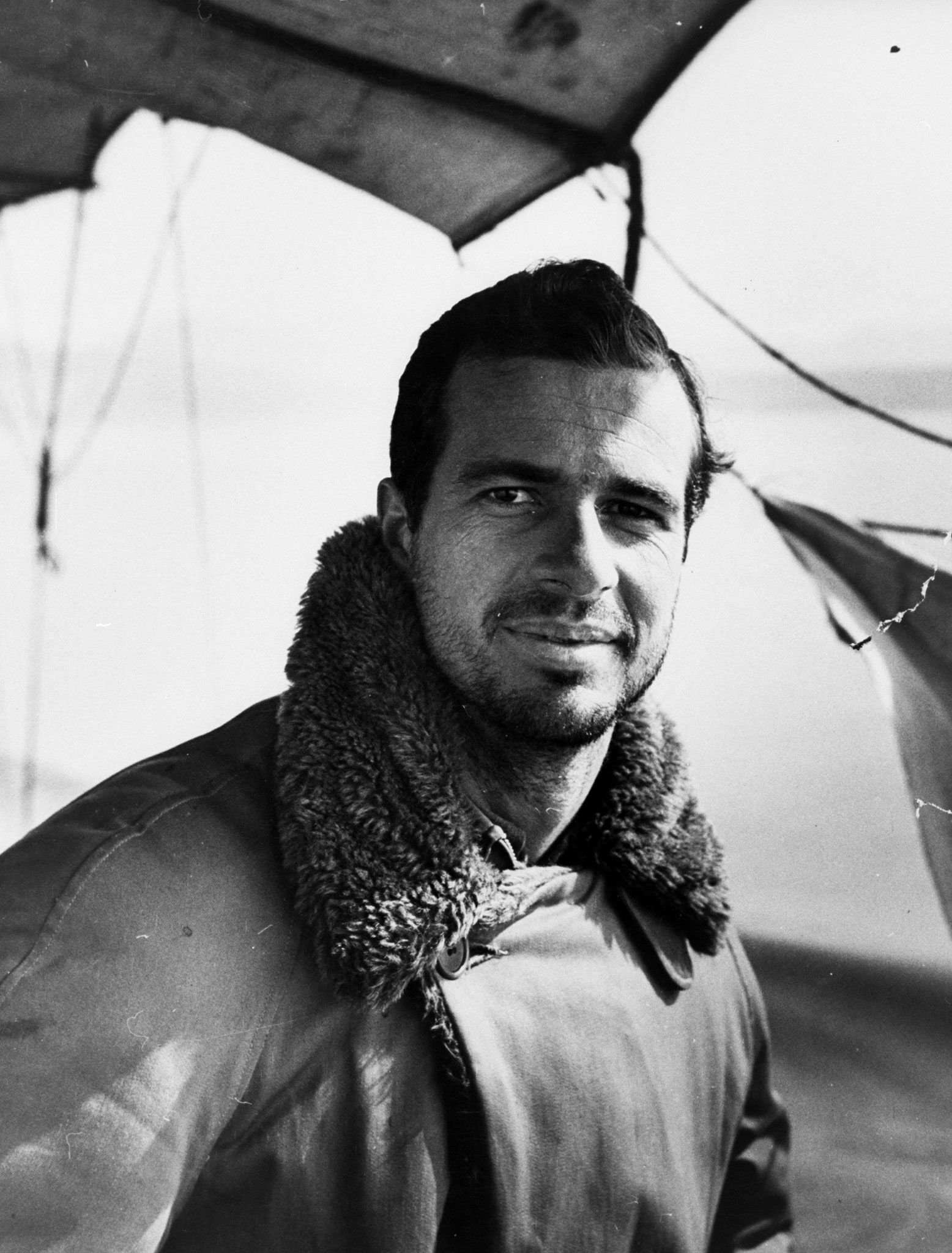
In 1946, John Hersey wrote a magazine article that changed the world. On the 75th anniversary of the events he described so vividly in Hiroshima, journalist Lesley M. M. Blume has given us Fallout, a timely reminder that Hersey’s courageous and influential reporting is as important today as it was when the facts about nuclear weapons were still shrouded in secrecy.
Blume depicts a diligent and resourceful wartime reporter struggling to uncover suppressed facts and disclose essential truths. She takes us into the musty offices of The New Yorker, at the time an upstart humor and society magazine, as Hersey and his editors plot to outmaneuver the post-war military censors who, under Gen. Douglas MacArthur, had closed off media access to Hiroshima and Nagasaki to all but the most cooperative journalists. Through a combination of careful preparation, his reputation for integrity, fortunate timing, and a certain amount of luck, Hersey himself had little trouble getting permission to enter Hiroshima, moved about freely, and was able to leave without interference, unlike colleagues who had their notes and film confiscated. (Hersey, Blume tells us, actually took no notes during his interviews as a means of evading the censors, and did not begin writing until he got home. Remarkably, he retained everything his subjects told him, and quoted them at length, with uncanny accuracy and respect for their stories.) Getting the story past the censors and into print once he had written it was a more daunting challenge, which Blume recounts with enthusiasm.
Read more…IPPNW statement on the US-Russia Presidential Joint Statement on Strategic Stability; Geneva, 16 June 2021

IPPNW, which along with Pugwash initiated the 7 June 2021 Russian-American High-Level Appeal to Presidents Biden and Putin on the issues of preventing nuclear war and nuclear disarmament, strongly welcomes the “US-Russia Presidential Joint Statement on Strategic Stability,” adopted by the two leaders at their meeting in Geneva on 16 June 2021.
By proclaiming the “shared goals of ensuring predictability in the strategic sphere, reducing the risk of armed conflicts and the threat of nuclear war,” the Presidential Statement offers hope for a much-needed shift from the climate of suspicion, misunderstanding and hostility that has characterised Russia-US relations in recent years. We look forward to early constructive outcomes from the integrated Strategic Stability Dialogue initiated by the presidents of Russia and the US.
In reaffirming the principle that “nuclear war cannot be won and must never be fought,” the Statement again establishes this essential truth as the foundation of negotiations between their two countries.
We hope that other nuclear weapons states, especially the Permanent Members of the UN Security Council, will also soon embrace this principle.
We call on President Putin and President Biden to make rapid progress on reducing and eliminating nuclear dangers based on this Statement. We urge them to recognize that nuclear weapons do not make either country more secure and are, in fact, the principal threat to their national security and to the security of the entire planet. We call on them to begin now negotiations for further deep reductions in their nuclear forces, which will pave the way for a verifiable, enforceable, time-bound agreement among all nine nuclear-armed nations to eliminate their nuclear weapons and accede to the Treaty on the Prohibition of Nuclear Weapons that entered into force in January of this year.
The Risk of Nuclear War With China
[The following letter was published in the New York Times on June 3. Dr. Gould is North American regional co-vice president of IPPNW and is president of the San Francisco Bay chapter of Physicians for Social Responsibility.]
To the Editor:
Re “The U.S. Nuclear War That Almost Happened” (news article, May 23):
The courageous disclosure by Daniel Ellsberg of the dangerous 1958 U.S.-China flash point over Taiwan provides a vivid warning of how easily we can precipitate a nuclear Armageddon by pursuing our strategy of heightened confrontation with China throughout the Pacific region.
Congress needs to oppose plans to greatly expand our military budget, including modernizing our deadly and overflowing stockpile of conventional and nuclear weapons. These expenditures, a down payment for a new Cold War, move us further from the global collaboration needed to solve our climate and other planetary emergencies evinced by the Covid pandemic.
Hopefully, learning from this grim historical revelation, our representatives should mobilize immediately to support the No First Use Act (H.R. 2603), introduced by Representative Adam Smith, to help avoid future predictable close calls involving nuclear weapons.
This would provide an opening for the United States and other nuclear-weapons states to move speedily to ratify the United Nations Treaty on the Prohibition of Nuclear Weapons, which would do much to end the daily, too-invisible threat to our very existence.
Robert M. Gould
San Francisco
On the violence in Israel and Palestine
IPPNW endorses statement by Middle East Treaty Organization; echoes call for immediate ceasefire
[The following statement on the deadly conflict between Israel and Palestine was issued by METO on 13 May. IPPNW endorses this statement by our partners in the region, and the views expressed here fully reflect our own.]
The latest violent conflict between Palestine and Israel further destabilises an already volatile region. The Middle East continues to face insecurity, instability and carnage from the manmade catastrophe in the Saudi-led war on Yemen, the on-going Syrian war, Iraq’s internal turmoil, and in faltering states such as Libya and Somalia. METO unequivocally condemns all forms of violent conflict raging across the region by all parties involved. We stand in solidarity with the civilians who are paying the ultimate cost of war with their lives and shattered hopes of a better future.
Read more…[IPPNW’s co-presidents, on behalf of the Executive Committee, have made the following recommendations for high priority agenda items and outcomes for the First Meeting of States Parties of the Treaty on the Prohibition of Nuclear Weapons (TPNW), which will convene in Vienna in January 2022.]
We look forward to the first meeting of States parties of the TPNW in January 2022 as an important milestone and step in the increasingly urgent race against time to eradicate nuclear weapons, which pose the most acute existential threat to humankind.
We are pleased to offer these initial recommendations, based on our professional expertise and obligations to prevent and treat disease and suffering, work to fulfill the human right to the highest attainable standard of health for all the world’s people, and promote the conditions required to achieve it.
Read more…IPPNW has co-signed the following letter to the 2021 G20 Summit in partnership with the Coalition of Global Health, Primary Care and Social Work Professionals, initiated by the World Federation of Public Health Associations. The same letter was sent to the 2021 G7 Summit.
Geneva 20 April 2021
Open Letter To:
Hon. Mario Draghi
Prime Minister of Italy
President of the 2021 G20 Summit
Together We Can Overcome the COVID-19 Pandemic: Global Health, Primary Care and
Social Work Professionals Call for Representation at the G20
The COVID-19 pandemic is a global public health issue requiring a global solution with
regional, national and local applicability. The extreme COVID-19 fatigue and uncertainty
experienced by populations worldwide urgently requires both short-term and long-term
practical solutions. The Coalition of Global Health, Primary Care and Social Work
Professionals, created under the auspices of the World Federation of Public Health
Associations, is representing over 160 million professionals worldwide, the expertise and
knowledge, the experience and the networks to make the difference.

It’s official – the first meeting of states parties to the Treaty on the Prohibition of Nuclear Weapons (TPNW) will be held on 12-14 January 2022 in Vienna.
The TPNW is the first new multilateral nuclear disarmament treaty to enter into force in 49 years, (since the 1972 Seabed Treaty prohibiting weapons of mass destruction on the seabed). Ironically nuclear weapons, the most destructive of all weapons, were the last weapons of mass destruction to be banned. Adopted at the United Nations in New York on 7 July 2017, the TPNW now has 86 signatories and 54 ratifications, and entered into legal force on 22 January this year.
Read more…The recent announcement by the British government that it plans a 40 percent increase in the number of nuclear weapons it possesses highlights the escalation of the exceptionally dangerous and costly nuclear arms race.
After decades of progress in reducing nuclear arsenals through arms control and disarmament agreements, all the nuclear powers are once again busily upgrading their nuclear weapons capabilities. For several years, the US government has been engaged in a massive nuclear “modernization” program, designed to refurbish its production facilities, enhance existing weapons, and build new ones. The Russian government, too, is investing heavily in beefing up its nuclear forces, and in July 2020, President Vladimir Putin announced that the Russian navy would soon be armed with hypersonic nuclear weapons and underwater nuclear drones. Meanwhile, China, India, Pakistan, and North Korea are expanding the size of their nuclear arsenals, while Israel is building a new, secret nuclear weapons facility and France is modernizing its ballistic missiles, cruise missiles, and missile-carrying submarines.
Read more…Amid widespread disease, death, and poverty, the major powers increased their military spending in 2020
Last year was a terrible time for vast numbers of people around the globe, who experienced not only a terrible disease pandemic, accompanied by widespread sickness and death, but severe economic hardship.
Even so, the disasters of 2020 were not shocking enough to jolt the world’s most powerful nations out of their traditional preoccupation with enhancing their armed might, for once again they raised their military spending to new heights.
During 2020, world military expenditures increased to $1,981,000,000,000—or nearly $2 trillion—with the outlays of the three leading military powers playing a major part in the growth. The US government increased its military spending from $732 billion in 2019 to $778 billion in 2020, thus retaining its top spot among the biggest funders of war preparations. Meanwhile, the Chinese government hiked its military spending to $252 billion, while the Russian government raised its military outlay to $61.7 billion.
Read more…
by Carlos Umaña
In this global crisis caused by the COVID-19 pandemic, the world has become aware of the importance of following science and evidence in policymaking, and there is a greater understanding of where true security actually lies and which countries and systems are more capable of protecting their people.
This pandemic is a symptom of a disease that ails humanity, and that could very well lead to more pandemics once this one is over, if we, as a global community, do not take drastic action.
This COVID-19 crisis has exposed many systemic flaws and vulnerabilities, and as serious as its impact has been to our health and our economies worldwide, it is not an existential threat, and its impact is insignificant compared to that of the impending climate crisis and of a nuclear war, whatever its proportions.
Climate change and nuclear weapons are the 2 existential threats to life on Earth. They are intricately linked and mutually reinforcing. With the world’s climate being as unpredictable and changing as it currently is, the climate crisis is impossible to ignore. However, most people do ignore how serious the risk of nuclear war is and why nuclear disarmament is more important today than ever.
Read more…
 Bimal Khadka
 Bjorn Hilt
 Charles K. Johnson
 Gunnar Westberg
 IPPNW
IPPNW John Loretz
 Lawrence Wittner
 Maria Valenti
 mollymcgint
 Sue Wareham
 Tilman Ruff
 Tim Wright
 Xanthe Hall


 IPPNW peace and health blog