Proposed US/UK nuclear-powered submarines for Australia: jeopardising health and fueling an arms race
Summary of joint statement by IPPNW and its affiliates in Australia, UK and US
Health professionals in Australia, the UK and the US have expressed their deep concerns at Australia’s proposed acquisition of nuclear-powered submarines with UK and US assistance, stating that the plan will jeopardise global health and security. Their concerns are set out in a briefing paper.
Read more…Global health summer school encourages hands-on learning about medical peace work
by Victor Chelashow, IPPNW International Student Representative, Kenya
The 10th Annual Global Health Summer School (GHSS) was hosted by IPPNW Germany, Medical Peace Work, and Institute for Social Medicine, Epidemiology and Social Sciences at Charite University. It commenced on 24 July 2021 and ran for a week, with the focus on “Climate Change and Health.” I was invited to participate and present on medical peace work courses and the practical approach we take at the Medical Students for Social Responsibility in Kenya.
Read more…Nuclear sharing must end in Europe
[On September 5, IPPNW regional Vice President Angelika Claussen spoke at a demonstration at the Büchel nuclear base in Germany, where 800 activists formed a human chain to call for the removal of the 20 US nuclear bombs that are stored there.]
by Angelika Claussen
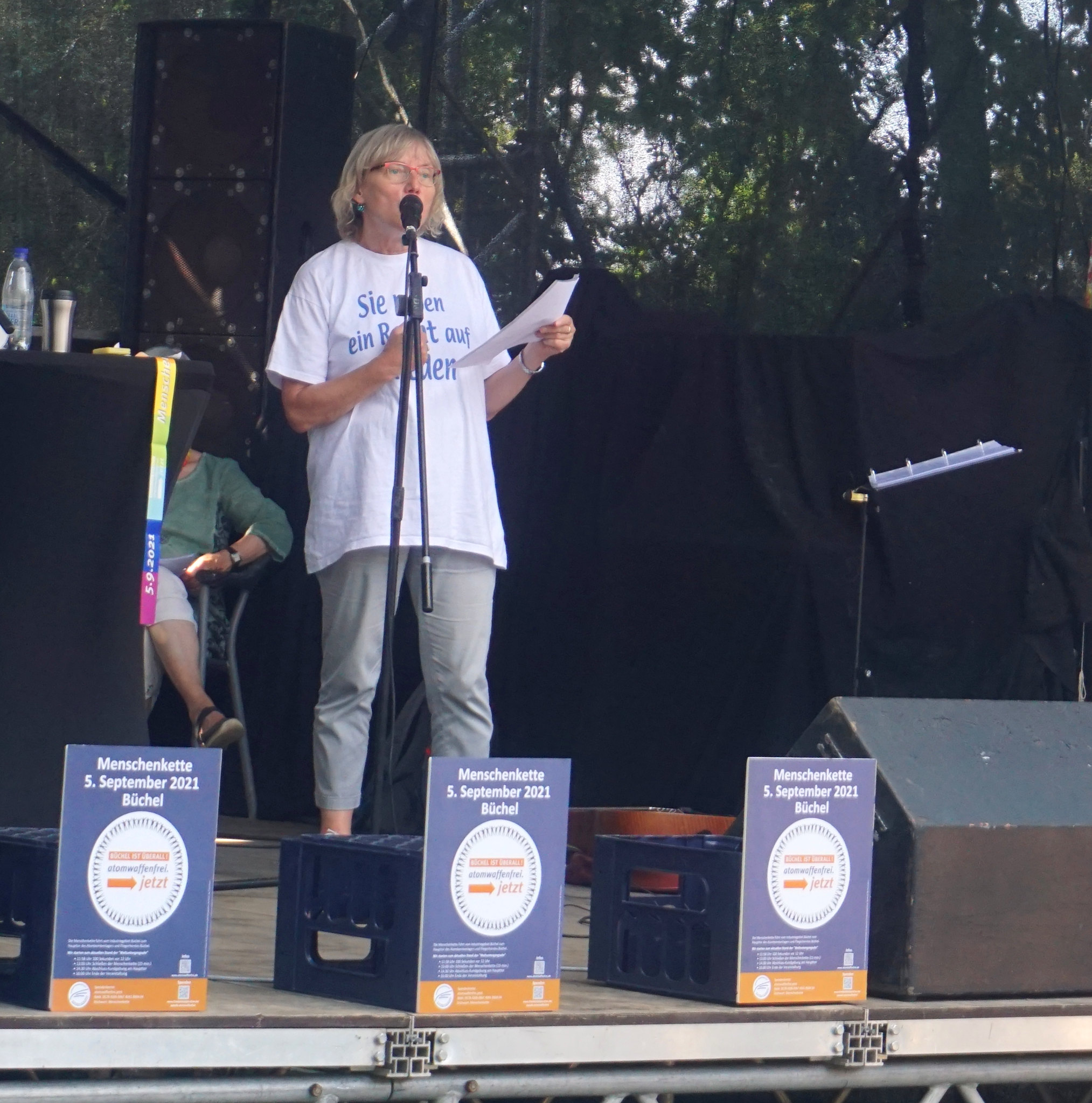
From a peace and security policy perspective, the year 2021 has been particularly marked by two events:
1. The entry into force of the Treaty on the Prohibition of Nuclear Weapons in January 2021 and
2. The defeat of the USA as a world power in Afghanistan.
The entry into force of the Treaty on the Prohibition of Nuclear Weapons is a huge success story of the worldwide peace movement! The peace movement is a real success story. We, global civil society, in alliance with the countries of the global South and courageous, outstanding politicians from countries in Europe, from Austria and from Ireland, have achieved a nuclear ban. We expected resistance from the nuclear weapons states, as the TPNW is diametrically opposed to their interests!
Now it’s Europe’s turn! Nuclear sharing must end in Europe: in Germany, in Belgium, in the Netherlands and in Italy. We can also achieve this goal together if we are clever in our approach.
The first step is to call NATO’s nuclear dogma, the dogma of nuclear deterrence, into question.
Read more…By Dr Arun Mitra
The incident of shouting highly communalized slogans and chanting genocide of Muslims and also that they be thrown out of India by a mob of Hindutva goons with police watching as mute spectator is not a new thing. The difference however is that this incident has happened at Jantar Mantar in proximity to the Parliament. Till date neither the Prime Minister nor the Home Minister have uttered a single word to condemn it. Even in his Independence day speech the Prime Minister took no notice of this. Their silence is intriguing. Encouraged with government’s covert support, an incident of similar type occurred in Kanpur just after three days. In this case the accused got bail in the Police station itself
Earlier too we have seen crowds forcing people to chant Jai Shri Ram. Many innocents have faced mob lynching something hitherto unknown in our country. All this is not spontaneous but apparently a part of the pre-planned strategy of the Hindutva brigade to vitiate the atmosphere and generate communal riots so that the situation is then utilized to further their agenda at a time when elections in some parts of the country are a few months away. As a result of such incidents social cohesion becomes weak and health is a major casualty.
Read more…Baby teeth collected six decades ago will reveal the damage to Americans’ health caused by US nuclear weapons tests
by Lawrence Wittner and Joseph Mangano
In 2020, Harvard University’s T. C. Chan School of Public Health began a five-year study, funded by the National Institutes of Health, that will examine the connection between early life exposure to toxic metals and later-life risk of neurological disease. A collaborator with Harvard, the Radiation and Public Health Project, will analyze the relationship of strontium-90 (a radioactive element in nuclear weapons explosions) and disease risk in later life.
The centerpiece of the study is a collection of nearly 100,000 baby teeth, gathered in the late 1950s and early 1960s by the St. Louis Committee for Nuclear Information.
Read more…Setsuko Thurlow Rose honors the legacy of a Hiroshima survivor and abolition campaigner

In the year that the Treaty on the Prohibition of Nuclear Weapons enters in force, a new variety of rose will be planted in Spain. The Setsuko Thurlow Rose, a rose of hope, will be planted on the International Day for the Total Elimination of Nuclear Weapons, September 26, 2021, in a prominent rose garden in Madrid, with a nameplate “Setsuko Thurlow”. The rose was cultivated by Matilde Ferrer, a world-renowned rose breeder and former president of the European society of rose breeders. Matilde describes the Setsuko Thurlow Rose as a “beautiful, multicolored rose, delicate in appearance, yet resilient. It does not lose its leaves throughout the year.”
Read more…UN PoA at 20 – How to #Breakthechain of Armed Violence
Today the 7th Biennial Meeting of States of the United Nations Programme of Action on Small Arms and Light Weapons (UN PoA) convenes. According to the UN, with this international agreement adopted in 2001, “governments agreed to improve national small arms laws, import/export controls, and stockpile management – and to engage in cooperation and assistance,” with a goal “to prevent illegal manufacture of and illicit trafficking in small arms and light weapons, or their diversion to unauthorized recipients.”
Read more…Paying tribute to Maohi Nui heroes
[Message of support and solidarity to the Maohi Lives Matter event, 17 July 2021, Papeete,
Maohi Nui/French Polynesia]
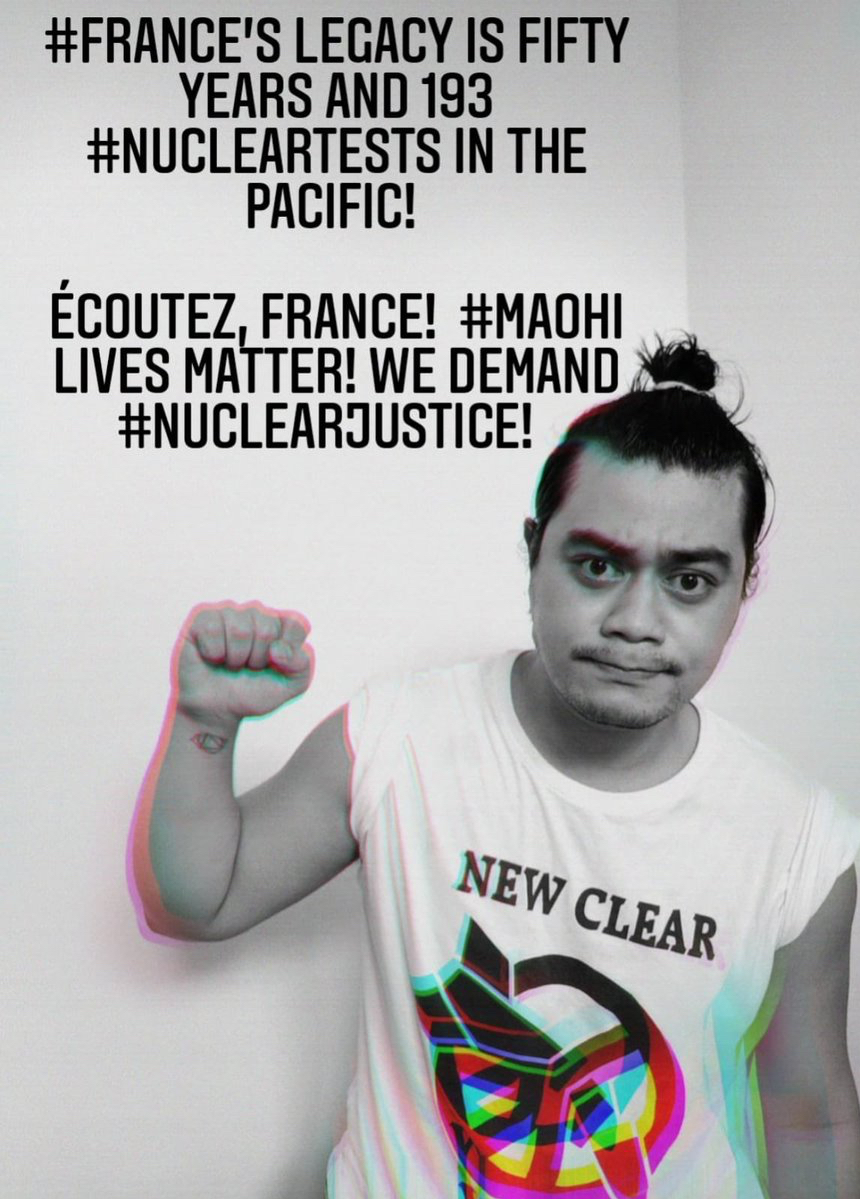
From our international medical federation, representing national affiliate organisations of physicians and health professional colleagues around the world, we send our warm greetings and solidarity to people participating in the Maohi Lives Matter event in Papeete on 17 July 2021.
We note that this day marks the anniversary of the infamous Centaur nuclear test explosion at Moruroa in 1974, one of many which indiscriminately contaminated inhabited areas of Maohi Nui and other areas of the Pacific region with radioactive fallout. These invisible radioactive toxins will continue for many generations hence to damage the genetic inheritance of human beings and other organisms, increasing the risk of cancer, adverse pregnancy outcomes, and cardiovascular and other chronic diseases. We also know that the effects of nuclear test explosions go well beyond physical radiation harms; in addition causing physical damage and chemical and toxic contamination of islands and reefs; distress, displacement, disruption of livelihoods, communities, cultures and connections to ancestral lands.
Conflict or cooperation in US-China relations?
The United States and China, the world’s mightiest military and economic powers, are currently heading toward a Cold War or even a hot one, with disastrous consequences. But an alternative path is available and could be taken.
Read more…Nationalism on the decline
Although, beginning in about 2015, nationalist political parties made enormous advances in countries around the world, more recently they have been on the wane.
The nationalist surge was led by a new generation of rightwing populist demagogues who, feeding on public discontent with widespread immigration and economic stagnation, achieved startling political breakthroughs. Matteo Salvini of Italy, Geert Wilders of the Netherlands, and Marine Le Pen of France catapulted their fringe political movements into major party status. In Britain, Nigel Farage’s United Kingdom Independence Party (UKIP) startled mainstream parties by winning a referendum calling for Britain’s withdrawal from the European Union. Donald Trump, championing an “America First” policy, shocked political pundits by emerging victorious in the 2016 U.S. presidential race. Two years later, in Brazil, the flamboyant Jair Bolsonaro, campaigning under the slogan “Brazil Above Everything,” was easily elected president of his country. In May 2019, Narendra Modi’s BJP, a Hindu nationalist party, won a landslide election victory in India.
As the acknowledged leader of the rightwing, nationalist uprising in these and other nations, Trump forged close contacts with his overseas counterparts and pulled the U.S. government out of international treaties, as well as out of global institutions. “Wise leaders always put the good of their own people and their own country first,” he admonished the UN General Assembly in September 2019. “The future does not belong to globalists. The future belongs to patriots.”
But, even as he spoke, the nationalist momentum was beginning to falter.
Read more…
 Bimal Khadka
 Bjorn Hilt
 Charles K. Johnson
 Gunnar Westberg
 IPPNW
IPPNW John Loretz
 Lawrence Wittner
 Maria Valenti
 mollymcgint
 Sue Wareham
 Tilman Ruff
 Tim Wright
 Xanthe Hall


 IPPNW peace and health blog