What I learned about governments by reading classified documents

Donald Trump’s illegal retention of classified US government records reminded me that I have been reading these kinds of sensitive official files after their declassification―and learning from them―for decades.
The reason is that I am a scholar of international history and, in this connection, have drawn upon such material in my research. Governments keep secrets, and to understand the full story of their behavior, it is often necessary to dig into the documentary evidence.
Read more…A four-week festival of double standards
Hypocrisy & outright lying by nuclear-armed states
Guest commentary by Jackie Cabasso
The 10th NPT Review Conference didn’t fail because it couldn’t produce a final document. It failed because the nuclear-armed states haven’t made good on their fundamental nuclear disarmament obligation under Article VI of the Treaty, undertaken 52 years ago, nor on the promises and commitments to action items that would lead to nuclear disarmament they agreed to in connection with the indefinite extension of the Treaty in 1995 and in the 2000 and 2010 final documents.
Read more…Why should war criminals operate with impunity?
The issue of alleged Russian war crimes in Ukraine highlights the decades-long reluctance of today’s major military powers to support the International Criminal Court.

In 1998, the International Criminal Court (ICC) was established by an international treaty, the Rome Statute. Coming into force in 2002 and with 123 nations now parties to it, the treaty provides that the ICC, headquartered at the Hague, may investigate and prosecute individuals for war crimes, genocide, crimes against humanity, and the crime of aggression. As a court of last resort, the ICC may only initiate proceedings when a country is unwilling or unable to take such action against its nationals or anyone else on its territory. In addition, although the ICC is authorized to initiate investigations anywhere, it may only try nationals or residents of nations that are parties to the treaty, unless it is authorized to investigate by the nation where the crimes occurred.
Read more…“Limited regional” nuclear war would trigger a global climate catastrophe according to new study
It’s long been known a major nuclear war could destroy modern civilization and kill most of humanity. But what about a “limited” nuclear war—a conflict confined to one region, say, or involving just a tiny fraction of the world’s arsenals?
“Nuclear Famine,” a new report published today by IPPNW, summarizes the latest scientific work, which shows that a so-called “limited” or “regional” nuclear war would be neither limited nor regional. On the contrary, it would be a planetary-scale event. In fact, it would be far more dangerous than we understood even a few years ago. A war that detonated less than 1/20th of the world’s nuclear weapons would still crash the climate, the global food supply chains, and likely public order. Famines and unrest would kill hundreds of millions, perhaps even billions.
Read more…International Physicians for the Prevention of Nuclear War is urging governments attending the Review Conference of the Non-Proliferation Treaty (NPT) in New York to call for a ban on military attacks on nuclear installations. Obstacles to access for the International Atomic Energy Agency (IAEA) to the Zaporizhzhia nuclear power plant in Ukraine must be overcome.
“Waging war in a country with operational nuclear reactors is previously unknown and breaks a taboo,” says Dr. Angelika Claussen, IPPNW Vice-President for Europe. “With every day that the war in Ukraine continues, the probability increases that a nuclear disaster can occur. That is why we are urging NPT states parties to declare that military attacks on nuclear installations should be banned.”
Read more…Reflections on the faltering road to nuclear disarmament: from Hiroshima to the Ukraine war
Guest Commentary
by Dr. Ghassan Shahrour
August sixth of 2022, is the seventy-seventh anniversary of the launch of the “Hiroshima” and then “Nagasaki” bombs. Our world is again in difficult circumstances due to the Ukraine war, the catastrophic humanitarian and economic consequences of which are growing day after day. With the intensification of the war and conflict, there is the insinuation and statement of an inappropriate and unacceptable threat of more than one party resorting to nuclear weapons, which constitutes an insult to human dignity and the rules of the international humanitarian law.
Read more…If we are to survive…we must change course
[Former IPPNW co-president Ira Helfand, on behalf of the federation, will deliver the following statement today at the Non-Proliferation Treaty (NPT) Review Conference at the United Nations in New York.]
More than 50 years ago the nations of the world, understanding the grave existential threat posed by nuclear weapons, came together in this Non-Proliferation Treaty to stop the spread of these weapons and to commit to their elimination at the earliest possible moment.
Read more…An Appeal to The Rt Hon Patricia Scotland QC, Commonwealth Secretary
From Commonwealth affiliates of International Physicians for the Prevention of Nuclear War (IPPNW)
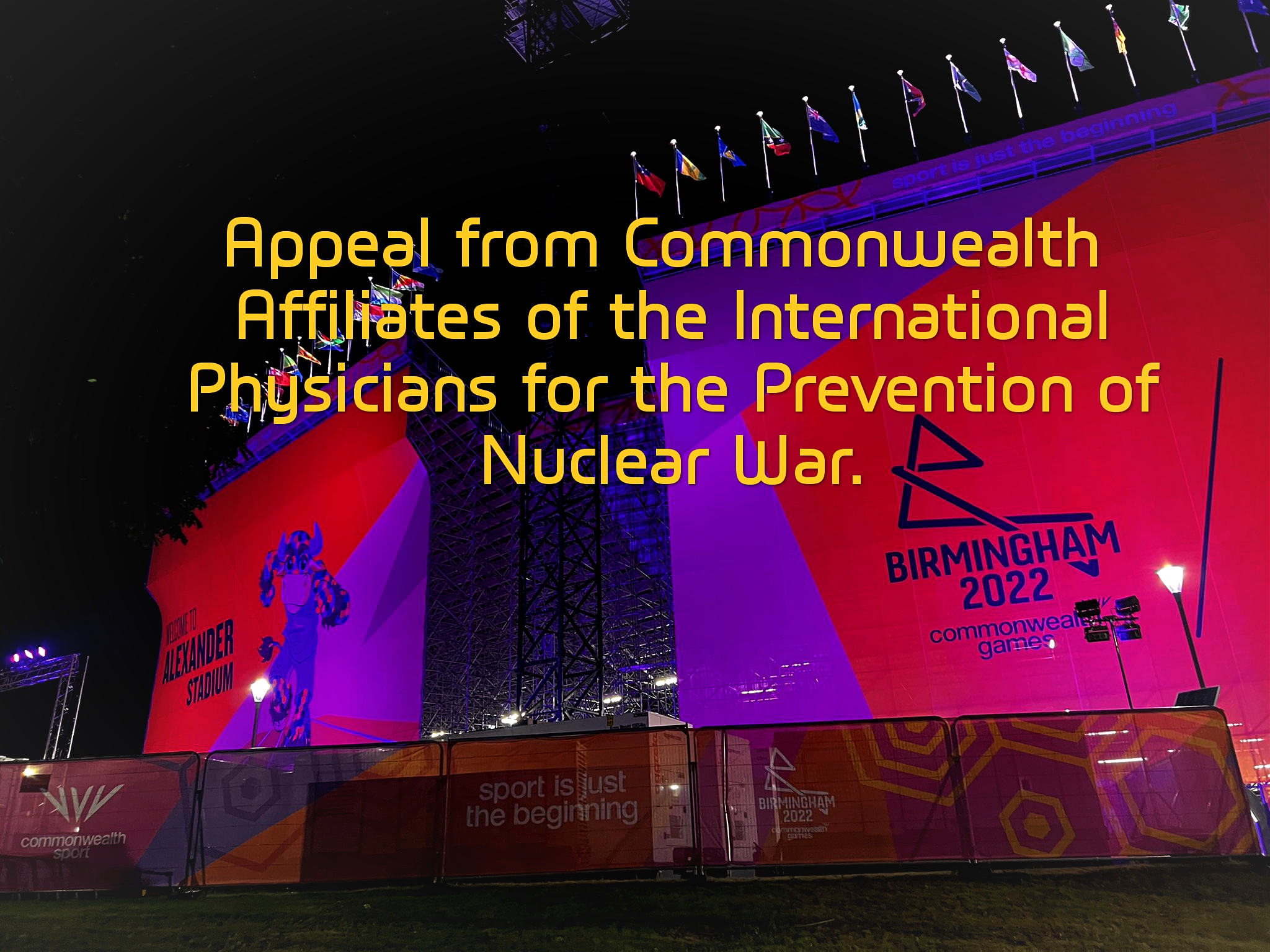
27 July 2022
International Physicians for the Prevention of Nuclear War (IPPNW) is an international federation of physicians working together for the abolition of nuclear weapons, the prevention of armed violence, and world peace. Established in 1980 amidst the Cold War which threatened our planet with nuclear catastrophe, IPPNW was honoured with the Nobel Peace Prize in 1985 for its global campaign to educate world leaders and the public about the medical and environmental consequences of nuclear weapons and nuclear war. It has more than 54 national affiliates worldwide working for peace on different levels.
Read more…Blueprint for nuclear disarmament: the first meeting of the nuclear weapons ban treaty
by Bimal Khadka
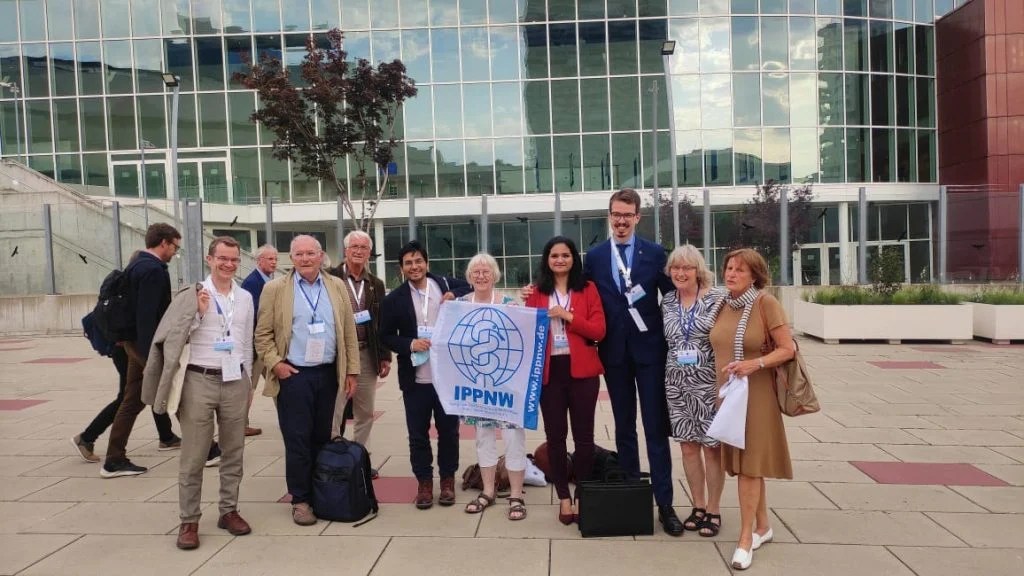
For almost three years, fighting COVID in an emergency department has left me with regular feelings of burnout. That’s why it was such a pleasure for me to join and witness history at a week of anti-nuclear events surrounding the first ever meeting of state parties to the Treaty on the Prohibition of Nuclear Weapons (TPNW), from 18 to 23 June, representing International Physicians for the Prevention of the Nuclear War (IPPNW). I was so generously hosted by Jana Reichhold, Austrian IPPNW medical student in Vienna, and we had such fun despite a hectic schedule of workshops, meetings, seminars, and a bike tour. My first time attending a United Nations conference was unforgettable, and I promise it will not be the last.
Read more…For many years, substantial military operations have been conducted by mercenaries, ranging from professional soldiers hired to fight wars for European potentates in the 14thcentury to the combat forces of Blackwater, a private company employed by the US government to undertake violent activities in the “War on Terror” of the early 21st century.
Today, the Wagner Group, a shadowy Russian company engaged in the thriving mercenary business, is perhaps the leading private enterprise partner in global military ventures. Employing as many as 10,000 military personnel, it is headquartered in the Russian town of Molkino, right beside a military base run by the GRU, Russia’s military intelligence agency. It relies heavily on the Russian government’s approval and military infrastructure for its far-flung operations.
Read more…
 Bimal Khadka
 Bjorn Hilt
 Charles K. Johnson
 Gunnar Westberg
 IPPNW
IPPNW John Loretz
 Lawrence Wittner
 Maria Valenti
 mollymcgint
 Sue Wareham
 Tilman Ruff
 Tim Wright
 Xanthe Hall


 IPPNW peace and health blog