by Lawrence S. Wittner
Perhaps the greatest tragedy of the immensely destructive Ukraine War lies in the fact that it could have been averted.
The most obvious way was for the Russian government to abandon its plan for the military conquest of Ukraine.
The problem on this score, though, was that Vladimir Putin was determined to revive Russia’s “great power” status. Although his predecessors had signed the UN Charter (which prohibits the “use of force against the territorial integrity or political independence of any state”), as well as the Budapest Memorandum and the Treaty on Friendship, Cooperation, and Partnership (both of which specifically committed the Russian government to respecting Ukraine’s sovereignty and territorial integrity), Putin was an ambitious ruler, determined to restore what he considered Russia’s imperial grandeur.
Read more…Mainstream media need to focus on peace
by Sue Wareham

The fact that Australia is sleepwalking towards a catastrophic war against China has received very welcome and responsible coverage in Pearls and Irritations and other non-mainstream media. The head-in-the-sand stance adopted by much of the mainstream media stands in stark contrast. The most recent example of the latter was a 15-page supplement in The Canberra Times (CT) on 17 May—‘Our Next Steps’, on the Defence Strategic Review. It was a most shameful collection of war-mongering articles and images.
Read more…by Arun Mitra
Much was expected from the recently concluded summit of the group of seven countries—the G7—which included the USA, the UK, France, Canada, Italy, Germany, and Japan. Since the world is faced with the serious threat of use of nuclear weapons during the on-going Russia-Ukraine war, there was a feeling that the G7 should come out with a clear-cut commitment and time-bound strategy for nuclear disarmament. The summit had special importance as it was held in Hiroshima, a city which faced the catastrophic impact of the first ever use of the atomic bomb on a human population. The final communiqué released after the summit—the ‘Leaders’ Declaration,’ as it is called—does not, however, cite their explicit commitment to take steps to abolish nuclear weapons as a matter of urgency.
Read more…
[Dr. Angelika Claussen, co-chair of the German section of IPPNW and the federation‘s regional vice president for Europe, gave the following speech in Germany’s national parliament, the Bundestag, on 8 May.]
You have scheduled this hearing on 8 May, the anniversary of the end of the Second World War. With this commemoration, you have set an example for the future and for disarmament, for building a peace order. I thank you for this.
The world is in profound, multiple crises. The climate crisis and the increasing danger of nuclear war are the two greatest threats in the 21st century.
Read more…It should come as no surprise that the world is currently facing an existential nuclear danger. In fact, it has been caught up in that danger since 1945, when atomic bombs were used to annihilate the populations of Hiroshima and Nagasaki.
Today, however, the danger of a nuclear holocaust is probably greater than in the past. There are now nine nuclear powers―the United States, Russia, Britain, France, China, Israel, India, Pakistan, and North Korea―and they are currently engaged in a new nuclear arms race, building ever more efficient weapons of mass destruction. The latest entry in their nuclear scramble, the hypersonic missile, travels at more than five times the speed of sound and is adept at evading missile defense systems.
Read more…[The following statement, adopted by the IPPNW Board during the 23rd World Congress in Mombasa, was not endorsed by Japanese Physicians for the Prevention of Nuclear War (JPPNW)]

Medical call to Japan to abandon the planned release of over 1.3 million tons of radioactively contaminated water from the Fukushima Daiichi nuclear power plant disaster into the Pacific Ocean
As physicians with professional responsibility to promote and protect long-term human and planetary health, we urge the Government of Japan to stop the planned release of large amounts of radioactively contaminated water from the damaged Fukushima Daiichi nuclear plant into the Pacific Ocean. We consider that the plan to use the Pacific Ocean has a radioactive waste dump involves risks to oceanic and human health and is neither responsible nor sustainable.
Instead we urge full, evidence-based and transparent consideration of several viable alternative approaches, including storage in purpose-built seismically safe tanks, possibly after initial purification, subsequent use in concrete for structural applications with little or no potential for contact with humans and other organisms, and bioremediation for some important isotopes such as strontium-90. All the proposed alternatives would have orders of magnitude less impact and avoid transboundary impacts.
Read more…by Carlos Umaña

[Co-President Carlos Umaña delivered the following remarks during the opening plenary of IPPNW’s 23rd World Congress in Mombasa, Kenya, on April 26.]
Climate change and nuclear weapons are the 2 existential threats to life on Earth. They are referred to as the twin existential threats, for they are intricately linked and mutually reinforcing. With the world’s climate being as unpredictable and changing as it currently is, the climate crisis is impossible to ignore. However, most people do ignore how serious the risk of nuclear war is, and how working in nuclear abolition can help solve the climate crisis.
Read more…[The following demand for a ceasefire in Ukraine and negotiations for a peaceful solution to a war that risks escalation to a nuclear catastrophe was issued by IPPNW’s International Council and Board of Directors at the conclusion of the 23rd IPPNW World Congress in Mombasa.]
At our 23rd World Congress in Mombasa in April 2023, we, the International Physicians for the Prevention of Nuclear War, discussed the risks and impending consequences of the current, crisis situation on our planet. The war in Ukraine bears enormous costs for people mainly, but not only in Ukraine and causes unspeakable suffering. So many civilians and soldiers from both sides have lost their lives, health and livelihoods. In addition, global food supplies have already suffered and prices for essential goods are rising. According to current figures, hunger in Africa threatens to increase by 117% if the war is not stopped immediately.
Crucially there is a real and growing risk that the world will enter a nuclear war in the near future. With every day of the ongoing war in Ukraine, this risk increases.
Read more…The world urgently needs to change course
[The following Congress Declaration was published at the conclusion of IPPNW’s 23rd World Congress in Mombasa, Kenya, 27-29 April 2023.]
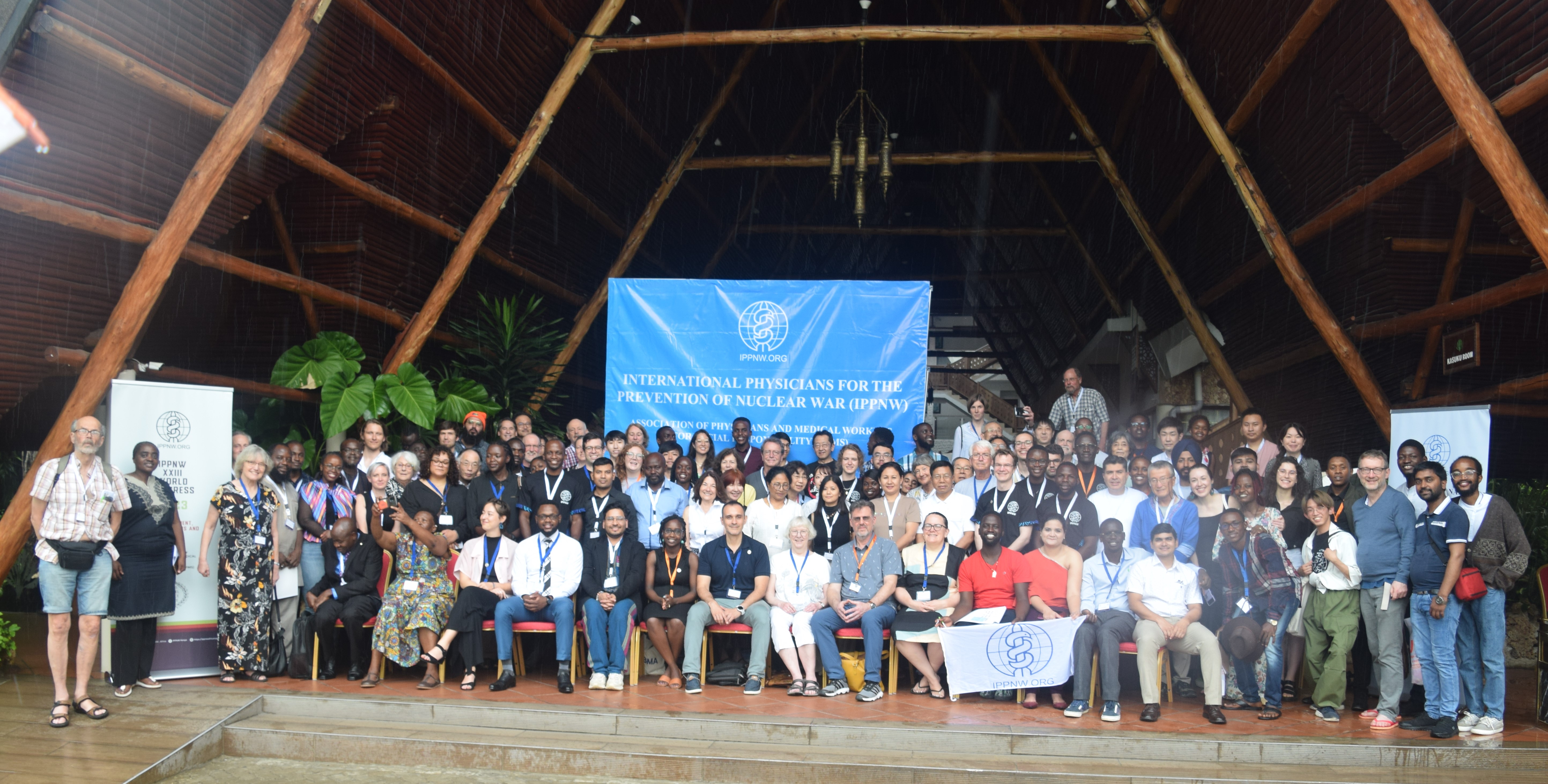
We are honored to gather in Mombasa, one of Africa’s oldest and most historic cities, for the first IPPNW World Congress on the continent. As physicians, medical students, and health professionals committed to a peaceful and equitable world for all people, we join in solidarity with our African colleagues, who struggle on many fronts to erase the vestiges of colonialism, to end the post-colonial conflicts that have killed millions, and to advocate for policies that will provide health, true security, economic justice, and environmental protection not only for Africa but also for the world as a whole.
Read more…Nuclear weapons: a big threat to Africa, too
by Sally Ndung’u
7th July 2017 the United Nations adopted a new nuclear ban treaty- the Treaty on the Prohibition of Nuclear Weapons.
A single nuclear bomb detonated in any part of the world could kill millions of people with the destruction extending far beyond the area of explosion. Those who remain would be at increased risk of cancer and chronic diseases over time and suffer genetic mutations that would persist through generations. If there were a nuclear war, even a limited one, the main cause of human fatalities would however not be the blast or radiation effects but mass starvation, and this brings the issue of nuclear weapons closer to you and I here in Africa!
Read more…
 Bimal Khadka
 Bjorn Hilt
 Charles K. Johnson
 Gunnar Westberg
 IPPNW
IPPNW John Loretz
 Lawrence Wittner
 Maria Valenti
 mollymcgint
 Sue Wareham
 Tilman Ruff
 Tim Wright
 Xanthe Hall


 IPPNW peace and health blog