IPPNW: “A fascinating case study of the power of medicalization”
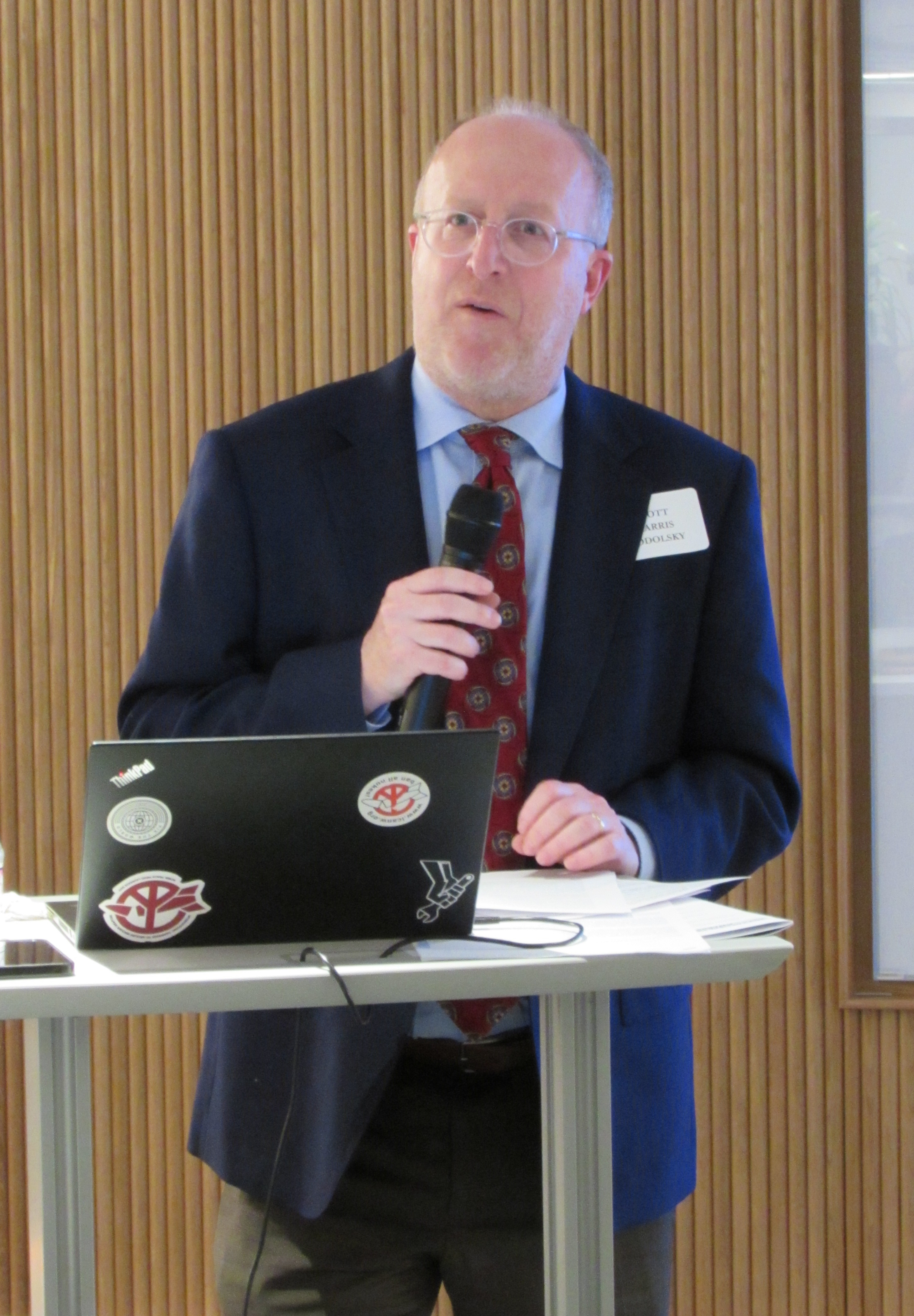
[Dr. Scott Podolsky is Professor of Global Health and Social Medicine at Harvard Medical School and a primary care physician at Massachusetts General Hospital. Since 2006, he has served as the director of the Center for the History of Medicine based at the Countway Medical Library. He delivered the following remarks at an event co-sponsored by IPPNW and Greater Boston Physicians for Social Responsibility at Harvard Medical School’s Countway Library on 21 October.]
Read more…“Reducing the risks of nuclear war—the role of health professionals”: the editorial’s impact
[In August, IPPNW reported that more than 100 (now more than 150) medical journals, including the Lancet, the British Medical Journal, the New England Journal of Medicine, and JAMA published a joint editorial entitled “Reducing the risks of nuclear war — the role of health professionals.” One of the authors of the editorial, Dr Chris Zielinski, has written the following report on the editorial’s reach and impact for IPPNW and the World Association of Medical Editors.]
Read more…The International Peace Bureau (IPB), Middle East Treaty Organization (METO), and International Physicians for the Prevention of Nuclear War (IPPNW) are deeply concerned over the unprecedented Israeli-Palestinian violent escalation launched in the morning of Saturday, 7th October, which has already resulted in the loss of hundreds of lives. The resulting fear, panic, and uncertainty that the Israeli and Palestinian people feel in these moments demand our compassion and understanding, even as the extent to which the conflict will escalate remains unclear.
The death toll cannot continue to rise. The signatories to this statement therefore call for immediate global attention to deescalate the conflict and provide on-the-ground humanitarian assistance. Furthermore, we call on the international community to support the immediate cessation of attacks and abductions of civilians and attacks on non-military infrastructure. The UNSC must live up to its charter-mandated responsibility for the maintenance of international peace and security. It should urgently demand all parties to stop violence and respect and protect lives of civilians, especially children.
There is no military solution to the multifaceted and complex crisis between Israel and Palestine; we acknowledge the deep suffering of Palestinians and Israelis even under the status quo, including settler violence, terrorist attacks, economic violence, and a constant environment of fear under violation of international law. The root causes of the conflict are deep and can only be addressed when immediate and direct violence is not present.
Therefore, together we call for:
- An immediate cessation of violence–in particular the targeting of civilian infrastructure;
- The immediate exchange of hostages and prisoners under humanitarian concerns;
- The establishment of a humanitarian corridor for safe passage of emergency services and aid;
- The international community, in particular the League of Arab States, to engage in negotiations based on the Arab Peace Initiative (API), the only comprehensive solution to the Israeli-Arab conflict in the Middle East.
The abolition of nuclear weapons is an essential part of respecting and protecting all living things
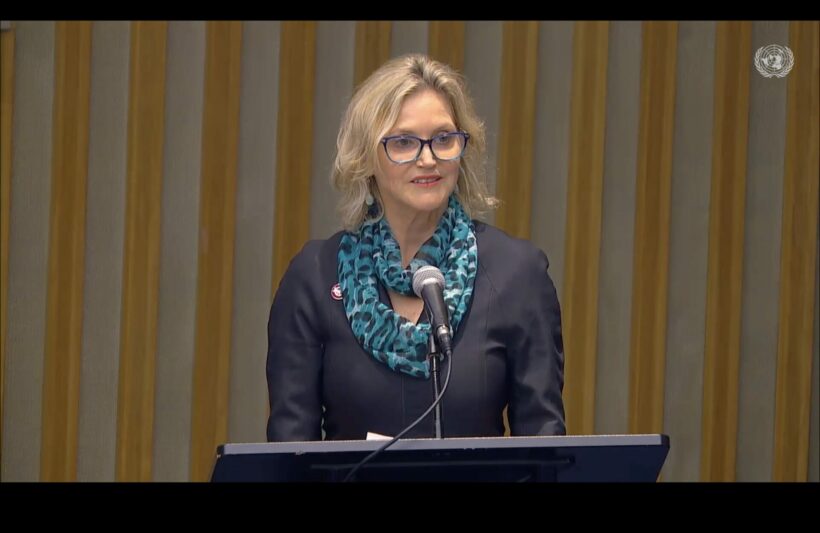
A conversation with ICAN Executive Director Melissa Parke
[Melissa Parke is a lawyer and parliamentarian who has worked with the United Nations on international humanitarian and human rights issues in several conflict areas. She’s a former Minister for International Development and a former member of Parliament for the Labour Party in Australia. She was the Australian chair of Parliamentarians for Global Action and was founding chair of the Australia United Nations Parliamentary Group. She’s been deeply involved with nuclear issues since the 1990s, campaigning against the establishment of a global nuclear waste dump in her home state of western Australia. More recently, Ms. Parke has served as an ambassador for ICAN Australia, promoting the Treaty on the Prohibition of Nuclear Weapons (TPNW) since its adoption by the UN in 2017. On 1 September, Ms. Parke took a new position as executive director of ICAN, the International Campaign to Abolish Nuclear Weapons.
Read more…World peace and security require a stronger United Nations
Addressing the UN Security Council on September 20, 2023, Ukrainian President Volodymyr Zelensky delivered a heartfelt plea “to update the existing security architecture in the world, in particular, to restore the real power of the UN Charter.”
This call for strengthening international security under the aegis of the United Nations makes sense not only for Ukraine―a country suffering from brutal military invasion, occupation, and annexation by its much larger, more powerful neighbor, the Russian Federation―but for the nations of the world.
Read more…Australia’s AUKUS nuclear submarine plans are bad for nonproliferation and increase the risk of nuclear war
by Tilman Ruff
Two years ago this week, the AUKUS pact was announced. When US President Joe Biden, UK Prime Minister Rishi Sunak and Australian Prime Minister Anthony Albanese stood together in San Diego on March 14, 2023, to announce arrangements for the Australian acquisition of nuclear-powered submarines (SSNs), many Australians were dumbstruck. They were as dumbstruck as they were when the initial announcement was made 18 months earlier by Biden and past prime ministers Boris Johnson and Scott Morrison in the dying stages of a discredited Australian government. Their dismay was shared by many of Australia’s neighbors in Asia and the Pacific.
Read more…From the Partial Test Ban Treaty to a nuclear weapons-free world

This September is the sixtieth anniversary of US and Soviet ratification of the world’s first significant nuclear arms control agreement, the Partial Test Ban Treaty. Thus, it’s an appropriate time to examine that treaty, as well as to consider what might be done to end the danger of nuclear annihilation.
Read more…Hiroshima and me
by Kati Juva
When I was a child I saw an advertisement of a movie called Hiroshima, mon amour and asked my parents “who is Hiroshima?” They said they were actually glad I did not know, but then explained what had happened there in 1945.

In the 1970s the fear of a nuclear war was very real, and we children and young people thought we may not live long enough to become adults. We knew what had happened in Hiroshima and Nagasaki and feared it could happen in our home town. Later in medical school there were courses about radiation and it causing cancer and malformations. Most of the knowledge of the impacts of ionizing radiation to humans are derived from the experiences of the atomic bombing, so Hiroshima and Nagasaki were always in the background of these lectures. Humankind and medical science could easily have lived without this experiment.
Read more…The world needs brave and responsible decision making

[Co-president Carlos Umaña delivered the following statement on behalf of IPPNW at the NPT PrepCom in Vienna on August 2. The PrepCom ended in stalemate when States Parties were unable to reach consensus on the chair’s factual summary of the two-week meeting. As a result, there is no official UN record of what was discussed. The draft statement and other PrepCom documents and presentations are available at Reaching Critical Will.]
IPPNW remains committed to helping create a world free from the threat of annihilation by nuclear war. We call for evidence-based policymaking to be the mainstay in all decisions regarding nuclear weapons and nuclear energy, placing science at the service of the people and people at the center of all discussions regarding nuclear weapons.
Read more…Students reflect on Mombasa Congress: “it gave me strength, power and new faith in humanity”
by Stella Ziegler
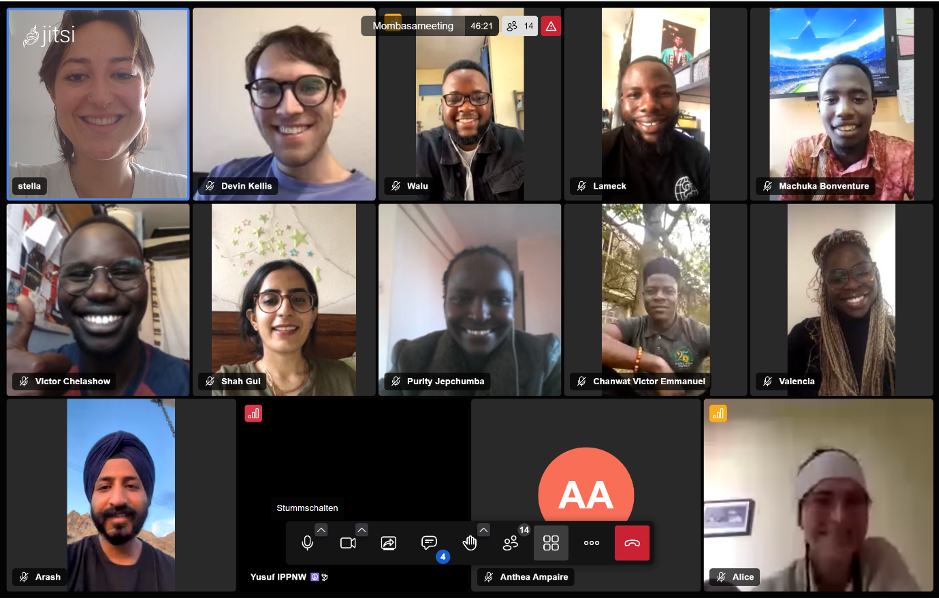
On Saturday, 12 August, we held the first online international student meeting since the World Congress in Kenya, Mombasa, in April 2023. In total, 26 students were present from different regions of the world, including the USA, Zambia, Kenya, Uganda, Nigeria, France, India, Pakistan, and Germany. The meeting was hosted by the new ISRs; Walusungu and Stella.

 Bimal Khadka
 Bjorn Hilt
 Charles K. Johnson
 Gunnar Westberg
 IPPNW
IPPNW John Loretz
 Lawrence Wittner
 Maria Valenti
 mollymcgint
 Sue Wareham
 Tilman Ruff
 Tim Wright
 Xanthe Hall


 IPPNW peace and health blog