Emerging web technology

IPPNW looks to emerging web technology to grow international campaigns for disarmament and health.
Through new developments on the internet, organizations and activists are beginning to find it easier to reach beyond typical spheres of influence. These new websites and technologies are, for some, just as confusing as they are exciting, but once started most find navigating this new terrain well worth the investment.
IPPNW is embracing these new tools and encouraging physicians, medical students and concerned citizens across our network to come along and get connected.
As a federation of national medical organizations in 60 countries, representing tens of thousands of doctors, medical students, other health workers, and concerned citizens, this is an exciting trend for IPPNW and its affiliates. Local “on-line” communities are launching everywhere, connecting activists in localized neighborhoods with activists across the globe. Will these new tools catalyze a groundswell of global support for the elimination of nuclear weapons? Who really knows the answer to that, but from Nairobi to Salt Lake City to Dusseldorf, thousands are logging-on to find out. We invite you to join a group, start a group or just investigate things for yourself.
Below is a list of social networking sites on which you can find IPPNW, our affiliates and individual activists.
Facebook (www.facebook.com) 61 Million Users
Facebook is a social utility that connects people with friends and others who work, study and live around them. People use Facebook to keep up with friends, upload an unlimited number of photos, share links and videos, and learn more about the people they meet.
There are currently 10 Facebook communities linked to the International Physicians for the Prevention of Nuclear War. Please feel free to check any of them out (IPPNW, IPPNW-Sudan, MAPW, Med. Students for Global Awareness, IPPNW-Philippines, ICAN, German Medical Students of IPPNW, Physicians for Social Responsibility Philadelphia, IPPNW-New Zealand, IPPNW-UK).
Myspace (www.myspace.com) Over 100 Million Users
MySpace is an online community that lets you meet your friends’ friends. Create a community on MySpace and you can share photos, journals and interests with your growing network of mutual friends!
There are currently two IPPNW groups located in Myspace. You can view or join ICAN or IPPNW and communicate with other activists and concerned citizens.
Youtube (www.youtube.com) 6.1 Million uploaded videos; 500K registered members
YouTube is the leader in online video, and the premier destination to watch and share original videos worldwide through a Web experience. YouTube allows people to easily upload and share video clips across the Internet through websites, mobile devices, blogs, and email.
Activists from across IPPNW’s federation frequently upload new videos documenting our anti-nuclear activity. We try our best to keep up with the volume and have established an IPPNW Group and an ICAN Group to help organize online video content. Frequent searches on Youtube will almost always yield new multi media projects from around the world.
LinkedIn (www.linkedin.com)
LinkedIn is an online network of more than 17 million experienced professionals from around the world, representing 150 industries. When you join, you create a profile that summarizes your professional accomplishments. Your profile helps you find and be found by former colleagues, clients, and partners. You can add more connections by inviting trusted contacts to join LinkedIn and connect to you.
By joining LinkedIn and becoming a member of the IPPNW Group you can link your professional career and all your lifetime credentials with your activism through IPPNW.

A nuclear-armed Iran?

A nuclear-armed Iran? Not according to intelligence agencies of world’s largest nuclear power
The Bush administration claims that Iran has been secretly developing nuclear weapons were rebuffed in November when a joint study conducted by US intelligence agencies reported that Iran does not have an active bomb program and has not had one for several years. The National Intelligence Estimate, entitled “Iran: Nuclear Intentions and Capabilities,” while cautioning that Iran has the scientific and industrial capacity to produce nuclear weapons if it decides to do so, concluded that Tehran halted its nuclear weapons program in the fall of 2003; that Iran does not have a nuclear weapon; and that “Iran will not be technically capable of producing and reprocessing enough plutonium for a weapon before about 2015.”
IPPNW Writing Fellow Tad Daley discusses the intelligence report, continuing concerns about Iran, and the responsibility of the US and other nuclear weapon states for the ongoing proliferation threat in a new article available here.
Click here to read the National Intelligence Estimate.
Click here to visit Tad’s Website.
Elevated cancer rates
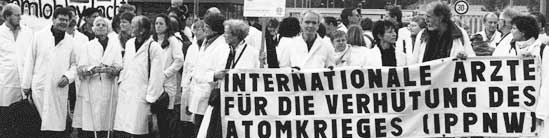
IPPNW-Germany warns of elevated cancer rates near nuclear plants
IPPNW-Germany is focusing public attention on a new study providing evidence that children under the age of five who live near nuclear power plants stations contract cancer at higher rates than the national average. The study was paid for by the Federal Radiation Protection Agency (BfS), the German government’s main adviser on nuclear health, and was conducted by the German Register of Child Cancer.
Among the findings were a 60 percent increase in cancer risk for children living within five kilometers (three miles) of nuclear power plants and a 117 percent increase in leukemia risk. The study looked at statistics between 1980 and 2003 in regions near 21 reactors or former reactors.
The German affiliate had been lobbying for the study since 2001, collecting more than 10,000 letters from citizens demanding that BfS commission the study. The campaign was triggered by preliminary research conducted for the affiliate by Dr. Alfred Körblein (Environment Institute Munich), who found significantly higher child cancer incidence near Bavarian nuclear power stations.
“Now that the connection between increased cancer and leukaemia rates and proximity of the residence to the nuclear power station has been established, the causes of this must be further clarified immediately,” said Dr. Angelika Claussen, Chair of IPPNW-Germany. She added that “The precautionary principle enshrined in European environment law now demands that the German nuclear power stations be switched off immediately” and that ” the burden of proof of cause of illness should no longer have to be borne by parents, but conversely by the operators of the nuclear installations.”
The executive summary of the German report can be found on the IPPNW European regional website. [www.ippnw-europe.org]
Aiming for Prevention

One-Bullet Stories show the human face of small arms violence
Small arms and light weapons kill an estimated 200,000 to 300,000 people each year. Hundreds of thousands more are injured, often with lifelong repercussions. Behind the statistics are the individual stories of people, families, and communities whose lives have been shattered by small arms violence.
A key educational tool of IPPNW’s Aiming For Prevention program is the One-Bullet Story (OBS), a close look in words and pictures, at the devastating human consequences of the global proliferation of guns and gun violence. The first One-Bullet Story was produced by physician activists in Kenya, and was presented to hushed audiences at the United Nations. “Linking dollars to human suffering strikes a chord with most ambassadors here,” said one UN delegate after seeing the Kenyan OBS. Since then, One-Bullet Stories have been created by doctors and medical students in Nepal, Nigeria, and Zambia, with more to follow.
The typical OBS documents in graphic, sometimes shocking, detail the nature and extent of the physical injuries that can be caused by just a single bullet wound. The complexities and cost of treatment and rehabilitation are then described, from the points of view of the victim, his or her family, and the doctors who must try to repair the damage. The psychological and social scars, which can persist long after the initial trauma, are also described. Each OBS concludes with a powerful appeal for primary prevention through stronger national and international controls on small arms trafficking.
To download One-Bullet Stories from Kenya, Nepal, Nigeria, and Zambia, click here.
Click on the following countries to view One Bullet Stories in web browser:
Kenya
[Support More One Bullet Stories]
Nepal
[Support More One Bullet Stories]
Nigeria
[Support More One Bullet Stories]
Zambia
ICAN Update

Global support for ICAN keeps on growing
The World Federation of United Nations Associations (WFUNA) has become an official supporter of the International Campaign to Abolish Nuclear Weapons (ICAN), and has launched “Students for a Nuclear Weapons-Free World” to encourage global youth involvement in nuclear disarmament issues. WFUNA joins the UK’s Campaign for Nuclear Disarmament (CND), Mayors for Peace, Abolition 2000, the Women’s International League for Peace and Freedom (WILPF), the Nobel Women’s Initiative, and the Mouvement de la Paix in France as global ICAN partners.
ICAN’s roving ambassador Bill Williams visited the United Kingdom, Germany, Switzerland, Denmark, and France in the closing months of 2007, promoting the campaign among national peace and disarmament organizations. Dr. Williams spoke in St. Gallen to physicians and medical students from all over Switzerland, where the IPPNW affiliate has recently launched a campaign to make Europe nuclear weapons free. In Copenhagen he shared a platform with Mayors For Peace Chair Tadatoshi Akiba and IPPNW Board member Caecilie Buhmann at the ICAN launch in Denmark, where they spoke to an audience of more than 800 high school students.
For news and updates on ICAN activities, and to download campaign materials and other abolition resources, visit www.icanw.org. [Help Make This Work Possible]
Rehabilitation under fire

“Rehabilitation under fire” – New report describes failure to support Iraqi health services
Researched and written by Iraqi, UK, and US health professionals and academics, the report focuses on the many failures of the occupying forces and their governments to protect health, or to help rebuild a health system based on primary health care principles. It assesses the current state of the health system: the impact of insecurity on the workforce and the chronic lack of supplies, medicines, and equipment. It contains a special focus on the neglected area of mental health care.
- the failure to follow good practice in rehabilitation of health care services;
- how powerful economic and political interests dominated health-related decisions;
- the failure to respect the Geneva Conventions related to medical neutrality.
The report makes key recommendations including:
- greater support for the World Health Organization in the region;
- more space for Iraqis to determine which health system they need;
- more flexible funding for initiatives to meet humanitarian needs.
Crises in Pakistan and Kenya
IPPNW responds to crises in Pakistan and Kenya
This issue of IPPNW’s e-update is dedicated to our friends and colleagues in Pakistan and Kenya.
IPPNW’s goal-the abolition of nuclear weapons-is pursued by doctors, medical students, and other health professionals around the world who are sometimes unavoidably caught up in armed violence that breaks out close to home. For these IPPNW activists, the threat of nuclear war is seen through the lens of conflicts that are taking lives and undermining societies all around them. Tragically, 2007 came to a bloody end in two countries where the pursuit of peace, political stability, and development could not be more important.
In nuclear-armed Pakistan, the prominent former Prime Minister and leader of the Pakistan People’s Party Benazir Bhutto was assassinated on December 27 as she left a campaign rally in Rawalpindi. Her death sent shock waves through a country already grappling with political instability and internal violence. Fear that a sudden collapse of the Musharraf government might leave Pakistan’s nuclear weapons up for grabs led to media-fueled speculation about US plans for yet another military intervention. In the midst of the crisis, e-mails from members of Pakistan Doctors for Peace and Development described a society on the brink of chaos, and appealed for support from the international community.
Allegations of vote-counting fraud following national elections in Kenya in December led to a sudden and frightening breakdown of civil society. Members of the Kenyan Association of Physicians and Medical Workers for Social Responsibility told IPPNW the casualty figures were far higher than those reported in the mainstream media, and documented killing sprees and a refugee crisis eerily reminiscent of the early days of the 1994 Rwanda genocide. Like their fellow peace advocates in Pakistan, the Kenyan doctors issued a plea for help.
IPPNW issued a statement within days of these events, expressing solidarity with our Pakistani and Kenyan affiliates and calling for an end to the violence, for open and credible elections, and for measures to prevent the further loss of life.
To read IPPNW’s statement, click here.
For a collection of press clippings and images on the post-electoral violence in Kenya prepared by Racheal Gitau of IPPNW-Kenya, click here.

 Bimal Khadka
 Bjorn Hilt
 Charles K. Johnson
 Gunnar Westberg
 IPPNW
IPPNW John Loretz
 Lawrence Wittner
 Maria Valenti
 mollymcgint
 Sue Wareham
 Tilman Ruff
 Tim Wright
 Xanthe Hall


 IPPNW peace and health blog