The ongoing Fukushima nuclear disaster 15 years on: a photoessay
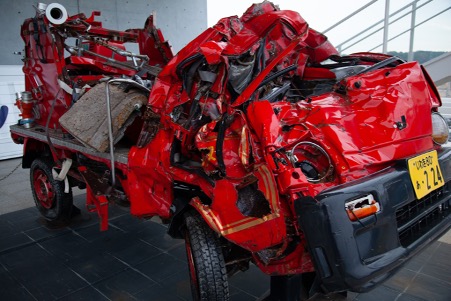
It is now 15 years since the Great East Japan Earthquake on 11 March 2011—and the tsunami it generated—wrought havoc on the Fukushima Daiichi Nuclear Power Plant (FDNPP). A predictably dangerous plant design, a corrupt and negligent operator, and Japan’s incestuous and corrupted ‘nuclear village’ involving collusion and revolving doors between government, regulator and operators, combined in a lethal mix.
The myth that a nuclear disaster couldn’t happen in Japan and therefore didn’t need to be prepared for continues to exact a high toll. The Fukushima Nuclear Accident Independent Investigation Commission, the only such body ever established by the National Diet of Japan, concluded that:
“It was a profoundly man-made disaster – that could and should have been foreseen and prevented. … a multitude of errors and willful negligence that left the Fukushima plant unprepared for the events of March 11.” “… Bureaucrats … put organisational interests ahead of their paramount duty to protect public safety.”
The accident “was the result of collusion between the government, regulators and TEPCO … They effectively betrayed the nation’s right to be safe from nuclear accidents.”
“The Commission concludes that the government and regulators are not fully committed to protecting public health and safety”.
Despite this clear and damning indictment, the highest courts in Japan have acquitted Tokyo Electric Power Company’s (TEPCO) top executives and have not held the government accountable. No TEPCO executive or government official is in prison because of a huge and ongoing disaster they could and should have prevented.
The 40th commemoration of the Chernobyl nuclear disaster on 26 April this year provides another sombre milestone to reflect on humanity’s flirtation with the most hazardous technology ever invented, intimately linked with weapons that pose the most acute existential threat to the biosphere.
While both national and prefectural governments seek to present the Fukushima disaster as effectively over and the region being open for business, the resulting catastrophe is far from over. A visit to Japan in late 2025 provided a valuable opportunity to visit Fukushima for the sixth time since the disaster and learn from those grappling with the ongoing challenges to health, livelihoods and rebuilding a sustainable future in the regions affected by the disaster, which extend far beyond the boundaries of Fukushima Prefecture, even though government programs to address the disaster’s aftermath focus exclusively on Fukushima.
Because ‘luckily’ half the radioactive caesium (Cs) released by the reactor meltdowns and explosions is Cs-134, with a two year half-life, rather than the 30 year half-life of Cs-137 which makes up the remainder of the caesium released, the initial decline in residual radioactivity, to which caesium is the dominant contributor, has been faster than following the Chernobyl disaster.
The damaged plants are unstable and decommissioning looks increasingly unfeasible
The multiple damaged nuclear reactors and spent fuel pools at Fukushima Daiichi are far from stable, and decommissioning as planned by TEPCO is barely progressing and looks increasingly unfeasible. Just 0.9 grams of fuel debris has been able to be removed to date, in two removals three years later than scheduled, while 880 tons remain with no plans yet for how to remove the bulk of this material. In addition, 1,007 tons of spent fuel remain in the spent fuel pools at Units 1 and 2. The melted reactors with spent fuel pools resting above them have been severely structurally damaged. In reactor 1 for example, robotic cameras have revealed that the concrete of the pedestal which supports the reactor has melted all the way around, exposing the internal reinforcing bars now providing effectively the only structural support. These damaged structures have heightened vulnerability to further earthquake and tsunami damage.
A major independent international assessment of a kind that Japan has resisted to date is warranted to assess the best means to address this extremely challenging, highly radioactive mess to order to most effectively and expeditiously secure the site as much as possible from further fires, meltdown or criticality events, further tsunami or earthquake damage, and ongoing or escalating release of radioactive materials. While it may be feasible and challenge enough to remove the fuel remaining in the spent fuel pools above Units 1 and 2, rather than stubbornly persisting with decommissioning plans going nowhere, aiming to stabilise the damaged fuel in the reactors so that active cooling is no longer required, and establishing durable physical encasement of the damaged facilities on all sides deserve more thorough consideration.
Decontamination and redistribution
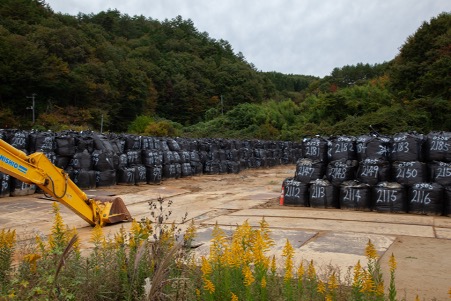
Extensive decontamination by scraping away the upper 5 cm of surface soil for 20m around houses, in fields and gardens, in schools, childcare centres, parks and public gathering places, resulting in the accumulation of 14 million m³ of contaminated soil, has denuded areas and reduced fertility of agricultural land, but has had some useful effect in reducing radiation exposure to residents and contamination of vegetables grown in decontaminated areas. Use of potassium-rich fertiliser has also contributed to reducing caesium absorption by crops. However, forested areas, which comprise 70% of Fukushima, particularly covering hills and mountains which received higher fallout than valleys and low-lying areas, act as reservoirs of radioactivity, which is constantly washed down by rain and snow to flatter and lower-lying areas where people’s homes, farms, paddies and fields lie, and also washes into estuaries and beach sands. This contributes to patchiness and high variability of contamination at a local level, and hence the importance of localised and ongoing measurement.
Hot caesium-laden particles
An important discovery was made by Japanese geochemists, particularly Satoshi Utsunomiya, that caesium-rich microparticles 2-3 microns in diameter, small enough if inhaled to be retained in the alveoli of the lung, were not only widely present in hotspots in Fukushima, but also widely deposited in Tokyo on 15 March 2011, when the most intensely radioactive fallout cloud passed over Tokyo following the explosion of the Unit 3 reactor.
These particles, assessed to be formed by the interaction of molten reactor fuel with concrete surrounding and supporting Fukushima Daiichi reactors 1 and 3, are intensely radioactive, more so than spent nuclear fuel. Contrary to conventional assumptions about the highly soluble nature of caesium and therefore (as a potassium analogue) its even dispersal in organisms and organs, these particles are insoluble, meaning they can deliver a much greater localised radiation dose to surrounding cells, and for a longer period. The main scientific publication of these findings was delayed some years because of academic infighting and political sensitivity. Their significant implications for human radiation exposures and radiation protection related to the Fukushima disaster, including the identification and isolation of radioactive hot-spots, have hardly been explored.
Public health and safety continue to be sidelined
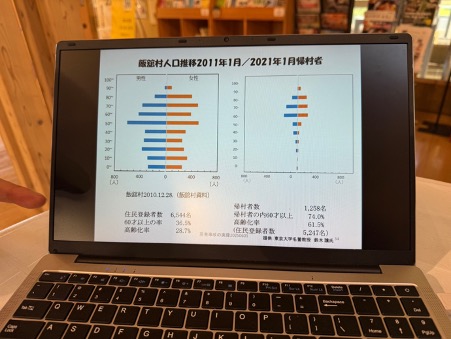
National and regional government policies are still negligent in failing to prioritise public health and safety. In the early weeks after the disaster, the Japanese government, arbitrarily and without scientific justification, increased the maximum permissible radiation exposure for a member of the public from 1 to 20 mSv per year. This unacceptably high level is still in place, 15 years later, as the basis for government policy, including clean-up standards and the designation of areas suitable for residents to return to and ending their eligibility for government support. No other government has accepted such a continuing high radiation level for its population, including the most vulnerable, particularly children. The government is now even countenancing some return to areas where doses estimated to be received are up to 50 mSv/yr.
The Japanese government also continues other weakened protection standards, for example before the disaster, waste and soil with radioactivity more than 100 Bq/kg was regarded as strictly controlled waste, whereas since the disaster, soil which is contaminated up to 8000 Bq/kg has been classified as suitable to be treated as ordinary waste, suitable for incineration and reuse in construction works around the country.
In August 2023, Japan began discharging processed radioactive Fukushima wastewater into the Pacific Ocean. As of 22 Dec 2025, according to TEPCO, 127,000 m3 of contaminated water has been dumped, containing about 31.2 TBq of tritium. Such discharges are planned to continue for at least 30-40 years, in breach of Japan’s obligations under the UN Convention on the Law of the Sea, which expressly prohibits ocean dumping of radioactive waste. This will no doubt include not only the 1.4 million m3 of wastewater already accumulated, but contaminated wastewater which continues to accumulate for the forseeable future, at a current average of 50 m3/day, containing a raft of radioactive contaminants. Alternatives such as prolonged storage in purpose-built large tanks, or incorporating treated wastewater into concrete for underground construction use, were given no serious consideration.
An epidemic of thyroid cancer in children
At the 63rd Pugwash Conference in Hiroshima in November 2025, Dr Hisako Sakiyama gave a revealing presentation about the ongoing effects of the Fukushima nuclear disaster. Dr Sakiyama was a researcher at the National Institute of Radiological Sciences, a member of the National Diet of Japan Fukushima Nuclear Accident Independent Investigation Commission, and chairs the Board of Directors of the 3.11 Fund for Children with Thyroid Cancer. She noted that after the Chernobyl accident, thyroid radiation exposure was measured for hundreds of thousands of people, whereas in Fukushima only 1080 children had doses measured, and by methods she considers inappropriate. Therefore the doses used in the evaluations undertaken at Fukushima Medical University (FMU) are mainly estimates and may well be underestimates.
Dr Sakiyama described several compelling lines of evidence establishing the occurrence of an epidemic of childhood thyroid cancer following the Fukushima Disaster, thankfully smaller than the one following the Chernobyl disaster, but nonetheless real and ongoing:
- Up to July 2025, the Fukushima Health Management Survey (FHMS) thyroid screening has identified 357 thyroid cancers or suspected cancers, between 8 and 20 times higher than the incidence rate in children observed before the disaster and in the rest of Japan. In addition, the 311Fund has identified another 79 children with thyroid cancer outside Fukushima.
- The argument by FMU researchers that the observed increase in thyroid cancer is related to active thyroid ultrasound screening of children in Fukushima, identifying many cancers that would never cause clinical problems. However this is not consistent with the surgical findings reported by the principal thyroid surgeon in the children operated on for thyroid cancer at FMU, with lymph node metastases present in over 70% of patients and extra-thyroidal invasion in over 40%.
- While multiple independent analyses have shown a clear gradient of thyroid cancer incidence correlating with radiation exposure in Fukushima, the FMU researchers have reclassified contaminated areas in Fukushima in a way which obfuscates these consistent findings.
- Data on over 470 thyroid cancer cases in children since the disaster, both those identified by screening and those not, show a clear clinical benefit of early diagnosis through ultrasound screening. Those identified by screening were five times less likely to require removal of the whole thyroid gland, six times less likely to have distant metastases, and more than six times less likely to require radioactive iodine treatment than patients whose cancers were diagnosed because of symptoms.
Population radiation exposure
The only broad population-based radiation exposure measurements rather than estimates I am aware of in Fukushima was a large study conducted in Date City. Date is located about 60 km north-west of the Fukushima Daiichi plant, and about 10 km north-east of Fukushima City, inside the northern edge of the main fallout plume. It is not one of the most contaminated municipalities. Between July 2012 and June 2013, radio-photoluminescence glass badges were distributed to all 65,000 residents of the city; 81% received and returned their glass badges every three months for the one-year monitoring period. Allowing for a 3-fold underestimate in the original published paper, acknowledged by the senior author, the average additional lifetime radiation exposure (up to age 70) on the basis of these measurements was estimated at between 33 and 54 mSv, with the 99th centile ranging from 60 to 105 mSv. This is significantly higher than official estimates which in comparable areas are typically an order of magnitude lower. A number of factors are likely to make these results conservative. The glass badges used are likely to underestimate chronic low-dose exposures by approximately 30 to 40%. Any periods when participants didn’t carry their glass badges with them, when they are most likely to have been left at home or otherwise indoors, are more likely to result in under- than over-estimates of exposure. And in the second year after the disaster, radiation exposures, particularly external ones, will have already subsided significantly compared with the first year. These findings relate only to external exposure. They raise serious questions about official population dose estimates used in Japan and by international bodies such as the UN Scientific Committee on the Effects of Atomic Radiation and the International Atomic Energy Agency.
A second interesting finding in the data from Date is that residents of areas which underwent widespread decontamination, by removal of surface soil around houses and in public places, external radiation doses were not significantly lower than for those living in areas that were not decontaminated.
Although ethical concerns have been raised about deficiencies in the informed consent procedures in the study and the failure to retain samples for review after testing, leading to the results being formally withdrawn from journal publication, I am not aware of a challenge to the veracity of the actual measurements, and none was mentioned by the senior expert Japanese panel members when I raised this question during the session on Fukushima during the IPPNW congress in Nagasaki last October.
Inspiring local citizens
During my visit to Fukushima in late 2025, I was privileged to meet a number of remarkable people not content to be sidelined, at the mercy of continued government and TEPCO collusion, but working with inspiring dedication to help address the suffering and needs of the victims and evacuees from the disaster and work for a healthier nuclear-free future in Fukushima and across Japan. Our host, local journalist Hiroko Aihara, provides valued and ongoing support to affected people and communities, bearing witness to the continuing disaster and working to ensure accountability of officials and that the related issues and needs are not forgotten.
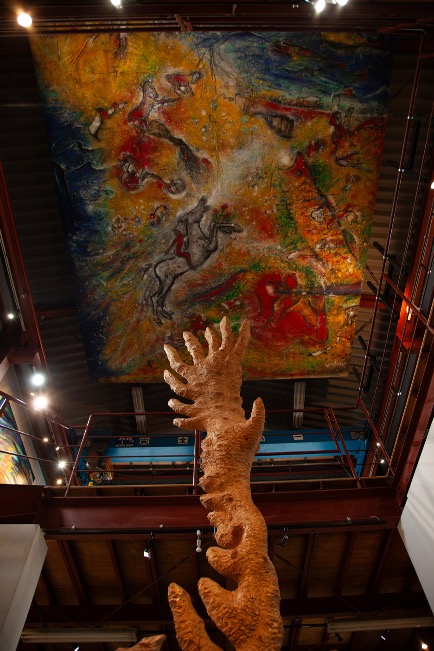
We visited Our Memorial Museum and Citizens Measurement Centre Todoke-Dori in Odaka, Minamisoma City, directed by Nakasuji Jun, which contains deeply moving art about the disaster and is also a focus for people to gather and work together to address the disaster’s legacy. It was a much more authentic and positive place to visit than the large, much better funded official Great East Japan Earthquake and Nuclear Disaster Memorial Museum in Futaba which opened in 2020, which was notably deficient in the voices and perspectives of affected people, included minimal discussion of health issues and no discussion about thyroid cancer, and addressed in quite superficial fashion the issue of ocean discharge of large quantities of radioactive wastewater over decades.
We met Sumio Konno, a former TEPCO worker who chose to leave the company and now supports citizens’ lawsuits and efforts for justice. We spent time with Shima Akemi from Date, whose concern about her children’s health, discrepancies in official radiation monitoring results, and inconsistencies and public exposure of unethical practices in use and management of citizens’ radiation monitoring data led her to become a Date City councillor in 2022, shaking up a complacent council with persistent efforts for accountability, transparency and effective inclusion of local citizens in addressing the ongoing human and environmental effects of the disaster.
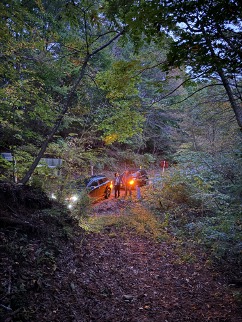
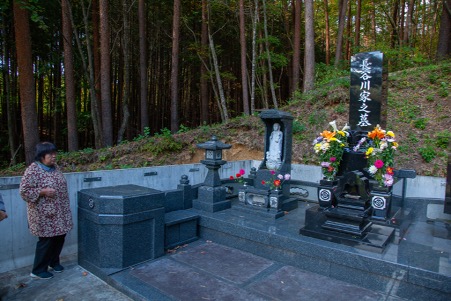
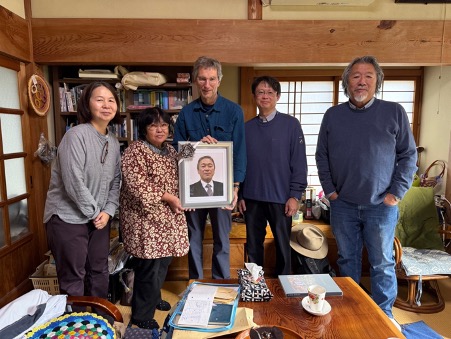
Iitate Village, 30-40 km northwest of FDNPP, was directly in the path of the main fallout, but this was not discovered till a month after the disaster by Greenpeace staff checking radioactivity in the absence of reliable government information, resulting in residents being avoidably significantly exposed and evacuated inexcusably late. In Iitate we visited Hanako Hasegawa, in the magnificent traditional Japanese farmhouse passed down through generations of the family, which before the disaster bustled with life and laughter of 3 generations, but where Hanako now lives alone, her children with their families having moved to safer areas. Her husband and former local mayor Kenichi died several years ago of aggressive thyroid cancer, quite likely related to the high radiation exposure they sustained staying for 5 months in their heavily contaminated village, initially unaware of the fallout, and later feeling obligated to look after their dairy cows, which otherwise would have starved to death, as many animals did across Fukushima. Having to kill his cows because of the severity of their radioactive contamination was a bitter blow. A neighbouring farmer, among several who took their own life in similar circumstances, left a note: “I wish there wasn’t a nuclear plant.” As we paid our respects to Kenichi by his grave at the edge of the forest beside his farm, his words rang in my ears: “There is no future here. It has been stolen from us.” Many aspects of the severe and multifacetted harm that nuclear forces can unleash are ample reason to keep the nuclear genie in the bottle, but robbing the future may be the greatest crime.
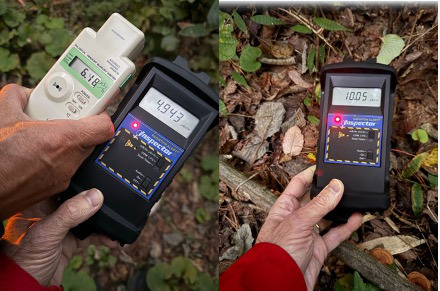
In Iitate we also met with Nobuyoshi Ito, a farmer who since the disaster has meticulously monitored and documented local radioactivity. He described, a few days after the disaster, recording external radioactivity up to 44.7 microSv/hr (in comparison with the normal background level of 0.1 microSv/hr). He also described radioactivity in the upper 5 cm of soil in Iitate in 2017 of 36,000 Bq/kg, compared with levels of 35 Bq/kg, 1000 times lower, in Nagano Prefecture.
At the World Nuclear Victims Forum in Hiroshima in October, I met Nahoko Nakamura, who works for a citizen’s initiative in Fukushima which has coordinated and collated extensive citizen measurement of food and soil radioactivity around Japan, a more accessible and thorough information source on the distribution of soil contamination than is available from government sources.
Food monitoring
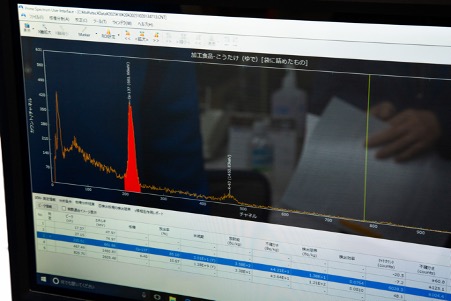
We visited a food radioactivity monitoring station in Kawamata, where local farmers and residents can bring their produce for its radioactivity to be measured prior to consumption or sale, at no cost to them. Staff there including former TEPCO worker Kenichi Togawa described continuing high levels of radioactivity in locally foraged foods. In 2024 for example, local wild mushrooms were measured to contain up to 51,000 Bq/kg of radioactivity and in recent months the highest level they recorded was 8847 Bq/kg for mushrooms grown in cleaned-up soil, compared with 26,000 Bq/kg for mushrooms grown in uncleaned soil. The Japanese radiation limit for most foods is 100 Bq/kg, and 50 Bq/kg for milk and infant foods. In 2023, local freshwater fish were still being measured at over 900 Bq/kg. Foraged plants and mushrooms with radioactivity exceeding regulatory limits continue to be found in prefectures as far away as Nagano and Shizuoka, yet the national system for testing and recording radioactivity in foods is disorganised and opaque.
In national and prefectural governments’ desire to present the disaster as finished and promote investment and business, they have thrown large sums of money at some highly visible projects, often dissonant from the expressed needs and priorities of local people. For example, Iitate previously had 2 kindergartens, 3 elementary schools and a junior high school. After the disaster, in 2016 the government spent 5.7 billion yen (USD 52 million at that time), on an integrated early childhood education and care centre which catered to only 5 children.
The impacts of nuclear disasters are widespread, multifacetted and often not as immediately visible as the effects of many other types of disasters. These effects and the resultant needs continue across generations. They are too often, and prominently in Fukushima, subject to cover-up, misinformation and failure to establish the population registers, long-term surveillance and data linkage that could better ascertain their true extent and help guide provision of recognition, compensation, support and most importantly, care. In Japan structural conflicts of interest and powerful and colluding commercial and bureaucratic vested interests distort and continue to prioritise a uniquely hazardous industry over public health and safety and accelerating the urgent renewable energy transition.
The Nuclear Accident Independent Investigation Commission (NAIIC) – the first and only such commission established by the Japanese Diet, in 2012 produced a thorough and incisive report and recommendations to prevent future nuclear disasters. It remains a benchmark of thorough, impartial investigation and recommendations. It was chaired by physician Prof Kiyoshi Kurokawa. Two years later in 2014, he said: “… the unchanging situation in Japan is dominated by the political-industrial-bureaucratic complex, despite the glaring errors and gross negligence exposed in the aftermath of 3.11.” In 2018, he wrote that since the NAIIC submitted recommendations to the Diet in 2012: “Little progress of significance can be observed”; regulatory changes implemented are “only amounting to cosmetic changes”, and that “the structures of regulatory capture are still firmly maintained”. Little has changed since then, with the current Japanese government under PM Takaichi supporting re-starting and life-extensions of Japanese nuclear power plants and potentially even construction of new nuclear plants in Japan’s intensely seismically active and densely populated islands.
The lessons of the Fukushima disaster have largely not yet been heeded, in Japan and elsewhere. We in IPPNW should provide an ongoing and critical global health lens and voice, and continue to stand with people put in harm’s way under a radioactive cloud.
______________________________
Acknowledgements: My warm thanks to those who gave generously of their time and knowledge: Nahoko Nakamura, Nakasuji Jun, Sumio Konno, Yuichi Murakami, Kenichi Togawa, Nobuyoshi Ito, Shima Akemi, and Dr Hisako Sakiyama. My immense gratitude to Hiroko Aihara for wonderfully organising and hosting our visit to Fukushima, Hanako Hasegawa for welcoming us in her home and at Kenichi’s grave, and Hiroshi Takao for his friendship and generosity.

 Bimal Khadka
 Bjorn Hilt
 Charles K. Johnson
 Gunnar Westberg
 IPPNW
IPPNW John Loretz
 Lawrence Wittner
 Maria Valenti
 mollymcgint
 Sue Wareham
 Tilman Ruff
 Tim Wright
 Xanthe Hall


 IPPNW peace and health blog