Arms over norms: military budgets given priority at security conference
by Inga Blum
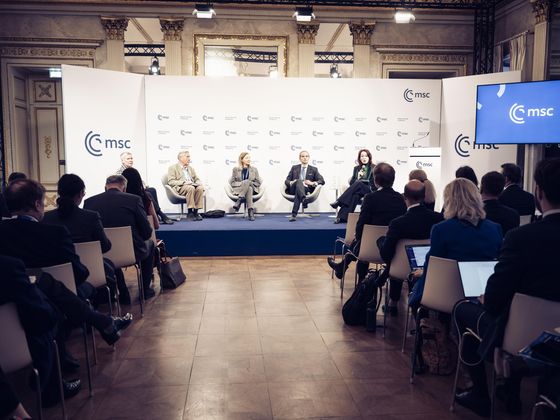
[Dr. Blum represented IPPNW at the Munich Security Conference, held from 12-15 February. The first part of her report from those meetings was posted yesterday. Part two follows.]
Overall, despite the palpable genuine concerns about the loss of values and rules, the conference was strongly characterized by competitiveness, superficiality, and a lack of perspective. Not only the applause for the US Secretary of State, but also the assumption expressed by many Western representatives after Wang Yi’s speech that China’s push to strengthen the United Nations was merely an attempt to expand its own sphere of influence, pointed to a strong need for leadership and the restoration of familiar patterns of order.
As a physician accustomed to scientific analysis and classification based on relevance to public health, I was astonished that even in the confidential side events, discussions rarely went beyond the narrative of “The US has abandoned us – we cannot trust Russia – so let’s arm ourselves.” I had hoped to gain a better understanding of why a Russian war of aggression is feared, even though both the balance of power in favor of NATO and many experts argue against it. After all, the narrative of impending war is the justification for the massive increase in defense spending, which will be at the expense of the real security interests of the population, such as health, education, etc.
At events involving German ministries on the necessary restructuring of the German transport and health systems for a war in Europe in which Germany would be the logistical hub, I was at least able to ask questions. For example, I asked whether the planned increase in defense spending to 50% of total German tax revenue should not be discussed more publicly so that there is no imbalance in favor of the economic interests of the arms industry, which is strongly represented at the MSC.
Many of the often confidential background discussions at the MSC, where solutions to supposed military capability gaps are presented, are financed directly by the arms industry or industry-affiliated think tanks. In medicine, such financial conflicts of interest would be unthinkable in the context of science-based and patient-centered treatment.
Even though the answers to my questions were often evasive or only came after the end of an event in bilateral discussions, I was pleasantly surprised by the opportunity to participate. The MSC motto “Peace through Dialogue” was displayed on all chairs, and the rules of discussion were strictly observed: After I was harshly interrupted by a moderator from the Ministry of Defense when I said that the German healthcare system would not be able to cope with a war in Europe, MSC staff approached me and said that this incident would be reported to the conference management. (The event ended with a joking suggestion that participants should refresh their first aid training).
At the closing event in the large hall, I even had the opportunity to ask a question about the necessary steps to take in view of the growing threat of nuclear war. The closing panel consisted exclusively of young female parliamentarians, almost all of whom agreed emphatically with me. Overall, I found the representation of women among the speakers and participants to be remarkably high, despite the traditionally male-dominated field of security policy.
I was very disappointed by the German politicians and representatives of German foundations and think tanks who were present. Many of them strongly advocated for rearmament and showed little willingness to engage in dialogue. In the run-up to the conference, I had contacted most of them via the website’s internal communication system and asked for bilateral talks on the sidelines of the event. For this purpose, the MSC provides private rooms and reserved tables in public lounge areas.
Almost all German politicians declined; only one SPD member of parliament signaled a willingness to talk, but had to leave at short notice, so it did not happen. However, several discussions took place with representatives of the German Armed Forces and NATO, who seemed genuinely interested in a critical perspective—for example, on the question of the resilience of the health care system in the event of war. My encounters with representatives of Chinese, South American, and US non-governmental organizations, as well as with political representatives of non-aligned states, were also insightful. They were both astonished and concerned about the extent of war preparations in Germany and the new bloc confrontation.
The exchange with representatives from other parts of the world was reassuring, especially in contrast to Germany’s narrow focus on military armament – there is another perspective. Some events also looked beyond the horizon. However, the program section on “human security” often seemed to me to be more of a fig leaf intended to conceal the activities of the military-industrial complex. For example, there was an event on development cooperation with the participation of the German Minister for Economic Cooperation and Development, Reem Alabali Radovan. It was mentioned that every dollar that goes into development pays off many times over because stable societies have fewer conflicts, and the drastic cuts in development cooperation were regretted.
However, there was no fundamental criticism of the redistribution in favor of the rapidly growing defense budget, which is already ten times the size of the development budget.
The panel on climate change was truly outstanding and illuminating in many respects. Ralph Regenvanu, Minister for Climate Change and Disaster Management of the Pacific nation of Vanuatu, made it clear that many of the countries represented at the conference bear direct responsibility for the fact that his homeland is threatened with destruction unless there is a rapid change in energy policy. Gavin Newsom, Governor of California, and Andrew Forrest, Australian entrepreneur, made it clear that the switch to renewable energies is not only morally imperative, but also economically sensible. According to its own figures, Forrest’s company Fortescue saves around one billion US dollars annually by switching to renewable energies. Conservative MEP Lidia Pereira argued that Europe’s energy transition is inevitable if the strategic independence from Russia or the US, which was repeatedly invoked at the conference, is to be taken seriously. However, obstacles include not only the lobbying power of large oil and gas companies – including Shell, Equinor, and Uniper, which are also partners or sponsors of the conference – but also the considerable influence of the defense industry, which continues to rely on fossil fuels for tanks and fighter jets.
And so the circle was complete: the following day, ways to end the war in Ukraine were discussed on the same stage. While representatives of the EU and NATO advocated further armament, the US representative proposed finally imposing effective sanctions on Russian oil exports.
Moving away from fossil fuels is not only vital for the survival of some of the world’s smallest countries; it could also reduce geopolitical dependencies, defuse conflicts, and thus contribute to genuine security.
But what did that mean for a conference that is largely supported by players from the arms and energy sectors?
If the MSC’s motto of “Peace through dialogue” is meant seriously, it would have to set out in search of new partners and genuine dialogue with the world.
[Inga Blum is IPPNW co-president.]

 Bimal Khadka
 Bjorn Hilt
 Charles K. Johnson
 Gunnar Westberg
 IPPNW
IPPNW John Loretz
 Lawrence Wittner
 Maria Valenti
 mollymcgint
 Sue Wareham
 Tilman Ruff
 Tim Wright
 Xanthe Hall


 IPPNW peace and health blog
Thank you Inga Bloom for your two insightful reports from the MSC. Hopefully Medact can work more with you in the run up to the conference next year. #solidarity. Michael