Arms over norms: giving priority to profits and deals
by Inga Blum
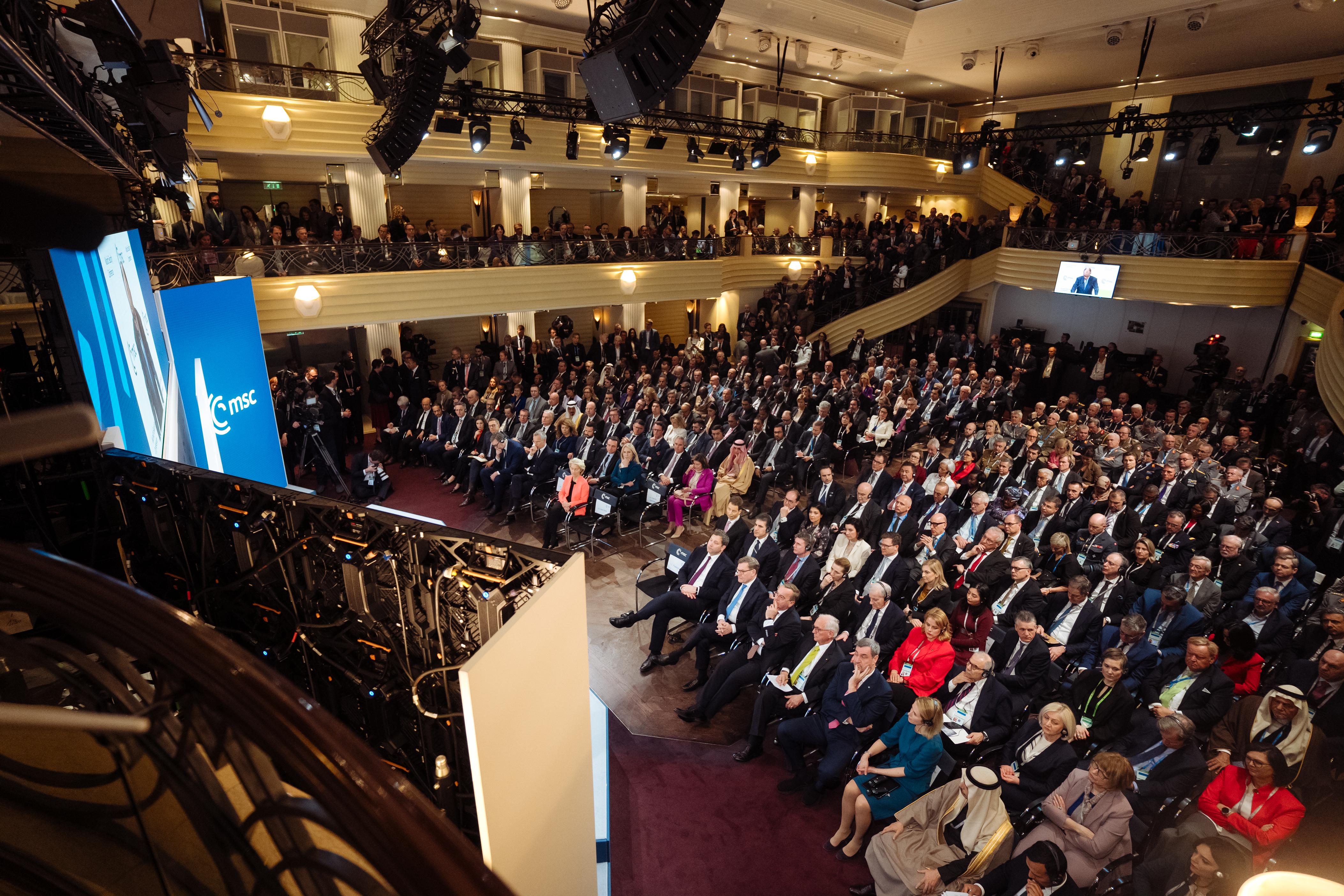
[Dr. Blum represented IPPNW at the Munich Security Conference, held from 12-15 February. Her observations from those meetings will be posted in two installments. Part one follows.]
For three days, politicians gathered at the Bayerischer Hof in Munich to discuss key issues of global security. This year, I was invited to attend as a representative of civil society through the project group “Münchner Sicherheitskonferenz verändern” (Changing the Munich Security Conference).
I was curious to hear what answers political leaders would give to the profound upheaval in the international order: to the cruel wars of our time, to US President Donald Trump’s open disregard for international law, to global inequality, hunger, and the escalating climate crisis.
As co-president of International Physicians for the Prevention of Nuclear War (IPPNW), I also wanted to address the growing threat of nuclear war.
At the end of January, scientists set the symbolic “Doomsday Clock” to 85 seconds before midnight—a dramatic sign that the risk of nuclear catastrophe is higher than ever before. Shortly thereafter, New START, the last treaty between Russia and the US to limit strategic nuclear weapons, expired. There are fears that this will trigger a further arms race.
However, the Munich Security Report 2026, published a few days before the conference began, only touches on the subject of nuclear weapons in passing. The focus is on US foreign policy under President Trump, which is described as a wrecking ball for international rules and multilateral cooperation. The report accurately analyzes the growing influence of profit-oriented companies and the logic of bilateral “deals” instead of binding international law. It also mentions the financial and credibility crisis of the United Nations as a result of increasing nationalism, geopolitical rivalries, and rising military spending.
However, it is disappointing—though not surprising—that the proposed solutions focus almost exclusively on higher military spending. It is not only American foreign policy that follows economic interests: arms manufacturers such as Hensoldt, Heckler & Koch, Lockheed Martin, and Rheinmetall are among the official sponsors of the conference, alongside several federal ministries.
The narrative of the “end of the old world order” also dominated the main stages. In his opening speech, German Chancellor Friedrich Merz effectively declared the rules-based order a failure. He said that strengthening the military capabilities of Germany and Europe was now the top priority. The Bundeswehr should become the strongest conventional army in Europe as quickly as possible – competition policy is security policy. He even wanted to discuss the possibility of joint European nuclear weapons.
He justified this by pointing out that Europe’s gross domestic product is ten times that of Russia, but that there is no corresponding military superiority. He did not mention that Germany is already the fourth largest military power in the world (surpassed only by the US, Russia, and China). Even without the US, the NATO countries have a clear advantage over Russia – not only in terms of military spending (420 vs. 300 billion US dollars), but especially in large-scale combat systems (e.g., 6,297 vs. 2,000 battle tanks, 2,073 vs. 1,026 combat aircraft). NATO countries also dominate the global arms market with over 70% of total sales (Russia 3.5%).
At least Merz emphasized that Germany must never go it alone again—a lesson learned from history. And he warned that a world in which power alone counts is a dark place. What concrete steps he would take as German chancellor to strengthen the rule of law as a counterweight to power remained unclear. He did not mention the United Nations, which was founded in response to World War II.
He criticized his “American friends” for the MAGA movement’s culture war, which violates human dignity, and for turning away from free trade, climate agreements, and the World Health Organization in favor of protectionism and nationalism.
US Secretary of State Marco Rubio reiterated this line the following day, saying that American interests had been subordinated to the “climate cult” and the global welfare state for too long. Mass migration, he said, was a threat to Western societies.
This speech received a standing ovation from German Foreign Minister Johann Wadephul, Defense Minister Boris Pistorius, and Bavarian Prime Minister Markus Söder—an image that was widely criticized both at home and abroad.
The contrast in content to the speech by Chinese Foreign Minister Wang Yi could hardly have been greater: he called for the strengthening of the United Nations, for multilateral cooperation, and for an international order based on dialogue rather than confrontation.
[Inga Blum is IPPNW co-president.]

 Bimal Khadka
 Bjorn Hilt
 Charles K. Johnson
 Gunnar Westberg
 IPPNW
IPPNW John Loretz
 Lawrence Wittner
 Maria Valenti
 mollymcgint
 Sue Wareham
 Tilman Ruff
 Tim Wright
 Xanthe Hall


 IPPNW peace and health blog
Dear Inga, Thank you so much for attending this meeting, and this great and revealing report. All the best, Bob.