Visiting Hiroshima and Nagasaki for the 80th remembrance ceremonies
[The 24th IPPNW World Congress takes place in Nagasaki from 2-4 October. Following is an account of a trip to Hiroshima and Nagasaki by IPPNW’s Norwegian affiliate and other Norwegian activists in August to commemorate the 80th anniversary of the US atomic bombings of those cities.]
by Knut Mork Skagen
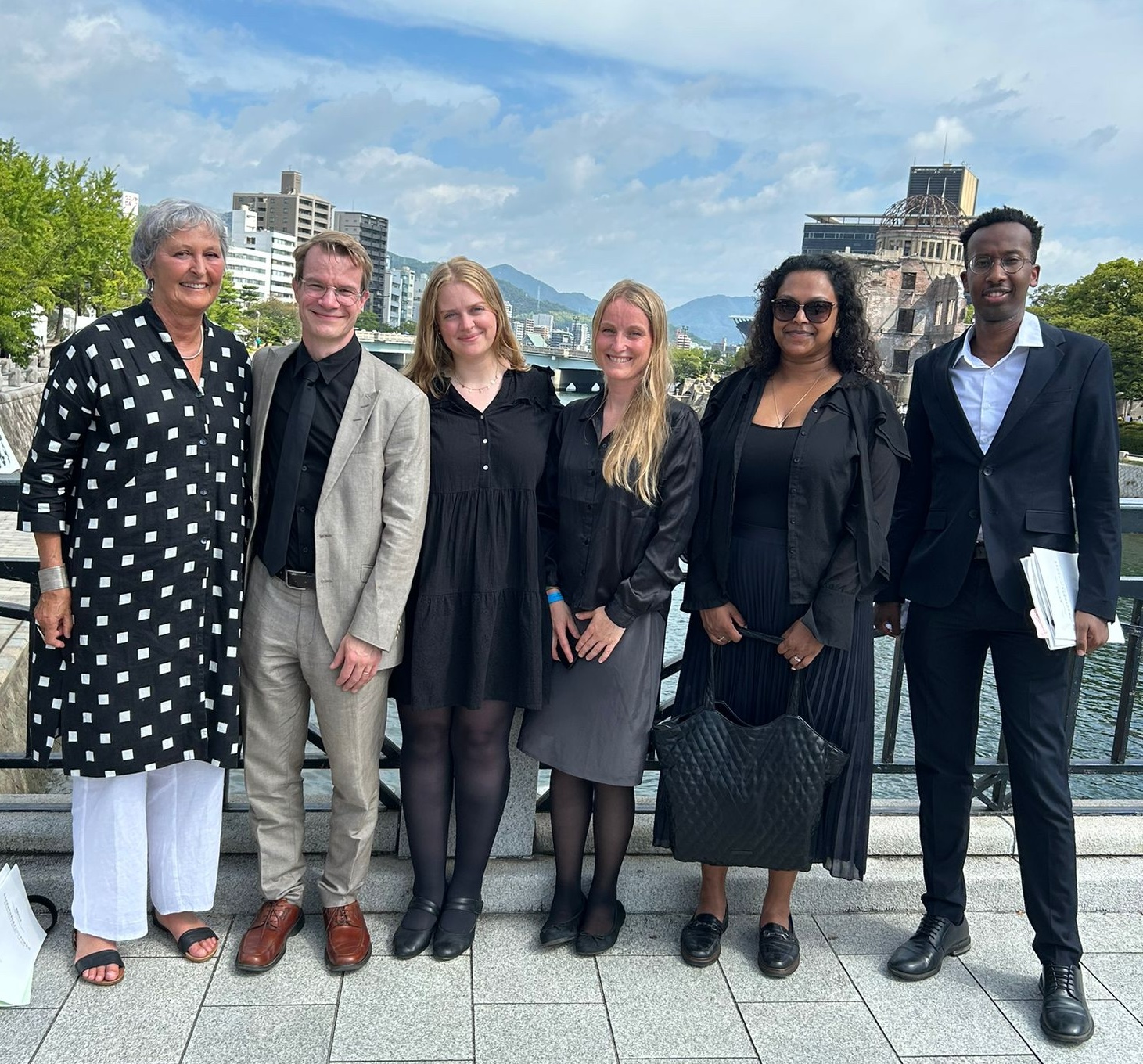
August 6, Hiroshima
I have travelled from Norway together with colleagues from IPPNW Norway, ICAN, and two of our labour politicians, one MP and one representative from the Workers’ Youth League (AUF). Japan has just had its hottest July on record, and Hiroshima is heavy with humidity and heat. The climate-nuclear nexus is on full display.
At the commemoration ceremony marking the 80th anniversary of the atomic bombing of Hiroshima, both what is said and what is not said carries weight. It is disappointing that not more world leaders are in place to hear the mayor of Hiroshima, Kazumi Matsui, speak plainly: “The Nuclear Non-Proliferation Treaty (NPT) is on the brink of dysfunctionality. The TPNW should serve as strong support for that treaty, helping it remain the cornerstone of the nuclear disarmament and non-proliferation regime.”
The sense of history is, as always, interrupted by the here-and-now. My shirt sticks to the chair back. A few rows in front of me, a delegation from the Teheran Museum of Peace furiously fan themselves throughout the entire the ceremony. In the distance we can hear a protest in support of the people of Gaza.
Unlike the mayor of Hiroshima, Prime Minister Shigeru Ishiba does not mention the NPT, the TPNW, or any other international agreements in his speech. He quotes instead the words of hibakusha poet Shinoe Shōda, inscribed on a nearby monument: “The heavy bone must be a teacher’s. The small skulls beside it must be students gathered around.” He is moved to recite the words twice. Mr. Ishiba also says: “I once again pledge that Japan will make its utmost efforts for the realization of a world without nuclear war and a world without nuclear weapons, as well as for the realization of eternal peace.”
How he intends to do his utmost for eternal peace was left to the imagination. On the day of the ceremony in Hiroshima, Prime Minister Ishiba was already fighting a losing battle for his political life. His party, the LDP, had recently lost the majority in the upper house. A month later, on September 7th, he resigned. Meanwhile, there are indications that Japan’s reliance and support for the American “nuclear umbrella” are increasing. According to Reuters, Japan has been in talks with U.S. on how Japanese conventional forces can support U.S. nuclear forces in the event of an attack, with some lawmakers even considering aloud the possibility of nuclear sharing.
In the evening paper lanterns drift downriver, past the original target site of the nuclear bomb.
*
August 7, Hiroshima
We have been extremely well received by our contacts in Asian Network of Trust (ANT) Hiroshima. Two days before, their executive director Tomoko Watanabe introduced us to some of Hiroshima’s hibakujumoku, survivor trees. Today we receive a tour of the atomic bomb museum and peace park.
The experience is overwhelming, and I won’t try to put it into words. Later the same day, I speak to a Japanese campaigner who was so traumatised by learning about the atomic bombs in school that she has a hard time even visiting Hiroshima, and still hasn’t been able to enter the museum. What affects me most is how these reminders of the bombing are situated within everyday, sunny Hiroshima. Again, this melding of history and here-and-now. The city outside the museum reflects the photographs of the city inside. I think back to every time we’ve used NukeMap to simulate an atomic bomb over Oslo or Trondheim. How would we choose to remember our dead and care for our survivors? What would our monuments and museums be?
Thanks to the assistance of ANT Hiroshima, we have the honor and privilege of hearing the testimony of Ms. Masae Matsumoto. She was a small child on the outskirts of Hiroshima in 1945, but she still remembers the flash, the charred out streetcars and bodies. She can tell us about the decades of fear over what radiation had done to her body. A formidable woman, at the age of 74 she began a PhD on the hibakuha poet Sadako Kurihara. One of Kurihara’s best known poems is Umashimen ka na, recounting birth in the immediate aftermath of the bomb: “And so, in the darkness of that hellish depth, new life was born. / And so, before dawn, still bathed in blood, the midwife died. / Let us be midwives! Let us be midwives! / Even at the cost of our own lives.”
*
Unable to secure seats at the 80th commemoration ceremony in Nagasaki, we watch a live stream from the auditorium of the Atomic Bomb Museum. We are, perhaps, fortunate. The rain is heavy. On the trip home we run into former Swedish prime minister Stefan Löfven, who was at the ceremony itself. He describes vividly rivulets of water running down the back of his suit.
Before the ceremony itself we tour the museum. The exhibition in Nagasaki is perhaps less visceral than in Hiroshima, but it also feels closer to everyday life. There is an intimacy which brings the enormity of the nuclear bomb closer to home, a feeling strengthened by the fact that Nagasaki, a city today with a population of about 400.000, in many ways reminds me of the Norwegian coastal city of Bergen. Suddenly I see our NukeMap simulations in a different light.
There is a full-scale model of the wasp-like Fat Man, painted as it was a lurid yellow, its welding sealed with great black stripes. Next to the model there is a film of U.S. servicemen preparing the bomb. Painting it, moving it around. They look comfortable, relaxed even; some have taken their shirts off in the heat. It reminds me of a recent commentary in my local paper, referring to a photograph of a schoolyard in Gaza where at least five were killed and thirty injured in an aerial attack. In the picture one can see the remains of a bomb with the words “WARNING – 2-MAN LIFT – WT 45 KG” printed on it. As if back injury is the true occupational hazard of any bomb.
In the afternoon we visit the Hiroshima and Nagasaki Peace Messengers, high school students who dedicate their free time to teaching about the bombs and collecting student signatures in support of the abolition of nuclear weapons. I ask them about their visits to elementary schools, where they talk to children as young as six and seven years old about the bombings. I can barely explain them to other adults. How do they explain them to children in the first grade?
I envision these young people as midwives, then, delivering tiny bundles of peace into the world, each time they speak to a child or secure another signature. Let us be midwives! Let us be midwives! Even at the cost of our own lives.
Knut Mork Skagen is an at-large board member of IPPNW and Chair of IPPNW Norway
Comments are closed.

 Bimal Khadka
 Bjorn Hilt
 Charles K. Johnson
 Gunnar Westberg
 IPPNW
IPPNW John Loretz
 Lawrence Wittner
 Maria Valenti
 mollymcgint
 Sue Wareham
 Tilman Ruff
 Tim Wright
 Xanthe Hall


 IPPNW peace and health blog
Raymond G. Wilson, Ph.D. Emeritus Associate Professor of Physics Illinois Wesleyan University Bloomington, IL 61702-2900