Our prescription for survival
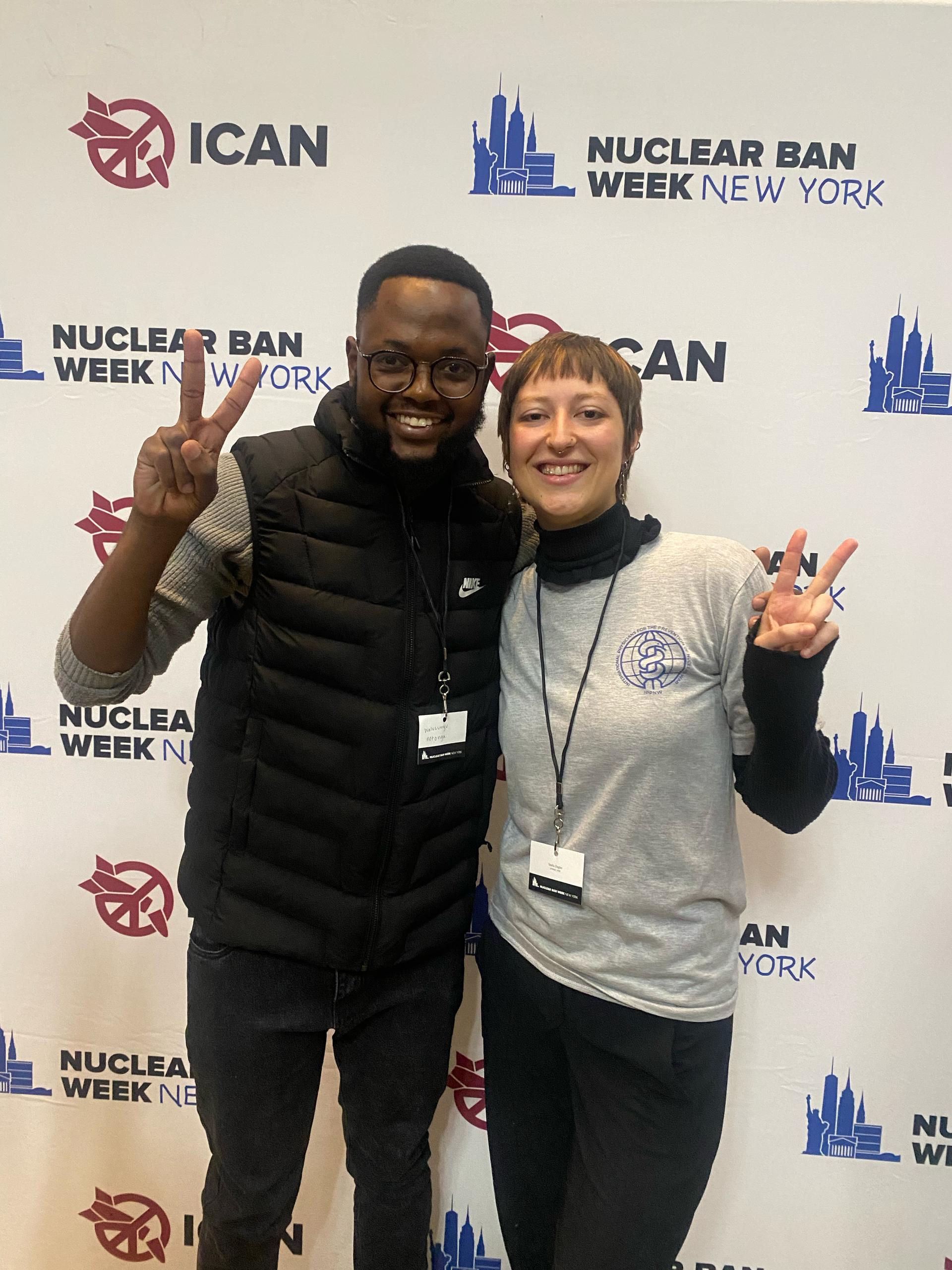
The following statement was delivered by Walusungu Mtonga and Stella Ziegler, IPPNW’s International Student Representatives, to the General Debate of the third Meeting of States Parties to the Treaty on the Prohibition of Nuclear Weapons (TPNW). United Nations Headquarters, NYC | 5 March 2025.

Distinguished delegates, esteemed colleagues, and honored guests,
We stand before you today as Board Members of the International Physicians for the Prevention of Nuclear War (IPPNW), a global network of health professionals united in the mission to prevent nuclear war and safeguard human and planetary health. We are medical students and members of the generation that is rising up to reject the deadly inheritance of nuclear weapons.
As we mark the 80th year in the nuclear age, we face the sobering reality that we are the last generation to hear directly from Hibakusha, survivors of the Hiroshima and Nagasaki bombings. As the threat of nuclear war grows, the Hibakusha prompt us to take action and ensure that such horrors are never repeated.
The evidence is clear: there can be no meaningful medical response following any use of nuclear weapons. Even a single Hiroshima-sized bomb, considered a “tactical” nuclear weapon by today’s standard, would cause immediate, catastrophic destruction. Those in the immediate vicinity of the blast would be vaporized, while survivors would endure third-degree burns, life-threatening crush injuries, sudden deafness, and temporary blindness. Survivors would have to navigate a decimated landscape, with no way to contact first responders or medical personnel, who themselves would be among the dead and injured. Hospitals and modern life-saving equipment would be destroyed, and the doctors and nurses who survive would have little to offer patients.
This does not account for the deadly effects of radiation exposure, which knows no borders. Acute radiation sickness can be fatal within hours, days, and weeks. In the long term, survivors face a heightened risk of developing cancer, birth defects, and other life-threatening complications, with disproportionate harm to women and girls. The environmental consequences would be equally devastating, with long-lasting pollution of the air, water, soil, and food resources, alongside genetic mutations and psychological trauma.
These are the effects of just one bomb.
Nuclear war threatens all life on earth. Even a “limited” nuclear conflict involving less than 3% of the world’s nuclear arsenals would result in upwards of 100 million direct fatalities, cause global temperatures to drop by an average of 1.3 degrees Celsius, and kill every third person on earth. Delegates, a nuclear war that starts in any corner of the globe, one that leaves 97% of the world’s weapons untouched, would cause irreparable harm to my community in Lusaka. An all-out nuclear war between the US and Russia would plummet global temperatures beyond that of the last Ice Age. This is the definition of madness.
Both of us recently swore a professional oath to prevent harm, whenever possible. This is why we are here at this 3rd Meeting of States Parties and why we have joined the movement to universalize the TPNW. Nuclear war can be prevented.
We reject the future that such weapons promise for our patients, families, and communities. It is a future that we must not allow to unfold. The threat of nuclear war is a very present danger, exacerbated by the growing challenges we face, including the erosion of the rule of law, the escalating climate crisis, and the integration of artificial intelligence into nuclear command and control systems. These factors only heighten the risks of nuclear weapons use and underscore the urgency of our collective work to abolish them.
But there is a path forward. The TPNW paves the way to the irreversible elimination of nuclear weapons. Our prescription for survival. We stand with and thank each TPNW Member State for the progress made thus far, but we cannot afford to rest.
Distinguished delegates,
In light of the catastrophic humanitarian and environmental impacts of nuclear weapons, we prescribe the following actions:
- We urge all UN Member States to join half the world’s nations and sign and ratify the Treaty on the Prohibition of Nuclear Weapons. It is with great regret that we must acknowledge that our home countries of Germany and Zambia have not yet joined the Treaty, and we implore them to do so at the earliest possible date.
- We call on all TPNW States Parties, under the guidance of the Scientific Advisory Group, to continue contributing to and strengthening work to update and disseminate information on the catastrophic humanitarian and environmental impacts of nuclear weapons. Among a number of actions, all TPNW States Parties should endorse and consider co-sponsoring the proposed World Health Assembly resolution, “Effects of nuclear weapons and nuclear war on health and health services”, to renew WHO’s 1987 report “Effects of Nuclear War on Health and Health Services” and the 1993 report “Health and Environmental Effects of Nuclear Weapons.” We further support full funding of the update of these studies, estimated by WHO to cost a total of $540,000 over four years.
Our collective work ahead to rid the world of these weapons of indiscriminate mass destruction will not be easy. It will require sustained commitment, collaboration, and action. But it is not impossible – we are running out of time, but not out of options.
Together, we can create a world free from the threat of nuclear weapons – a world where our patients, where humanity, no longer lives under the constant threat that the nuclear powers can extinguish most life on Earth within a matter of minutes. We urge you all to do the right thing, the moral thing, the responsible thing and act now to protect the health, life, and safety of future generations.
Thank you.

 Bimal Khadka
 Bjorn Hilt
 Charles K. Johnson
 Gunnar Westberg
 IPPNW
IPPNW John Loretz
 Lawrence Wittner
 Maria Valenti
 mollymcgint
 Sue Wareham
 Tilman Ruff
 Tim Wright
 Xanthe Hall


 IPPNW peace and health blog
Comments are closed.