We helped people grasp what a nuclear war would really be like
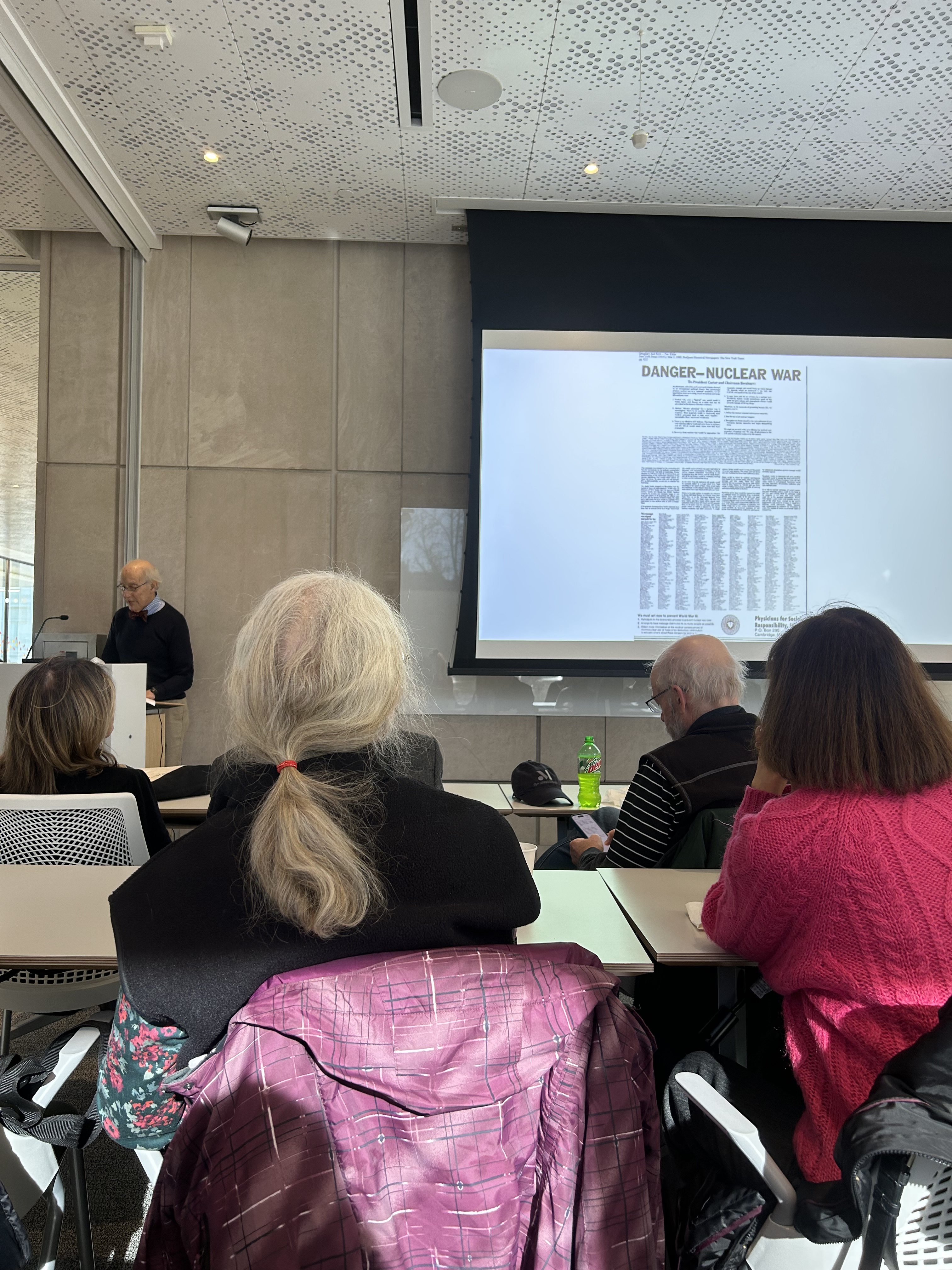
[On January 28, Dr. Eric Chivian, one of IPPNW’s founders in the 1960s, spoke at Harvard University’s Countway Library at an event entitled “Prescriptions for Peace: Physician Activism in the Nuclear Age, 1961-1985.” The event accompanied the launch of the Center for the History of Medicine’s “Prescriptions for Peace” exhibition on physician anti-nuclear activism, 1961-1985. The audience also heard from Harvard Medical School student Katie Blanton, MSc, whose undergraduate thesis, “The doomsday doctors: medical activism in the nuclear age, 1960–2000,” won Harvard’s Thomas Temple Hoopes Prize for outstanding scholarly research and excellence in the art of teaching.]
In the early 1960s, when Physicians for Social Responsibility was born, there was already a strong anti-nuclear movement in the US, organized by such groups as SANE Nuclear Policy, the Campaign for Nuclear Disarmament, and many others. Leading scientists like Linus Pauling and many of those who helped make the first nuclear weapons–Leo Szilard, Bernie Feld, Phil Morrison, Vicky Weisskopf, and many others were also deeply involved. I was very lucky to have known Bernie, Phil, and Vicky well.
These efforts were successful in many ways, but what physicians in PSR and IPPNW were able to do that these efforts were not able to accomplish, was that we helped people grasp what a nuclear war would really be like, so that they knew that these weapons were so catastrophically destructive that they could never be used in wartime, that it was a dangerous illusion to believe that civil defense was possible, that there could be any effective medical response whatsoever for the survivors, and that humanity could ever recover from a nuclear war.
We did this by translating the abstract, technical science of nuclear weapons explosions into the concrete, personal terms of human health, into everyday language that people could relate to and understand, namely what would really happen in such a war. We talked about skull fractures instead of the force of the explosion, about 3rd degree burns instead of the temperatures in the fireball, about radiation sickness instead of the amount of radiation in the fallout. And, as a result of these medical stories, I believe we helped make nuclear war more real for people, we made it harder for them to think about such wars in vague, abstract, technical terms.

This full page warning, “Danger-Nuclear War” in the March 2nd 1980 New York Times, written to President Jimmy Carter and Chairman Leonid Brezhev, that Jennifer Leaning, Jack Geiger, and I wrote at the conclusion of the two day conference “The Medical Consequences of Nuclear War” that I had organized at the Harvard Science Center, 45 years ago next week, and for which Bernie Lown, Herb Abrams, Alex Leaf, Howard Hiatt, Oliver Cope, Ron Arky, and many others got almost all the chairs of HMS departments to sign, along with 7 Nobel Laureates and hundreds of other physicians, could have been written today.
And it was this very public Physicians for Social Responsibility effort, that Brezhnev responded positively to, together with a parallel initiative that Bernie Lown, Herb Abrams, and Jim Muller had been working on for several months by that time, that led to the four of us founding IPPNW in June of 1980. Six months later, our three Soviet medical colleagues, Yevgueni Chazov, Mikhail Kuzin, and Leonid Ilyin joined us as founders at the luxurious, elegant Hotel Richemond on the shore of Lake Geneva.
The first IPPNW office was in a small upstairs back room at Sparr’s Drug Store on the corner of Longwood and Huntington Avenues, a store that opened in 1933 and closed in 2002! Sparr’s was where all of us Harvard Med School students went to get our medical equipment, and sometimes, coke floats at their soda fountain. Jim and I promised the Sparr’s brothers that we would install a plaque on their wall saying that Sparr’s was where it all began, in case we won the Nobel Prize. And we did! And we did!

The 2nd office was on my boat, a hundred foot, 150-ton former seagoing tugboat built by Bath Iron Works in 1918, named The Latin American. She was famous during her tugboat days, as she won the highly competitive Hudson River Tug Boat race in 1952.
When I bought her in 1977, she was at the very end of Lewis Wharf and had already been converted into a Houseboat. I added a 2nd story, with Palladian windows I salvaged from the beautiful 1916 Mosely Building at the MGH, which was being torn down when I was a resident to make way for the new Wang Building. I lived on that boat and saw psychiatric patients there for 10 years, from 1977 to 1987.
Now, as the treasurer of IPPNW, I was always seeking funding, and when I learned that younger members of the Rockefeller Family were working to prevent nuclear war, I invited Bob Scrivner, who was then the Executive Director of the Rockefeller Family Fund to meet Jim and me on the boat. Jim had just had his gall bladder removed, and ever a genius of theatre, Jim showed up to the meeting in his hospital Johnny, with an IV still in his vein, carefully walking down my steep gangplank, having to lift his IV pole over each of the cross pieces positioned to avoid slipping into Boston Harbor. Bob Scrivner’s jaw dropped. He knew then he was dealing with people who would do whatever it took for their critically important work, and he said to us “you are the right people in the right place at the right time.” We got our first grant, one that was given every year for many years.

As many of you may know, I became very involved in the early 1990s in efforts to protect the global environment, and I still am. In 1996, I founded and directed The Center for Health and the Global Environment at HMS, which is still very much alive almost 30 years later. It is now at the Harvard School of Public Health. The wonderful Dr. Mary Berlik Rice, a pulmonologist and professor at HMS, is its director. Here is another full page NY Times warning we published in advance of the Kyoto Summit in 1997, one written by the remarkable Paul Epstein and me, and organized from contacts that Paul and I had from around the world, many of whom came from my days in IPPNW. It was signed by leading physicians from 30 countries!
I am now directing a non-profit called The Program for Preserving the Natural World. Some people are amused to learn that the acronym of my new group is PPNW.
I want to say one last thing in closing.
In contrast to nuclear weapons explosions, changes to the global environment, like climate change and the loss of biological diversity, are even harder to grasp. We have no Hiroshimas or Nagasakis to serve as models, as concrete examples of what will happen. And the complexity of the science is orders of magnitude greater. Global Environmental changes, unlike explosions, can also be very hard to see. They often occur slowly or intermittently, sometime almost imperceptibly, and on global scales, and they can be obscured by normal fluctuations in things like temperatures or rainfall, which are changing naturally, often abruptly, and with large swings all the time. And so I felt that it was critically important for physicians to become involved in helping the public understand that our health and our lives, and especially those of our children, ultimately and totally depend on the health of the living world in which we live.
Once again, as was often true when I was working to prevent nuclear war, I turned to Alex Leaf, Chief of Medicine at the MGH, who, along with E.O. Wilson, was the most important mentor of my professional life. And so I want to honor Alex here today by reading from his seminal article in the New England Journal of Medicine “Potential Health Effects of Global Climatic and Environmental Changes”, published more than 35 years ago, on December 7th, 1989. This article changed my life and that of many other physicians around the world. We began to talk about global environmental change as “Armageddon in Slow Motion.”
This is what Alex said.
“What role do we have as physicians and health professionals in dealing with these global climatic and environmental changes? Clearly, they raise important social, economic, and political issues that transcend national boundaries. These are not fields in which health professionals possess special expertise.
Nevertheless, environmental change threatens to create serious health problems and thus becomes our special burden. We have been educated and given a mandate by society to be the guardians of its health. When issues portend such disastrous consequences to health, we must make them our concern. The effects of environmental change may be analogous to those of nuclear war, which although it basically involves political, economic, and military issues, has the potential to harm human health to an unprecedented and intolerable degree. Physicians and other scientists have served an important function by educating themselves, the public, and political leaders to the dangers of a nuclear war. We may have a similar function in publicizing the potential effects of global atmospheric changes.”

And so I want to publicly thank Alex for being a true visionary, and such a brilliant, humble, and extraordinarily generous mentor to me and to many, many others. And I want to say also how deeply indebted I am to all those on whose shoulders I have stood when we re-started PSR in 1978, and to all those with whom I have worked to help put IPPNW together—Bernie and Herb and Yevgueni, and Mikhail, and Leonid, all of whom are no longer with us today, and with all my heart, to my brother in life, Jim Muller, who is.
Photos from the Center for the History of Medicine’s “Prescriptions for Peace” exhibition


 Bimal Khadka
 Bjorn Hilt
 Charles K. Johnson
 Gunnar Westberg
 IPPNW
IPPNW John Loretz
 Lawrence Wittner
 Maria Valenti
 mollymcgint
 Sue Wareham
 Tilman Ruff
 Tim Wright
 Xanthe Hall


 IPPNW peace and health blog
Comments are closed.