The threat to end civilization has never been — and never will be — a guarantor of global peace or national security.
Delivered by Molly McGinty, IPPNW Program Director, at the High-level Meeting on the International Day for the Total Elimination of Nuclear Weapons at the United Nations Headquarters in New York City, 26 September 2024
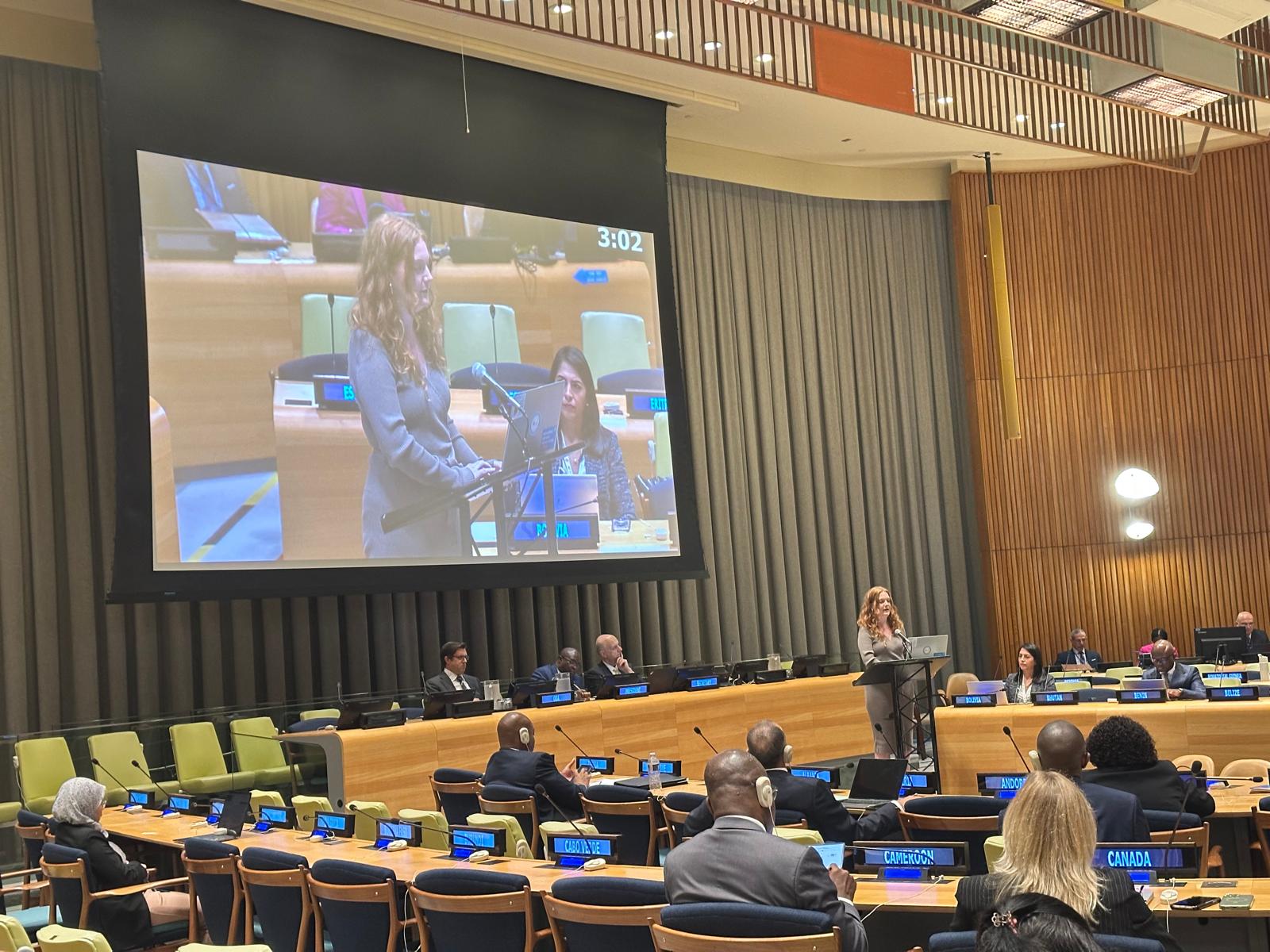
Distinguished delegates and colleagues,
I extend my profound thanks to the President of the General Assembly for inviting me today as a representative of the International Physicians for the Prevention of Nuclear War, a global federation of health professionals dedicated to the abolition of nuclear weapons and founding partner of the International Campaign to Abolish Nuclear Weapons. I stand here as a young disarmament campaigner who is inheriting the world you shape in these halls.
On this International Day for the Total Elimination of Nuclear Weapons, it is vital to recognize a stark and often overlooked reality: nuclear weapons pose the most acute existential threat to our shared planet and all its inhabitants.
For almost 80 years, the Hibakusha, survivors of the Hiroshima and Nagasaki bombings, and the frontline communities affected by the production, maintenance, and testing of nuclear weapons have been witness to their indiscriminate and lasting harm. The humanitarian and environmental impacts of nuclear weapons are not theoretical; they are real, devastating, and unforgiving, and they must be central to all discussions involving these inhumane weapons.
A single nuclear explosion over any major city would kill tens, if not hundreds, of thousands of civilians, inflict complex and life-threatening injuries on many more, decimate infrastructure, and disperse lethal doses of radioactive material into the atmosphere. The level of human suffering from this one single bomb is almost too vast to comprehend.
And yet, the nine nuclear armed states possess over 12,000 nuclear warheads, many of which are on hair-trigger alert and ready to be launched on civilian populations in a matter of minutes.
A nuclear war would end life as we know it. A nuclear war, which can begin and end over the span of a blockbuster movie, would loft millions of tons of soot and debris into the atmosphere, blocking the sun for the decades to follow. Global temperatures would drop and food production would fall. A so-called “limited” nuclear war involving just 3% of the world’s arsenals would put one in every third person at-risk of starvation. Let that sink in. With 97% of the world’s arsenals untouched, a third of the human population would likely starve to death. A nuclear war between the United States and Russia would drop temperatures below that of the last Ice Age.
The threat to end civilization has never been — and never will be — a guarantor of global peace or national security.
Delegates,
We are just one mistake, one miscalculation, one technical error away from catastrophe. This alarming truth must compel action before it’s too late.
Without delay, we call on each of you, UN Member States, to fulfill your disarmament obligations and join the UN Treaty on the Prohibition of Nuclear Weapons (TPNW), the best tool we have to achieve the needed safety and security of a world without nuclear weapons. We applaud all Member States who have put their words into action and taken this step, most notably Indonesia, Sierra Leone, and the Solomon Islands, which ratified the Treaty earlier this week.
The luxury of time is not on our side. You must act with the urgency that this moment requires.
Thank you.
Comments are closed.

 Bimal Khadka
 Bjorn Hilt
 Charles K. Johnson
 Gunnar Westberg
 IPPNW
IPPNW John Loretz
 Lawrence Wittner
 Maria Valenti
 mollymcgint
 Sue Wareham
 Tilman Ruff
 Tim Wright
 Xanthe Hall


 IPPNW peace and health blog
Dear Molly,
Amazing speech!
Keep going!
And going all together!
Marianne Begemann