Personal memories of a war that did not happen
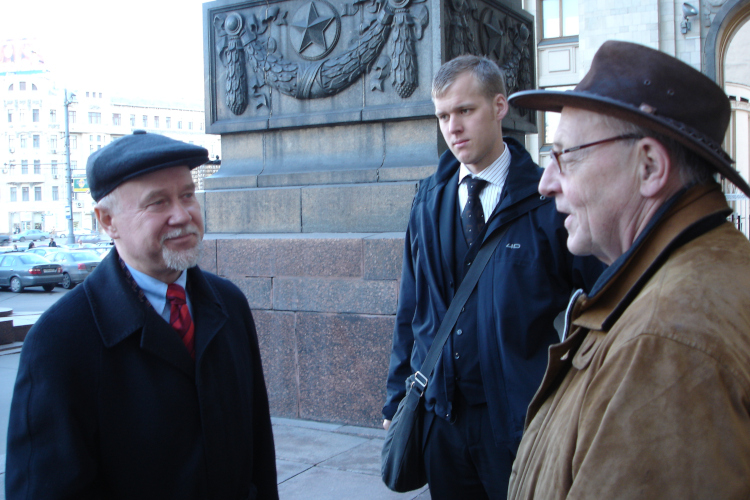
For twenty years, starting in 1983, IPPNW delegations visited the former Soviet Union frequently, sometimes twice a year. The Swedish affiliate arranged most of these, in cooperation with the Soviet IPPNW. I participated in most of these meetings, and rely mostly on my own memories in recounting them.
The respect for our dedication as doctors to the prevention of nuclear war was obvious. At most of these visits we met high ranking military and political officials. They told us how they did not only fear, they expected a large US nuclear attack. They often referred to President Reagan’s speeches about the “Evil Empire,” which he said had to be destroyed.
A Swedish Journalist, Peter Handberg, reported of meetings in the Baltic states with men who had been in charge of readying nuclear missiles. He was told: “We were instructed that a nuclear attack was expected, sooner or later.”
In Daniel Ellsberg’s book Doomsday Machine, we learn that US presidents had on many occasions threatened to use nuclear weapons against adversaries. A “no first use policy” has never been adopted.
In addition to a deliberate all-out nuclear war, a large attack by mistake was a real risk. Ellsberg gives detailed information about how local commanders at US bases in the Pacific had the ability to use nuclear weapons against China. Should he believe there was an attack, and he did not get in contact with headquarters—which happened fairly often—the sub commander could decide to attack targets in China.
Both Soviet and US submarine commanders had access to the codes for delivery of the large nuclear weapons onboard. A commander of a Russian nuclear submarine in the Arctic, whom we met twice in the early 1990s, told us how demanding it was to operate continuously in the deep ocean for up to six weeks on end. Periodically there were mock attacks by US submarines, which sped straight at the Russian sub, changing course at the last minute. “I sometimes lived on vodka and coffee. I was often so tired that I could not tell a red light from green on the display. And remember, I could fire the missiles, I had the code”.
From others sources I have learnt that Russian attack submarines played similar cat-and-rat games with US subs. And for many years, the US commanders knew that the code was 00000000.
We know of several instances when a nuclear war was only narrowly avoided. Best known is the case of Stanislav Petrov, a Russian military officer in charge of warning of approaching nuclear missiles against the Soviet Union. In 1983, his cool and courageous decision to wait for confirmation instead of reporting at once is sometimes said to have saved the world.
We know that the Soviet information service believed the NATO exercise “Able Archer” in 1983, was a “New Operation Barbarossa,” a nuclear attack in disguise. After the maneuver ended, the British Prime Minister Margaret Thatcher found it necessary to meet President Reagan personally to inform him of the fear in the Russian leadership.
Thus, before the Reagan-Gorbachev summit in Reykjavik in 1986 there was a strong fear in Russia of a surprise nuclear attack against their country. There was also fear in the US and in Europe but, in my experience, not at all as pervasive as in the Soviet Union. On the contrary, in the US I often met an attitude that nuclear weapons brought security, and disarmament would be dangerous.
Today the situation is different. The fear in Russia of a surprise large nuclear attack is, according opinion polls, not so great as in 1985, neither in the US nor in NATO countries.
Instead the threat of a “small” nuclear attack from Russia, for instance on a sparsely populated area in Ukraine, is seen as a risk. Such a limited attack would probably not cause the US to retaliate with nuclear weapons, risking a rapid escalation. The US and NATO have very large resources for attacking Russian military bases and production facilities without nuclear weapons.
Over a longer perspective, however, the risk for a nuclear war starting not by mistake but by escalation remains. The addition of a third major nuclear power, China, makes calculations more difficult. A scenario involving North Korea, as in the recent book Nuclear war: a scenario by Annie Jacobsen, adds to the uncertainty.
While the war in Ukraine continues, leaders in the US and Russia must be very careful to avoid misunderstanding strategic intentions. There should never be any ambiguity regarding nuclear weapons. Both sides should make it clear that the doctrine of “first use” of nuclear weapons is unacceptable.
“A nuclear war cannot be won and should never be fought,” said Ronald Reagan and Mikhail Gorbachev, and that belief was echoed several years ago Vladimir Putin and Joe Biden.
Never forget that.
Dr. Westberg is a former president of Swedish Physicians for the Prevention of Nuclear War and a former co-president of IPPNW.

 Bimal Khadka
 Bjorn Hilt
 Charles K. Johnson
 Gunnar Westberg
 IPPNW
IPPNW John Loretz
 Lawrence Wittner
 Maria Valenti
 mollymcgint
 Sue Wareham
 Tilman Ruff
 Tim Wright
 Xanthe Hall


 IPPNW peace and health blog
Comments are closed.