YouthMSP in NYC: Part 2
Written by Sarah Kuiter and Lea Dittmar, IPPNW Germany Student Leaders, and translated by Stella Ziegler, IPPNW International Student Representative
This article was originally published on IPPNW Germany‘s blog in German following Youth for TPNW‘s YouthMSP on 28 November. This is part-two of a three-part blog series by IPPNW Germany members.
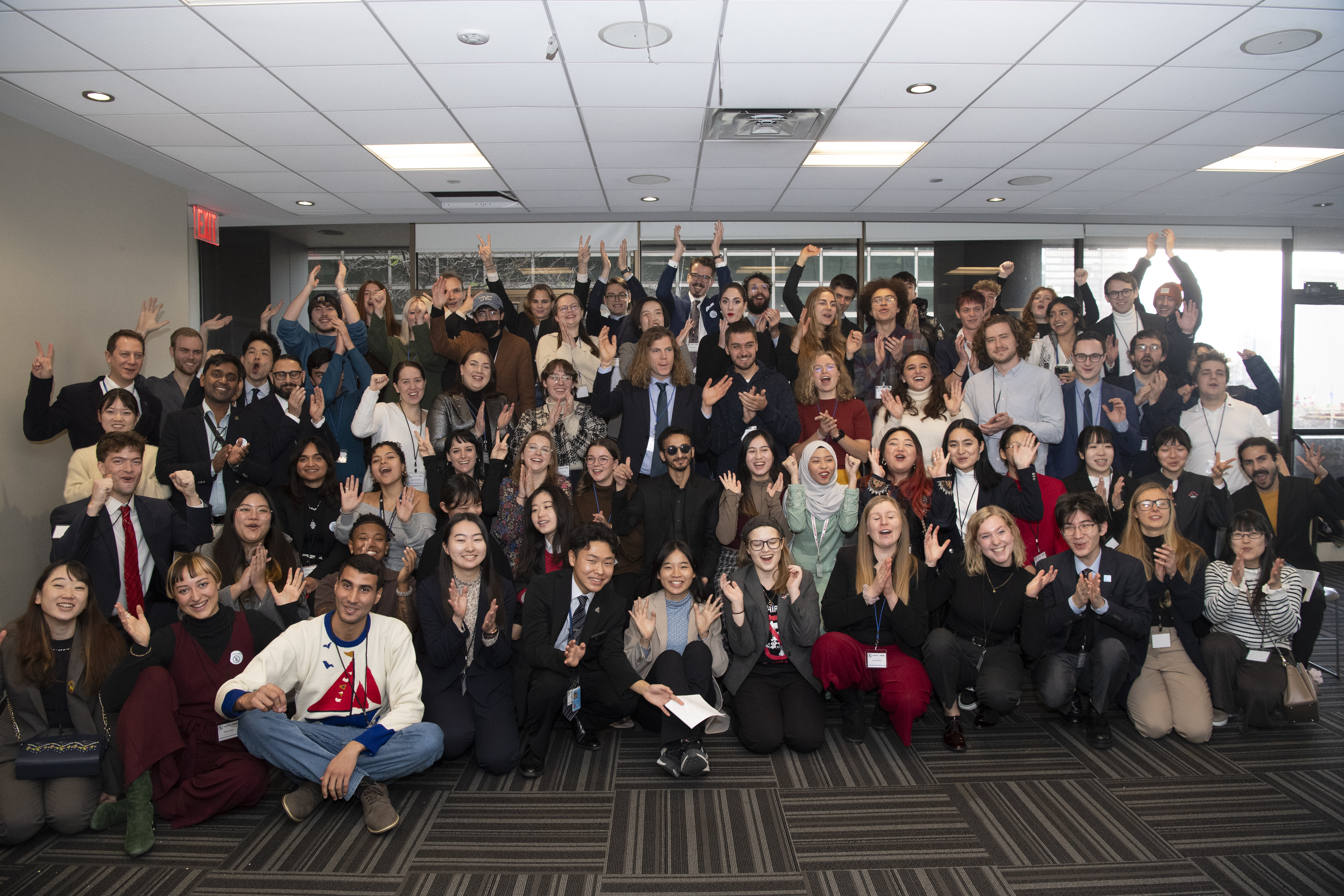
Tuesday lunchtime, 12:30 pm at the United Nations Church Centre: Almost 100 young people from over 20 countries around the world are meeting for the YouthMSP, a youth conference taking place in parallel to the 2MSP in the building on the opposite side of the street. Two panel discussions took place with a view of the UNHQ building, followed by a discussion round in small groups. Topics included the implementation of the TPNW (Treaty on the Prohibition of Nuclear Weapons) with a focus on Articles 6 and 7. Seth Sheldon spoke a lot about the so-called principle of universalisation, which we had also encountered at the campaigners’ meeting on Sunday. What was particularly important here was that the TPNW is not as complicated as it might seem at first glance: anyone can understand it and spread the values and norms that the treaty conveys.
We young people in particular have the privilege, but also the duty, to work for peace in this world and to ensure that nuclear weapons are abolished. Garret Welch gave an input on Articles 6 and 7, which include the obligation of all states to act in favour of affected groups of people and the environment that have been harmed. It is important to emphasise that this is not an admission of guilt, as the vast majority of states are not themselves responsible for nuclear weapons testing. Paula Soumaya Domit told us about the compatibility of the TPNW with other existing treaties. Her conclusion was that the TPNW fits in well with existing treaties and explicitly supports the NPT (Nuclear Non-Proliferation Treaty) in achieving a world free of nuclear weapons.
After a somewhat difficult, but very amusing group photo, we continued with the second panel.
Mohamed El Hajji, Fridays for Future activist, emphasised the connection between the climate crisis and the need for nuclear disarmament. With a personal story about the threat to farms and the livelihoods of entire families in Morocco, he emphasised that any CO2 emissions, especially those from weapons production, have serious humanitarian consequences. Sarah Gabriela Kuiter, European student spokesperson for the IPPNW, followed on from Mohamed’s speech. In addition to framing the climate crisis as a global health threat, the nuclear threat must also be mentioned in the same breath as a global health threat. She outlined the original idea of the IPPNW as a professional organisation, but extended the responsibility to all people who value and want to protect their own health or the health of their loved ones. In this way, she succeeded in building a bridge and extending the IPPNW’s message to society as a whole. Emma Pike, Nuclear Disarmament Consultant and peace activist, called on all attendees to take responsibility as experts on nuclear disarmament to publicly voice their opinions worldwide. Social media in particular is a tool for this, which offers both risks and opportunities to reach young people in particular. Dr Vincent Intondi, historian at Leiden University, spoke last.

 Bimal Khadka
 Bjorn Hilt
 Charles K. Johnson
 Gunnar Westberg
 IPPNW
IPPNW John Loretz
 Lawrence Wittner
 Maria Valenti
 mollymcgint
 Sue Wareham
 Tilman Ruff
 Tim Wright
 Xanthe Hall


 IPPNW peace and health blog
Comments are closed.