The first days in New York City: Part 1
Written and translated by Stella Ziegler, IPPNW International Student Representative
This article was originally published on IPPNW Germany‘s blog in German following the ICAN Campaigners Meeting on 26 November. This is part-one of a three-part blog series by IPPNW Germany members.
The Second Meeting of States Parties (2MSP) has begun!
What does this mean and what is happening? In our first blog post, we want to give an overview of what is happening at the MSP, what the Treaty on the Prohibition of Nuclear Weapons (TPNW) is, and what IPPNW’s role will be there. In addition, there have already been a few actions worldwide to draw international attention to the conference.
So: MSP, what is it? The First Meeting of States Parties took place in Vienna in June 2022 and served to implement the TPNW, or Treaty on the Prohibition of Nuclear Weapons (TPNW). All member states that have signed the TPNW are also invited to the 2nd MSP. Some “observer states” are also present, which are states that are not yet part of the TPNW but can already take part in the discussions. In addition, there is a large proportion of civil society participation, i.e. representatives of civil society, who will also be part of this MSP in the form of various organisations and independent events.
In 2017, the first negotiations on the TPNW were held at the UN headquarters in New York, where more than 135 states and civil society participated and the first states signed the treaty. The treaty officially entered into force on 22 January 2021. Currently, 93 countries have signed it and 69 have ratified it. The nuclear armed states are not among them.
Before the TPNW was adopted, nuclear weapons were the only weapons of mass destruction that were not banned. Now it serves as an international convention to outlaw nuclear weapons and prohibits states from developing, testing, manufacturing, producing, transferring, possessing, stockpiling, using or threatening to use nuclear weapons or authorising the deployment of nuclear weapons on their territory. By signing the TPNW, states promise to destroy their nuclear weapons in accordance with international guidelines and a timetable or to return foreign nuclear weapons to the possessor state. States also undertake to support the victims of over 2,000 nuclear tests and to take steps to clean up contaminated areas.
At the first MSP 2022, the States Parties adopted the Vienna Action Plan with 50 concrete and progressive measures to implement the Treaty and achieve a nuclear-weapon-free world. The Action Plan includes measures on universalisation, victim assistance, environmental remediation and international cooperation and assistance, scientific and technical advice to support implementation, support for the broader nuclear disarmament and non-proliferation regime, and integration and implementation of the Treaty’s gender equality provisions. To this end, various working groups and focal points have been established to implement measures related to Articles 4, 6, 7 and 12 of the Treaty, as well as gender equality and complementarity of the TPNW within certain deadlines.
You can find the entire treaty and further information here: https://www.icanw.org/tpnw_first_meeting_of_states_parties .
In the declaration, states also express the necessity and urgency of such a treaty, condemn any and all nuclear threats in any situation, and agree to continue to fight for the implementation of the TPNW and a nuclear-weapon-free norm. A major focus is also on the moral, ethical and security guidelines on the basis of which the TPNW was founded, putting nothing less than human security at the centre.
This is where the IPPNW comes into play, which was founded in 1980 as an organisation of physicians that placed itself above the international conflicts of an impending nuclear war and repeatedly referred to the catastrophic humanitarian consequences for people and the environment. The organisation was awarded the Nobel Peace Prize in 1985 and published several declarations and resolutions, as well as the Nuclear Test Ban Treaty. ICAN then received the Nobel Peace Prize in 2017 for the Treaty on the Prohibition of Nuclear Weapons on the basis and continuation of these declarations. To this day, the IPPNW continues to pursue the implementation of medical peace work in international conflicts and also gives lectures on these topics at the 2MSP. You can find a brief history of the IPPNW here: https://www.ippnw.de/der-verein/geschichte-der-ippnw/ippnw-chronologie.html .
At the 1MSP, UN Secretary-General Antonio Guterres said:
“The once unthinkable prospect of nuclear conflict is now back within the realm of possibility. More than 13,000 nuclear weapons are being held in arsenals across the globe. In a world rife with geopolitical tensions and mistrust, this is a recipe for annihilation.”
Once again this year, communities from affected areas such as Kazakhstan and several Pacific states as well as “hibakusha”, survivors from Hiroshima and Nagasaki, will be present to campaign for the implementation and ratification of the TPNW. There will be several events held by affected and indigenous communities, putting focus on the voices that have been silenced for too long.
While discussions will take place all day from Monday to Friday at the UN Headquarters on how the TPNW has been implemented, what the committees have achieved so far, what needs to be improved and how to move forward, there will also be a full programme all around! With several workshops, panel discussions and presentations by various participating organisations every day, we’re sure to be anything but bored – but more on that in the following blogs. There will also be exhibitions by Artists Against the Bomb and artists from various countries, as well as film screenings and concerts.
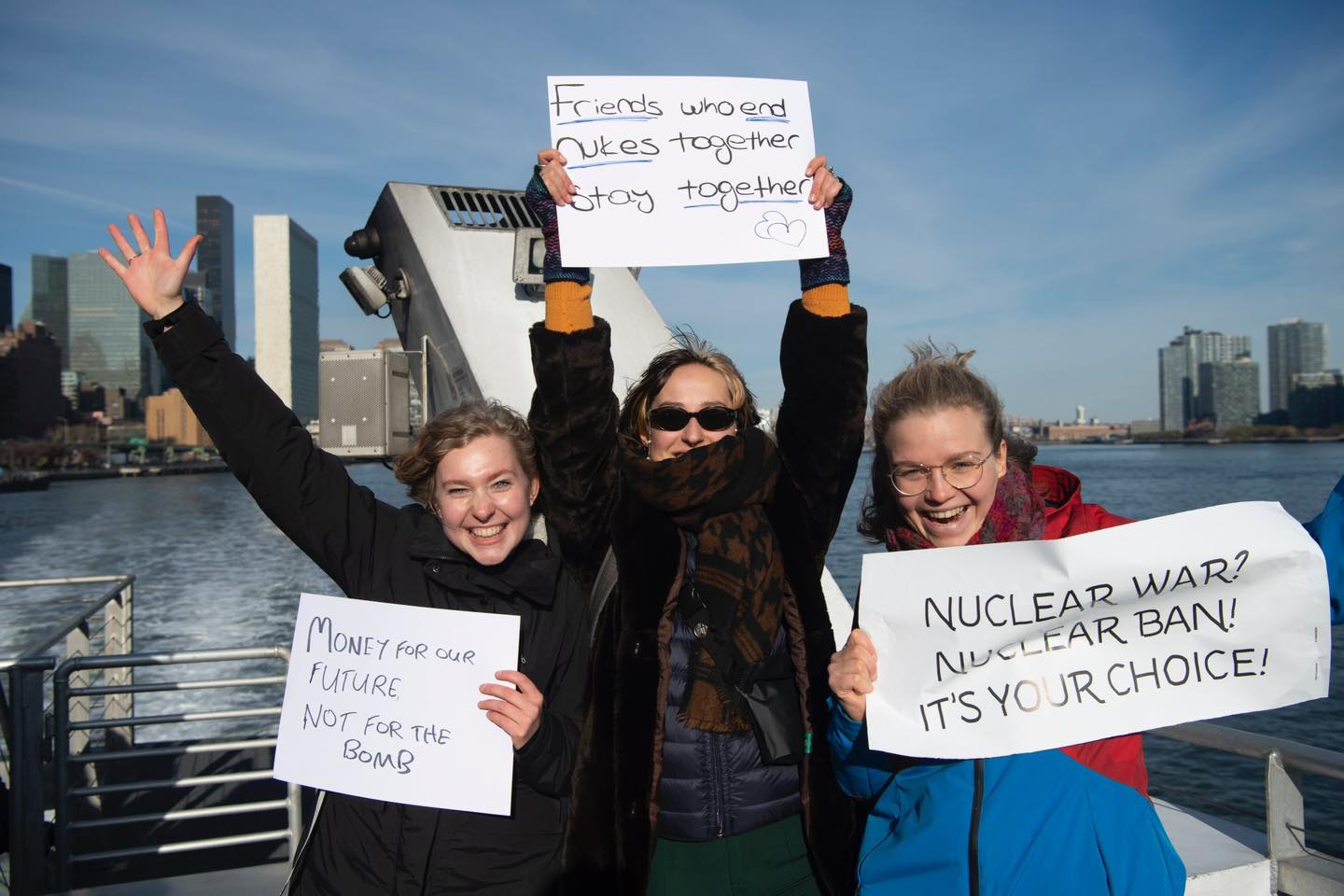
On Saturday, 25 November, there was already a photo campaign by ICAN, where we took the ferry from the Upper East Side to Wall Street and then on to Brooklyn to draw attention to the congress with posters and actions in front of the UN and well-known photo spots in the city.
On Sunday 26 November, ICAN held an all-day campaigners’ meeting to get this major congress off to a better start. What has actually happened since the 1MSP, who will be present this year, and what are the new goals? It was also a great opportunity to get to know many young and old people and activists from all over the world and to get ready for the next intense days together!
So, on your marks, coffee & notepad, ready, go!

 Bimal Khadka
 Bjorn Hilt
 Charles K. Johnson
 Gunnar Westberg
 IPPNW
IPPNW John Loretz
 Lawrence Wittner
 Maria Valenti
 mollymcgint
 Sue Wareham
 Tilman Ruff
 Tim Wright
 Xanthe Hall


 IPPNW peace and health blog
Comments are closed.