“Reducing the risks of nuclear war—the role of health professionals”: the editorial’s impact
[In August, IPPNW reported that more than 100 (now more than 150) medical journals, including the Lancet, the British Medical Journal, the New England Journal of Medicine, and JAMA published a joint editorial entitled “Reducing the risks of nuclear war — the role of health professionals.” One of the authors of the editorial, Dr Chris Zielinski, has written the following report on the editorial’s reach and impact for IPPNW and the World Association of Medical Editors.]
This is a brief report on the project on publishing an editorial on “Reducing the risks of nuclear war—the role of health professionals” in journals around the world, in commemoration of the anniversary of the Hiroshima bomb on 6 August.
The editorial was the brainchild of International Physicians for the Prevention of Nuclear War (IPPNW), with the endorsement of the World Association of Medical Editors (WAME). Journals that joined the project appeared to be enthusiastic and were uniformly helpful as regards administration—which was substantial, given that this was a project with 18 authors, and the administration had to be repeated for each of the 153 journals. So our heartfelt thanks go out to all journal editors and administrators for this, and for providing Open Access and granting us APC waivers.
Altogether 153 journals agreed to publish the editorial in the allotted time frame. These journals were based in at least 34 countries. The editorial was published mainly in English, but Arabic, Croatian, Dutch, French, and Spanish translations were also in evidence. The full list of journals that published the editorial is available here.
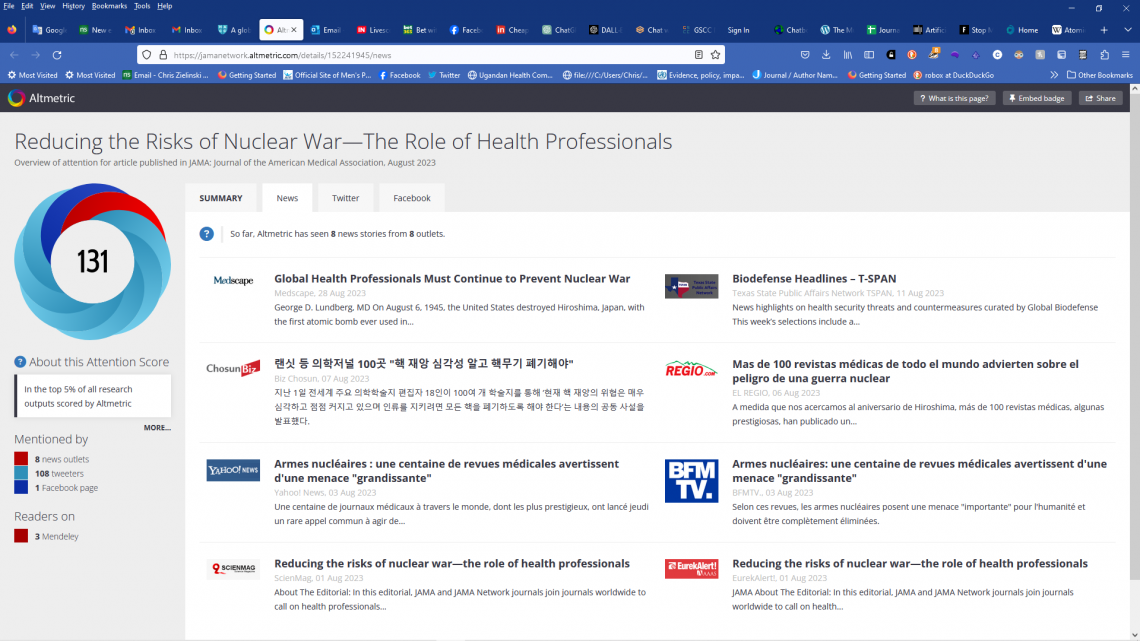
Not only was it published in many journals, but it was being read. For example, the editorial published in JAMA was “in the top 5% of all research outputs scored by Altimetric” (see the infographic at the end of this report). The one published by the American Journal of Psychiatry was selected to appear in the American Psychiatric Association (APA) Showcase on Kudos, which ensures that the editorial “reaches more people – not only academics, but also 1000s of influential researchers, policy makers, journalists and funders worldwide.”
The project was widely reported in analog and digital media. As an example, in the Netherlands, Dr Marcel Olde Rikkert, Editor-in-Chief of the Dutch Journal of Medicine, and one of the co-authors of the editorial, released a podcast on the project. This was picked up by the national media and press ( for those who read Dutch, see here and here). Marcel was interviewed both on national radio (450,000 listeners) and on a national television news report at prime time (1.2–1.4 million watchers). “Afterwards I received a lot of positive comments from colleagues on the global joint forces, and the social media discussion was very active.”
A similar interest was found in a number of countries, and the editorial continues to attract favourable comment. Apart from comment, however, the editorial also had a very practical effect. Work was underway at the Vienna International Centre in Vienna, Austria, where IPPNW staff were attending the Preparatory Committee for the 2026 Review Conference of the Parties to the Treaty on the Non-Proliferation of Nuclear Weapons (NPT). This was the first of three planned sessions that will be held prior to the 2026 Review Conference.
According to IPPNW Policy Director Chuck Johnson, “This editorial is benefiting us in so many ways and is giving us an enhanced entree in working with diplomats, and others in civil society… We have been distributing the Lancet copy as we advocate for the inclusion of language in the chair’s final summary document for demilitarizing nuclear power plants in conflicts…”
Clearly, there are real, practical benefits in this kind of collective speech. Chuck Johnson is working to build consensus that WHO should update its 1987 report on the health and medical impacts of nuclear weapons and nuclear war, and has used the editorial to begin conversations with delegations on this initiative. “The timing of all of these actions happening simultaneously has stretched us out,” he said, “But we are consequently able to use this editorial to very good effect already, when it is fresh.”
We are discussing establishing a consortium of journals to put this kind of multi-journal editorial work on a more stable and formal footing. We will keep the number of editorials low – two or three a year, with a primary focus on climate issues.
Chris Zielinski
6 October 2023

 Bimal Khadka
 Bjorn Hilt
 Charles K. Johnson
 Gunnar Westberg
 IPPNW
IPPNW John Loretz
 Lawrence Wittner
 Maria Valenti
 mollymcgint
 Sue Wareham
 Tilman Ruff
 Tim Wright
 Xanthe Hall


 IPPNW peace and health blog
Comments are closed.